

 Image 1 of 1
Details
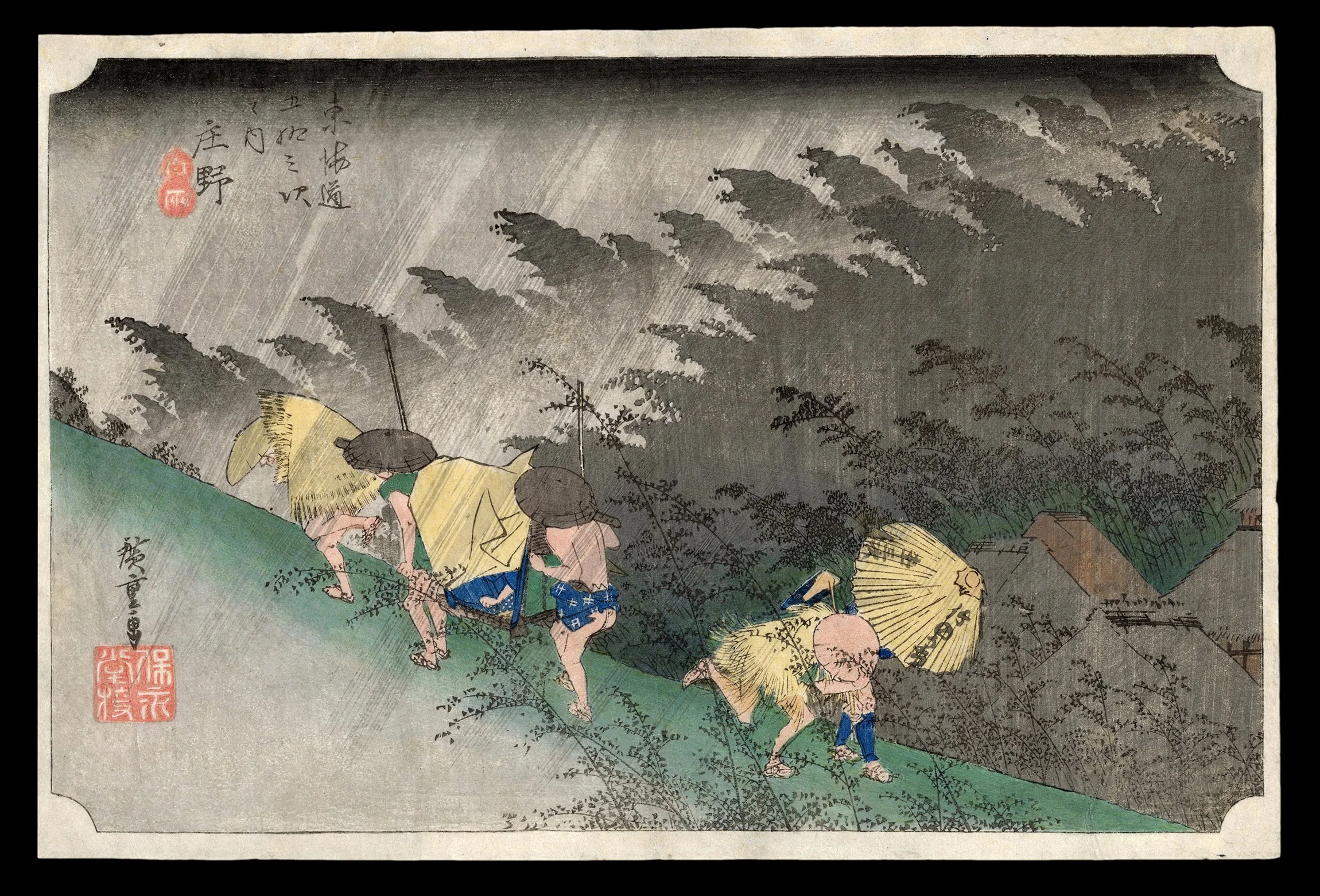
Few designs in the history of Ukiyo-e capture the poetics of weather, motion, and human labor with the same lyrical resonance as Hiroshige’s “Shono.” This print, one of the most iconic within the Fifty-three Stations of the Tokaido series, depicts a group of travelers and porters caught in a sudden summer downpour as they ascend the slope outside the post station of Shōno. Umbrellas strain against the wind, straw cloaks ripple, and diagonal lines of rain cut sharply across the scene—rendering atmosphere itself as the subject.
This was Hiroshige’s first rendition of the Tokaido, published by Hoeido (Takenouchi Magohachi), and it quickly became his breakthrough masterpiece series. While earlier travel prints tended toward static, diagrammatic views, Hiroshige introduced an entirely new sense of psychological immediacy. Here, the viewer does not merely observe the travelers but feels the weight of the hill and the sting of rain. The design bridges ukiyo-e landscape with narrative—a humble yet enduring moment on a well-trodden road that resonated deeply with Edo-period audiences.
Connoisseur's Note
This design holds a central place not only in Hiroshige’s oeuvre but in the broader canon of Japanese printmaking. The Shono design was so admired in the West that it became a touchstone for European artists: Vincent van Gogh directly copied several Hiroshige compositions in oil, while Impressionists and Post-Impressionists absorbed Hiroshige’s dynamic sense of atmosphere, and flat fields of color. For them, Hiroshige’s designs, such as Shono, exemplified the power of simplicity and the drama of nature in everyday life.
This example is a relatively early impression, evidenced by the strong, clean keyblock lines and the richness of the pigment—especially in the stormy gray of the sky, the vertical rain streaks, and the fine and distinct writing on the yellow umbrella. There is minor trimming to the margins, consistent with 19th-century album presentation, but the integrity of the image remains untouched. It stands as an exquisite example of Hiroshige’s genius at the intersection of motion, environment, and emotion.
More prints by Ando Hiroshige: