

 Image 1 of 1
Details
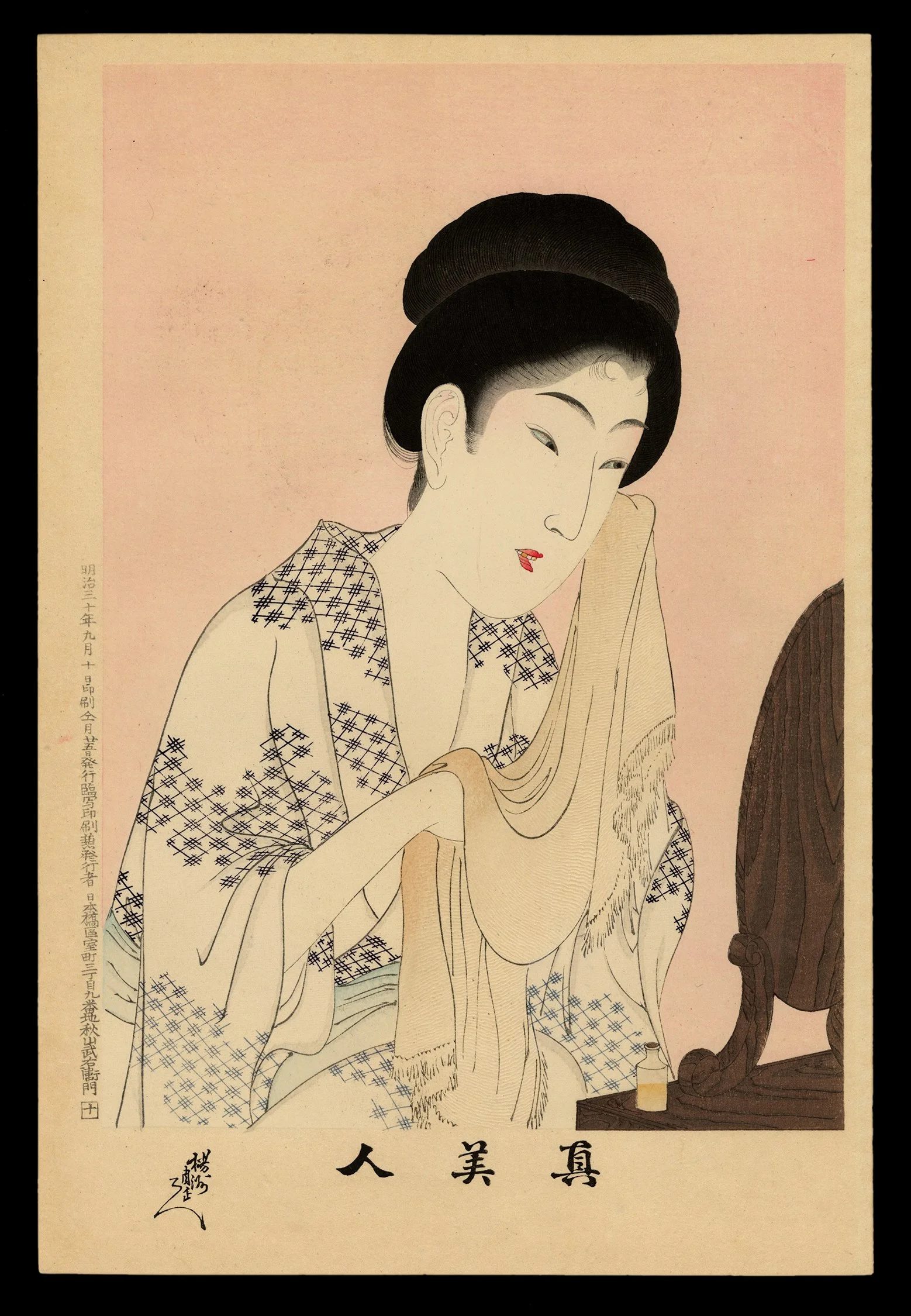
Toyohara Chikanobu, one of the last great masters of Ukiyo-e, created this serene and elegant portrait during the height of the Meiji era, a time when Japan stood at the crossroads of tradition and modernization. In this design, a refined beauty delicately dabs her face with a towel, a private moment rendered with grace and restraint. The image is suffused with a quiet tenderness—her pose composed, her features softly idealized in the Yamato-e lineage, even as the style bears the evolving aesthetic of Meiji-period printmaking.
The subtlety of the color palette enhances the overall mood: the faint blush of the background sets the stage for the woman’s pale skin, while the richly patterned kimono, rendered with fine-line precision, gently fades into delicacy around the sleeves. The composition demonstrates Chikanobu’s command of Meiji-period bijin-ga, not merely as a continuation of the past, but as an evolution—at once nostalgic and newly refined. His work here feels like a parting gesture to a vanishing world of Edo courtly grace, captured just before the tide of modernity sweeps fully in.
Connoisseur's Note
This impression is an exemplary example of Meiji-period nishiki-e in both technical and material integrity. The beni (pink pigment) in the background—so often the first to fade—remains strikingly fresh, preserving the luminous ambiance so vital to the composition’s mood. Of particular note is the use of karazuri (embossing) in the towel and garments, lending the print a tactile richness and dimensionality.
Published by the esteemed Akiyama Buemon, this print hails from one of the period’s most discerning studios. Chikanobu’s bijin prints have become increasingly sought after, not only for their nostalgic aesthetic but for their ability to bridge the worlds of Edo romanticism and Meiji modernity. This work stands as a pristine example of that sensibility—quiet, refined, and immaculately preserved.
1890
$800
Snow in Asakusa
Toyohara Chikanobu (1838–1912)
SERIES: Snow, Moon, and Flowers
MEDIUM: Woodblock Print
DATE: 1890
DIMENSIONS: 14 ¾ x 9 5/8 inches
CONDITION: Excellent impression and color; no issues to note
NOTE: Red pigment has beautifully oxidized
$800.00
Contact us to purchase