

 Image 1 of 1
Details
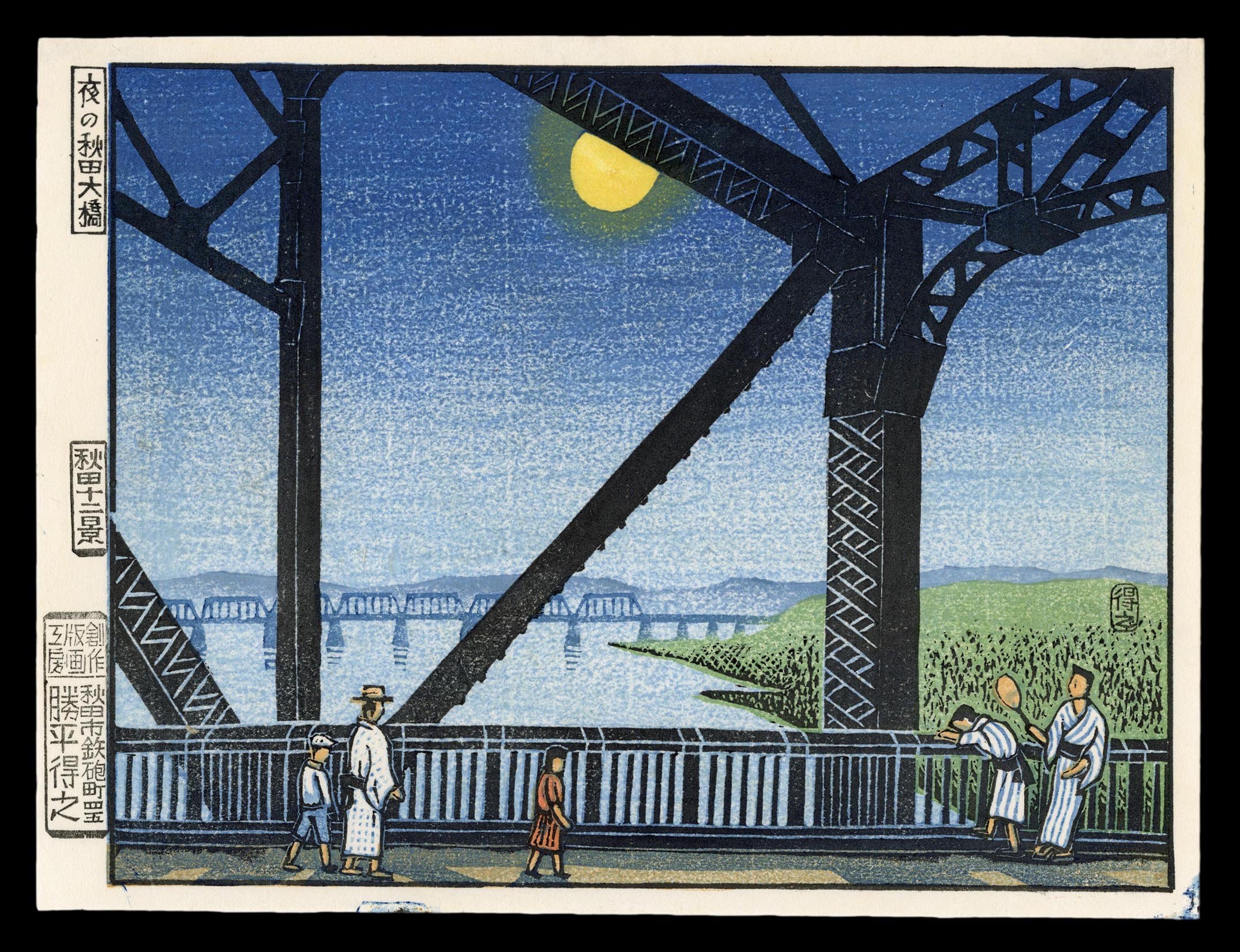
Produced in 1937, Night View of the Great Bridge in Akita is a quietly powerful testament to the expanding presence of modern infrastructure in provincial Japan. Tokushi Katsuhira, deeply rooted in his native Akita, here records an iron bridge silhouetted against a moonlit sky—its steel frame not as brute imposition, but as a solemn, almost reverent structure that harmonizes with the landscape. The print belongs to his regional masterwork, 12 Views of Akita, a series that balances documentary intent with poetic sensibility.
The composition is structured with dramatic clarity: massive beams slice the visual field, while below, residents in summer yukata walk leisurely across the bridge. The river shimmers under the light of a near-full moon, its surface echoing the quiet pulse of a town at rest. Tokushi’s mastery lies in this contrast—the human-scaled poetry of daily life nestled beneath the overwhelming geometry of industrial progress. Even the shadows and gradations of sky seem measured, deliberate, meditative.
Connoisseur's Note
As an adherent of the Sosaku Hanga movement, Katsuhira Tokushi embraced the philosophy of the artist as sole creator—designing, carving, and printing each work himself. Night View of the Great Bridge in Akita exemplifies this spirit, combining technical rigor with expressive depth. Unlike many contemporaries who looked to Kyoto or Tokyo for subjects, Tokushi centered his gaze on Akita, capturing its quiet transformation as Japan edged deeper into the modern era.
The depiction of an iron bridge in 1937 is significant—not only as a feat of engineering but as a symbol of national ambition during the Showa period. Yet Tokushi’s treatment is intimate rather than monumental. The print does not glorify the machine; it instead positions human figures in balance with it, highlighting the continuity of tradition within change. For collectors, this early work stands as a poignant document of rural Japan on the cusp of a new epoch, rendered with humility, warmth, and an unwavering fidelity to place.