

 Image 1 of 1
Details
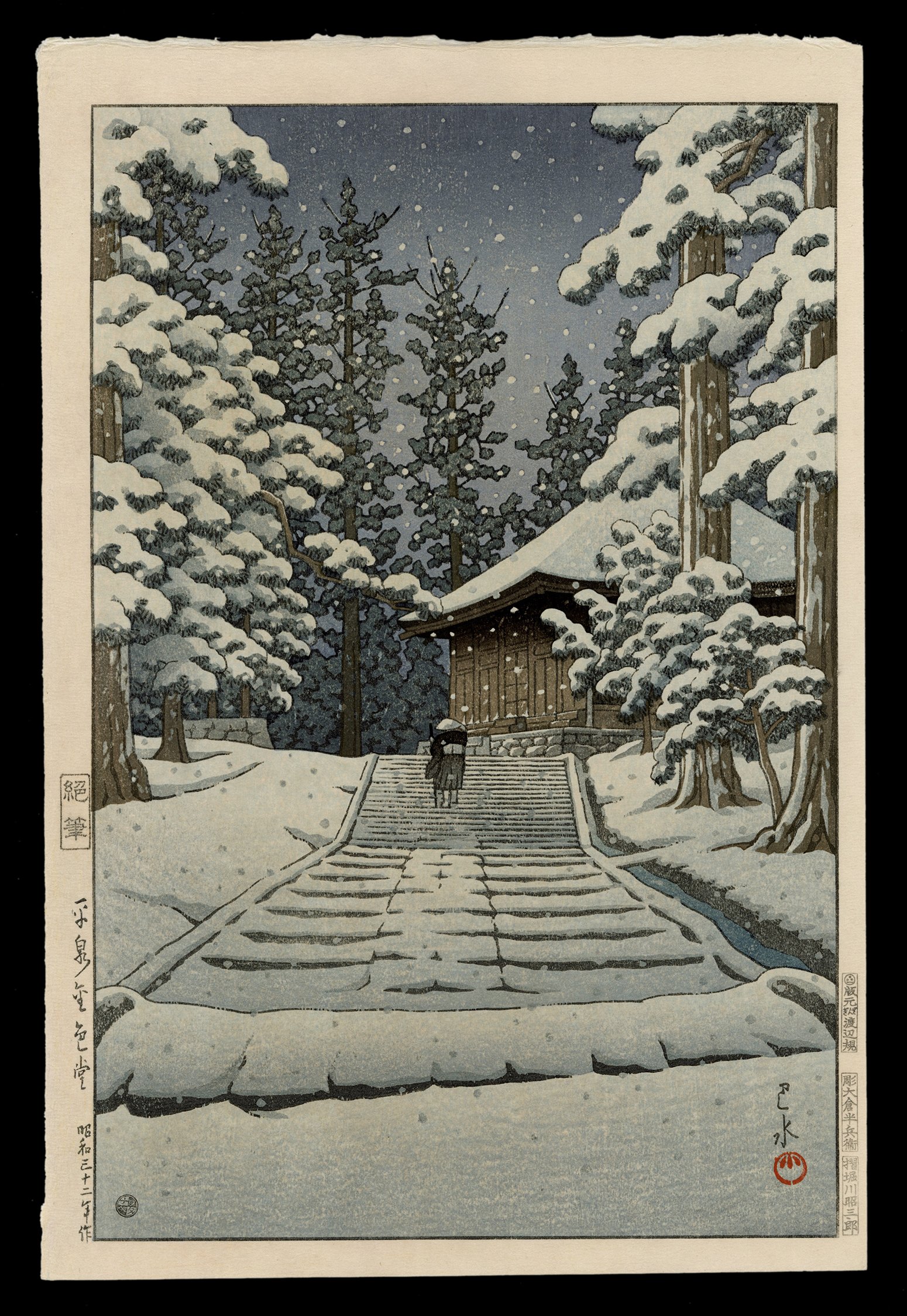
A solemn hush blankets the sacred precincts of the Konjiki-dō (Golden Hall) at Hiraizumi, rendered here beneath a soft snowfall. In this final print of his prolific career, Kawase Hasui evokes not only the quiet dignity of a winter temple landscape but also a profound sense of closure. The stepped approach draws the viewer upward, toward a lone figure moving away from us—perhaps a self-portrait of Hasui himself—ascending gently into stillness. The delicate palette of blue-grays and ivory tones dissolves any distinction between stone, snow, and sky, leaving only the echo of footsteps in falling flakes.
The Konjiki-dō, part of the Chūson-ji temple complex, is one of the most venerated Pure Land Buddhist sites in Japan. Founded in the 12th century by the Fujiwara clan, the hall is entirely gilded and enshrines sacred images of Amida Buddha. Hasui’s depiction is restrained, even austere, allowing the sacredness of the place to speak through atmosphere rather than iconography. The use of graded shading (bokashi) and finely textured carving demonstrates the consummate refinement of his late style.
Connoisseur's Note
This work holds a special place in Hasui’s legacy—it is his final design, completed shortly before his death in 1957. Remarkably, it forms a bookend to his first published woodblock print, The Okane Road, Shiobara (1918), which likewise features a solitary traveler—though in that inaugural work the figure walks toward the viewer. Here, Hasui turns away, as if exiting the stage of his life’s work, with grace and composure.
Only a small number of impressions were produced of the original 1957 edition, making early examples rare. The edition presented here was published posthumously in 1979 by Mainichi Communications on the occasion of the artist’s catalogue raisonné. Like the first printing, it bears the special “Zeppitsu” (final work) seal in the left margin, along with title and date notations. This second edition bears the publisher’s seal “Hanmoto Ginza Watanabe Tadasu,” as well as the carver’s seal “Okura Hanbei” and printer’s seal “Horikawa Shozaburo” on the right-hand side margin. On the verso is a limited-edition stamp with the hand-numbering of 158/350. Even within this second edition, the print remains a rare and deeply poignant testament to Hasui’s enduring artistry.
More prints by Kawase Hasui:
c. 1933
$6,000
Kasuga Shrine in Snow, Nara
Kawase Hasui (1883-1957)
MEDIUM: Woodblock Print
DATE: c. 1933
DIMENSIONS: 15 ¼ x 10 ¼ inches
CONDITION: Mounted onto original backing, minor losses to silver edge of backing, small loss to coversheet of calendar; minor soiling and staining
NOTE: Full-size woodblock print
$6,000.00
Contact us to purchase