

 Image 1 of 1
Details
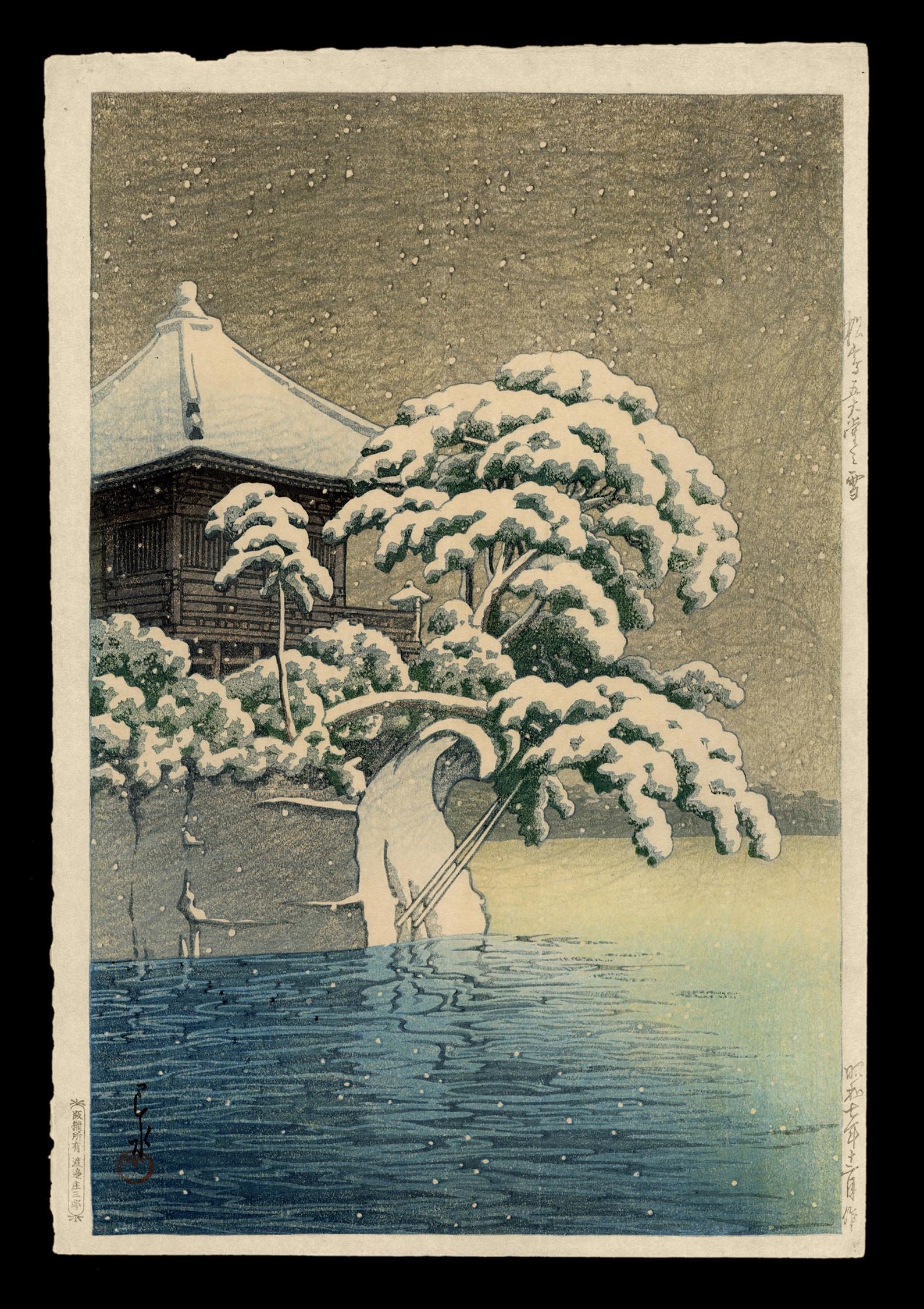
In Snow at Godaidō, Matsushima, Kawase Hasui renders a winter scene of ethereal stillness and spiritual depth. Perched at the edge of a pine-clad cliff, the Godaidō Temple—a revered structure dedicated to the Five Wisdom Kings—stands half-veiled in a flurry of falling snow. The ancient pines bend gracefully beneath their weight of powdery white, their boughs seeming to exhale the hush of winter. Below, the deep indigo of Matsushima Bay reflects the quiet rhythm of snowflakes and branches alike, a mirror of solitude and seasonal grace.
The composition reveals Hasui’s extraordinary sensitivity to atmosphere and design. Through nuanced bokashi gradation and restrained palette, the sky and bay dissolve into one another with quiet harmony. The eye is gently guided across the snowy canopy to the distant hall, then downward to the gently rippling water, where the mirrored weight of branches and falling snow deepens the sense of seasonal hush. It is a scene not of spectacle, but of inwardness—an evocation of presence through silence.
Connoisseur's Note
Matsushima, long celebrated as one of Japan’s "Three Scenic Views" (Nihon Sankei), finds in Hasui an interpreter capable of distilling its mystical beauty into a single moment. Godaidō Hall, perched against sea and sky, becomes here a symbol not only of enduring faith but of harmony between built and natural worlds. Hasui’s rendering of snow—lightly textured, almost floating—echoes the Zen aesthetic of wabi-sabi, in which impermanence and quiet decline are seen as integral to beauty.
Created during the height of the Shin-Hanga movement and published by Watanabe Shōzaburō, this 1932 print is among Hasui’s most elegant winter compositions. The interplay of structure, stone, tree, and water invites the viewer into a contemplative space, where nature is both foreground and spirit. In this snowy reverie at the edge of Matsushima Bay, Hasui offers not merely a view, but a moment of profound stillness—timeless, weightless, and deeply Japanese.
c. 1933
$6,000
Kasuga Shrine in Snow, Nara
Kawase Hasui (1883-1957)
MEDIUM: Woodblock Print
DATE: c. 1933
DIMENSIONS: 15 ¼ x 10 ¼ inches
CONDITION: Mounted onto original backing, minor losses to silver edge of backing, small loss to coversheet of calendar; minor soiling and staining
NOTE: Full-size woodblock print
$6,000.00
Contact us to purchase