

 Image 1 of 1
Details
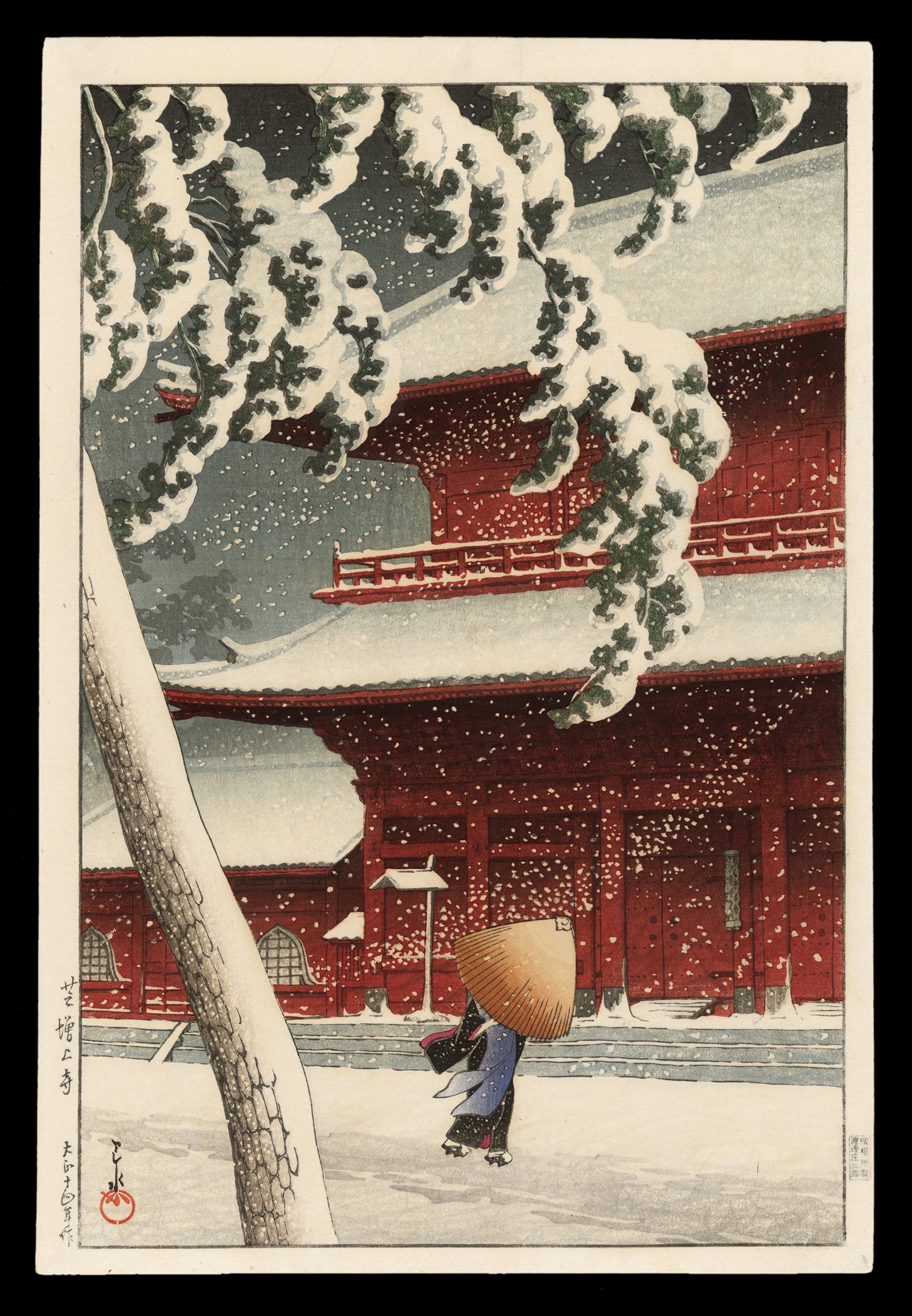
Few images in the history of modern Japanese printmaking have captured the public imagination with such serene elegance as Kawase Hasui’s Zojoji Temple, Shiba. A lone figure in traditional winter dress crosses the snow-blanketed grounds of the great red-lacquered gate, framed by branches heavy with fresh snowfall. Above, the softly descending flakes create a screen of motion against the hushed architecture, blurring the line between sky and temple eaves. This scene, both intimate and monumental, marks the quietude of a fleeting winter day in Tokyo.
Rendered with extraordinary sensitivity, Hasui’s print balances structure with atmosphere. The bold vermilion of the Zojoji gate glows warmly beneath the snow, while the delicate blue-violet of the traveler’s kimono draws the eye to human presence amid nature’s hush. The softly textured snow on roofs, tree limbs, and the ground below was achieved through careful subtle gradations of bokashi, enhancing the print’s tactile, almost dreamlike quality. In this work, time appears to pause—only the footfalls of the traveler and the silent fall of snow speak.
Connoisseur's Note
Zojoji Temple, Shiba is widely considered Kawase Hasui’s most celebrated and beloved design. First published in 1925 by Watanabe Shōzaburo, it quickly became an emblem of the Shin-Hanga movement, which sought to revitalize traditional Ukiyo-e techniques with modern sensibilities. Here, Hasui masterfully fuses Western influences—particularly in the rendering of perspective and natural light—with a deeply Japanese appreciation for seasonal atmosphere and solitude.
This design encapsulates the aesthetic ideals of wabi-sabi: the beauty of impermanence, the poignancy of a quiet moment caught in the swirl of time. Its enduring popularity is not merely a matter of technical mastery but emotional resonance—it invites stillness, reflection, and reverence. As both an icon of Japanese art and a deeply personal meditation on winter, Zojoji Temple, Shiba endures as a defining masterwork of early 20th-century printmaking.
This print bears a Watanabe A-type seal, making it an exceedingly early first-state impression. The print's condition is excellent. This print has never been framed, exhibiting colors as fresh as the day they were printed. The colors and impression of this design are a time capsule—collectors, take note, this is how this design should look!
More prints by Kawase Hasui:
c. 1933
$6,000
Kasuga Shrine in Snow, Nara
Kawase Hasui (1883-1957)
MEDIUM: Woodblock Print
DATE: c. 1933
DIMENSIONS: 15 ¼ x 10 ¼ inches
CONDITION: Mounted onto original backing, minor losses to silver edge of backing, small loss to coversheet of calendar; minor soiling and staining
NOTE: Full-size woodblock print
$6,000.00
Contact us to purchase