

 Image 1 of 1
Details
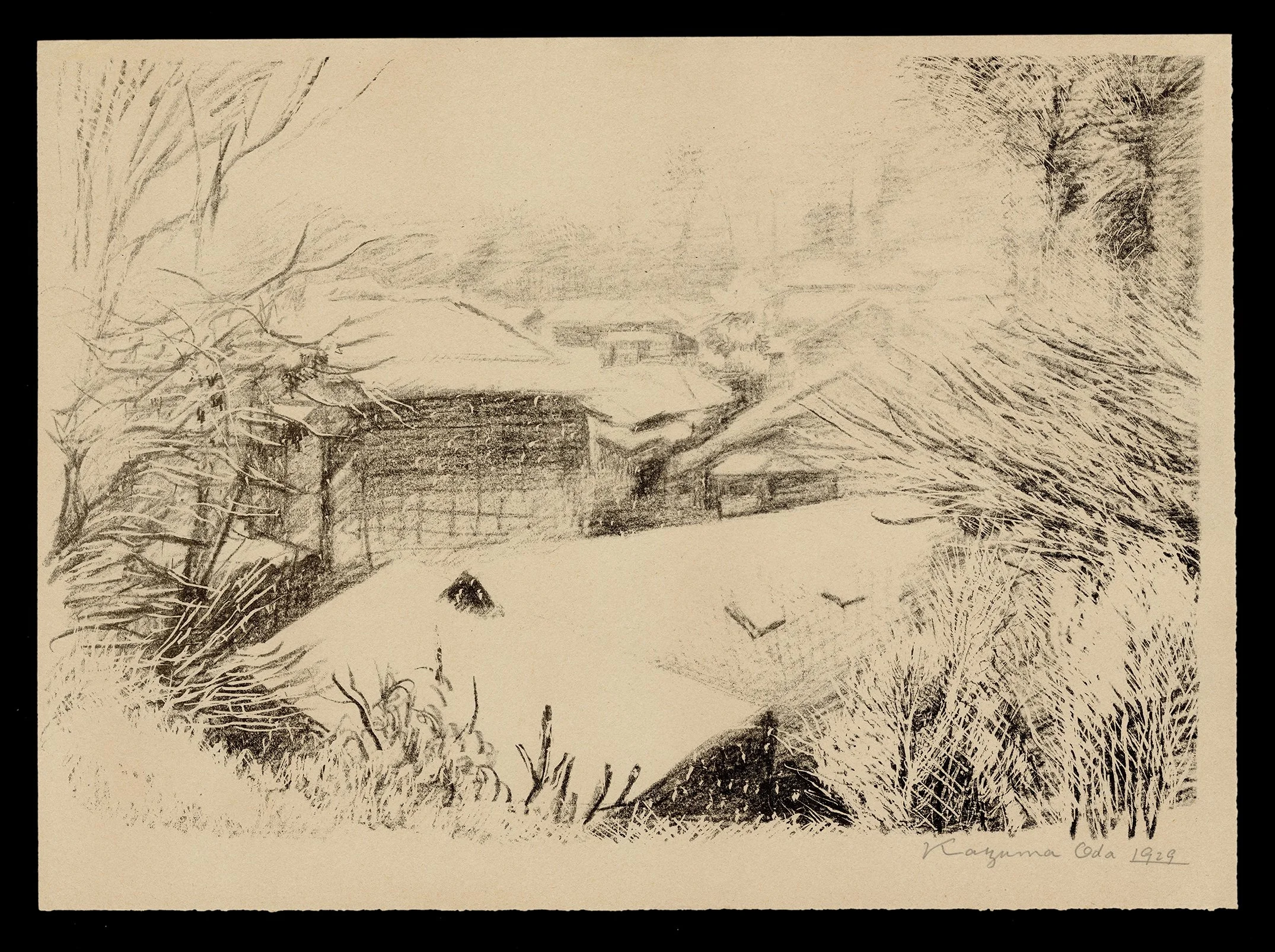
In Snowy Village, Kazuma Oda captures a landscape suspended in quietude and light. Rendered in soft, tonal gradations of black on cream, the lithograph evokes the fleeting stillness of a snowfall blanketing a rural hamlet. Roofs sag gently under the weight of snow; bare trees, etched with fine, almost spectral lines, stand vigil over the muffled world. Oda’s delicate control of the lithographic crayon allows the image to breathe, its subtle textures dissolving into one another like memory itself. The viewer is drawn not merely into a scene, but into a moment of profound atmospheric reverie.
Oda’s masterful handling of the medium reflects a profound reverence for the material itself. Rather than layering heavy pigment, he allows the natural tone of the paper to serve as the snow, building the scene upwards from its quiet luminosity. This thoughtful collaboration with the surface, treating the paper as a living element rather than a passive ground, evokes the Japanese aesthetic ideals of restraint and harmony with nature. Snowy Village is an act of listening as much as depiction — a quiet revelation of landscape through touch, breath, and silence.
Connoisseur's Note
Kazuma Oda was among a rare group of early 20th-century artists who bridged the worlds of Shin Hanga refinement and Sosaku Hanga individuality. While capable of the technical polish prized by traditionalists, he chose the path of self-expression, producing Snowy Village entirely by his own hand in the spirit of Sosaku Hanga’s founding ideals. His mastery of lithography — a European medium still poorly understood in Japan at the time — positioned him as the nation's foremost lithographic artist, demonstrating the medium’s subtle power and poetic potential.
For collectors, Snowy Village offers a glimpse into the fullest possibilities of lithography under the hand of one of Japan’s most versatile talents. The print’s luminous quietude, technical brilliance, and emotional immediacy reveal Oda’s extraordinary gift: the ability to render not merely place, but the inner weather of experience itself. Rare and refined, this work endures as a profound testament to Oda’s singular contribution to modern Japanese art.
More prints by Kazuma Oda:
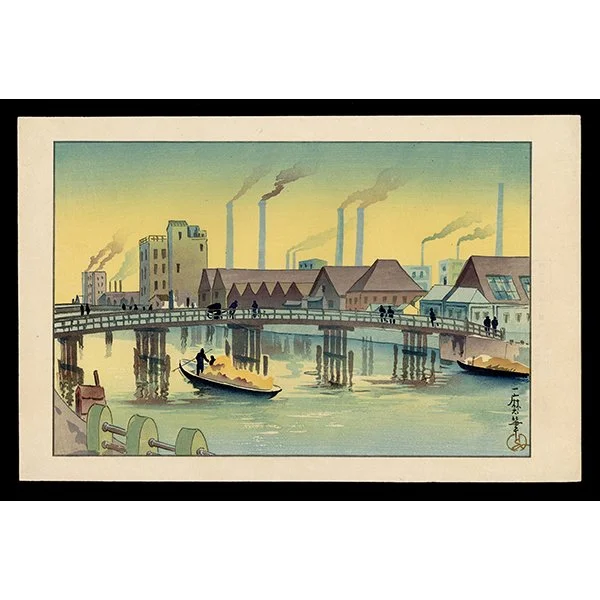

1929-30
RESERVED
Twilight at Ginza
Kazuma Oda (1882-1956)
SERIES: Print Collection of Great Tokyo
MEDIUM: Woodblock print
DATE: 1929-30
DIMENSIONS: 9 3/8 x 12 7/8 inches
CONDITION: Excellent, no problems to note
NOTE: This impression is a rare color variant with a lighter and brighter palate
LITERATURE: Machida City Museum of Graphic Arts, Kazuma Oda, pl.102
$4,500.00 <RESERVED>