

 Image 1 of 1
Details
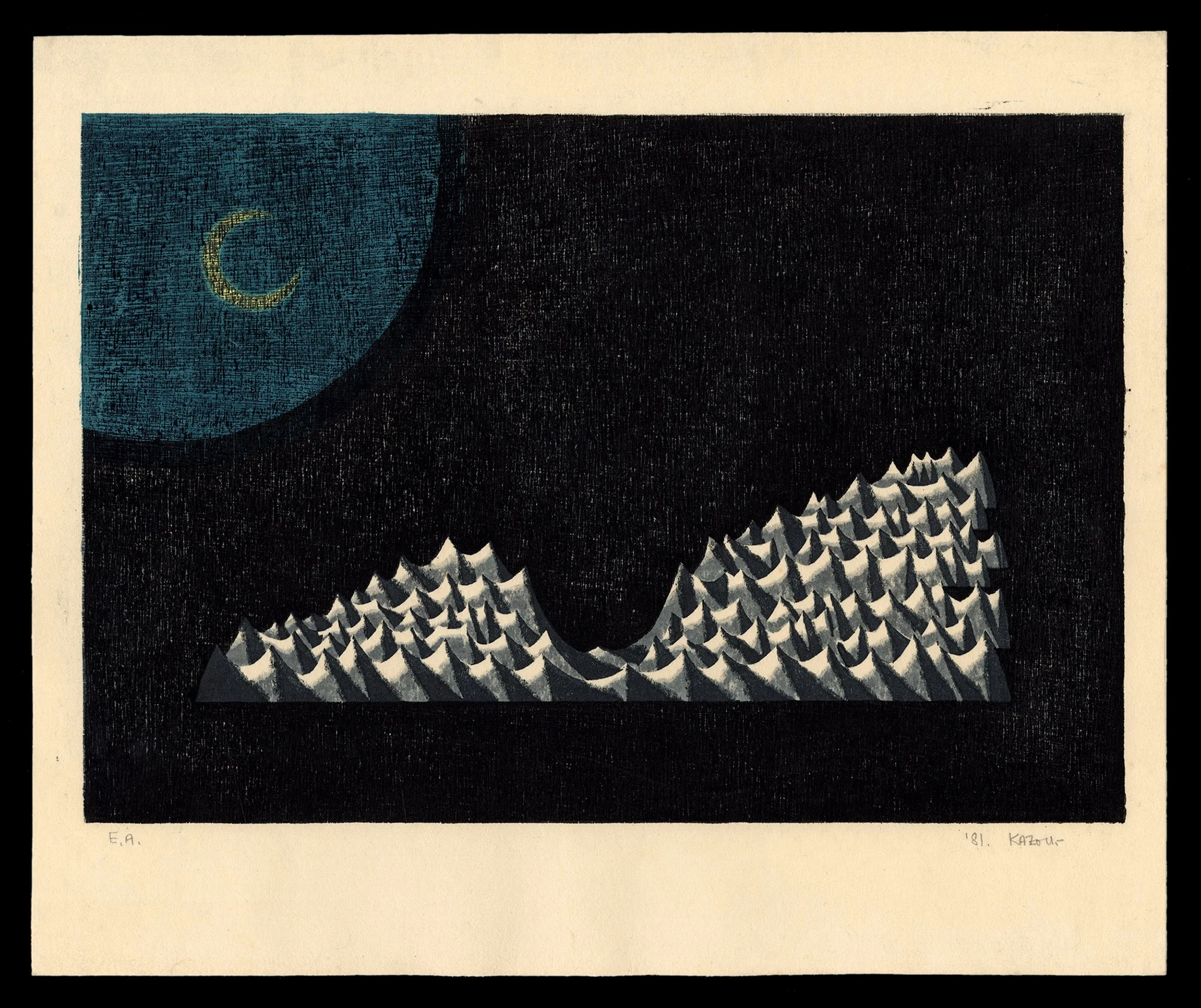
In Moonlit Mountains, Kazuyoshi Otani creates a stark and otherworldly terrain suspended beneath a sliver of a yellow crescent. Jagged peaks form a rhythmic, undulating pattern across the print’s lower register, their sharp edges illuminated in silver tones against a void of deep black. In the upper corner, a massive celestial sphere looms—its crescent moon enclosed within a deep teal halo, suggesting not merely the Earth’s sky but some cosmic vista altogether.
The composition is abstracted yet deliberate, with Otani’s calculated geometry and sharply modulated value shifts creating an atmosphere both alien and reverent. It is a mountain landscape in name only; what the artist evokes is something metaphysical—a terrain imagined rather than surveyed. The landscape becomes a stage of contrasts: light against dark, curve against spike, presence against absence.
Connoisseur's Note
Otani Kazuyoshi studied under Umetarō Azechi, whose legacy of dynamic, stylized landscapes and mountain men is clearly echoed here—but Otani extended the visual vocabulary of his teacher beyond the boundaries of realism. Where Azechi’s forms celebrated the earthy vitality of Japan’s alpine culture, Otani’s forms veer toward the mythic and celestial. His mountains suggest not only the terrain of Japan, but the terrain of the subconscious—the unseen, the imagined, the eternal.
This rare artist’s proof from 1981 reveals Otani at his most confident and experimental. The print’s richly textured black field, likely achieved through careful baren rubbing and layered inking, absorbs the eye like deep space. Collectors of mid- to late-20th century Japanese printmaking will recognize in Otani a powerful voice—a synthesis of modern abstraction and traditional woodblock discipline, shaped by influence but strikingly individual.