

 Image 1 of 1
Details
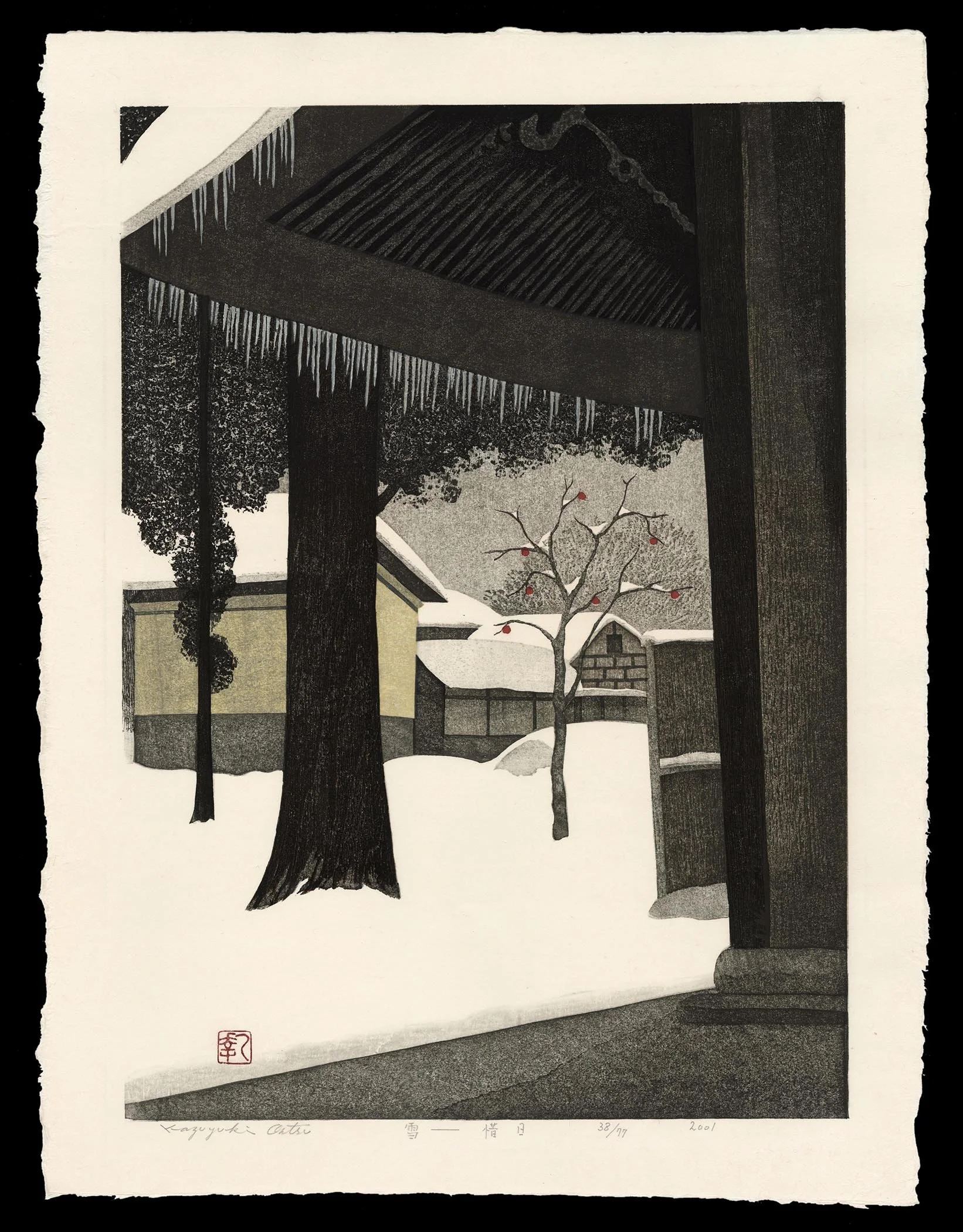
In Snow—Missing Day, Kazuyuki Ohtsu invites the viewer into a scene of hushed stillness, where the breath of winter has laid a thick white quilt over the world. A heavy temple roof, laden with icicles like frozen spears, frames the composition from above, while the dark vertical thrust of tree trunks anchors the space below. Beyond the shadowed gate, a courtyard stretches quietly outward, its undisturbed snow interrupted only by a bare persimmon tree clinging to its last few fruits, red as drops of memory against the muted backdrop. The work exudes a tranquility that verges on the sacred, a moment where absence—the "missing day"—is felt as a presence in itself.
Ohtsu’s use of gentle gradations and flattened planes of muted color owes much to his mentor, Kiyoshi Saito, yet his own voice emerges in the tender emotional charge that infuses every surface. The sweeping textures of the woodgrain are left subtly visible in the printing, allowing the medium itself to speak—a quiet reminder of the hand-hewn quality of the image. The perspective, slightly askew and leaning inward, draws the viewer bodily into the space, as if crossing a threshold between the seen world and the world of reflection.
Connoisseur's Note
Kazuyuki Ohtsu, a master of the postwar woodblock tradition, is celebrated for his ability to distill the essence of the Japanese countryside and temple precincts into scenes of contemplative simplicity. Snow—Missing Day is an outstanding example of Ohtsu’s mature style, characterized by a deep reverence for nature, a lyrical sense of seasonality, and an acute sensitivity to atmosphere.
Produced in 2001 in a small edition of only 77 prints, this impression is particularly fine, showcasing Ohtsu’s restrained yet masterful palette and his hallmark balance of stillness and underlying emotional resonance. The deliberate framing under the heavy roof, the delicate handling of falling snow, and the expressive minimalism of the bare tree imbue the work with an almost haiku-like beauty. Few artists capture the poetics of winter’s silence as deftly as Ohtsu, and this work stands as a testament to his lifelong devotion to the quiet lyricism of the everyday.
2001
$2,000
Snow—Missing Day
Kazuyuki Ohtsu (1935–2020)
EDITION: 38/77
DATE: 2001
MEDIUM: Woodblock Print
DIMENSIONS: 24 × 18 ¼ inches
CONDITION: Excellent impression and color; no issues to note
NOTE: Rarely seen snow scene
$2,000.00
Contact us to purchase