

 Image 1 of 1
Details
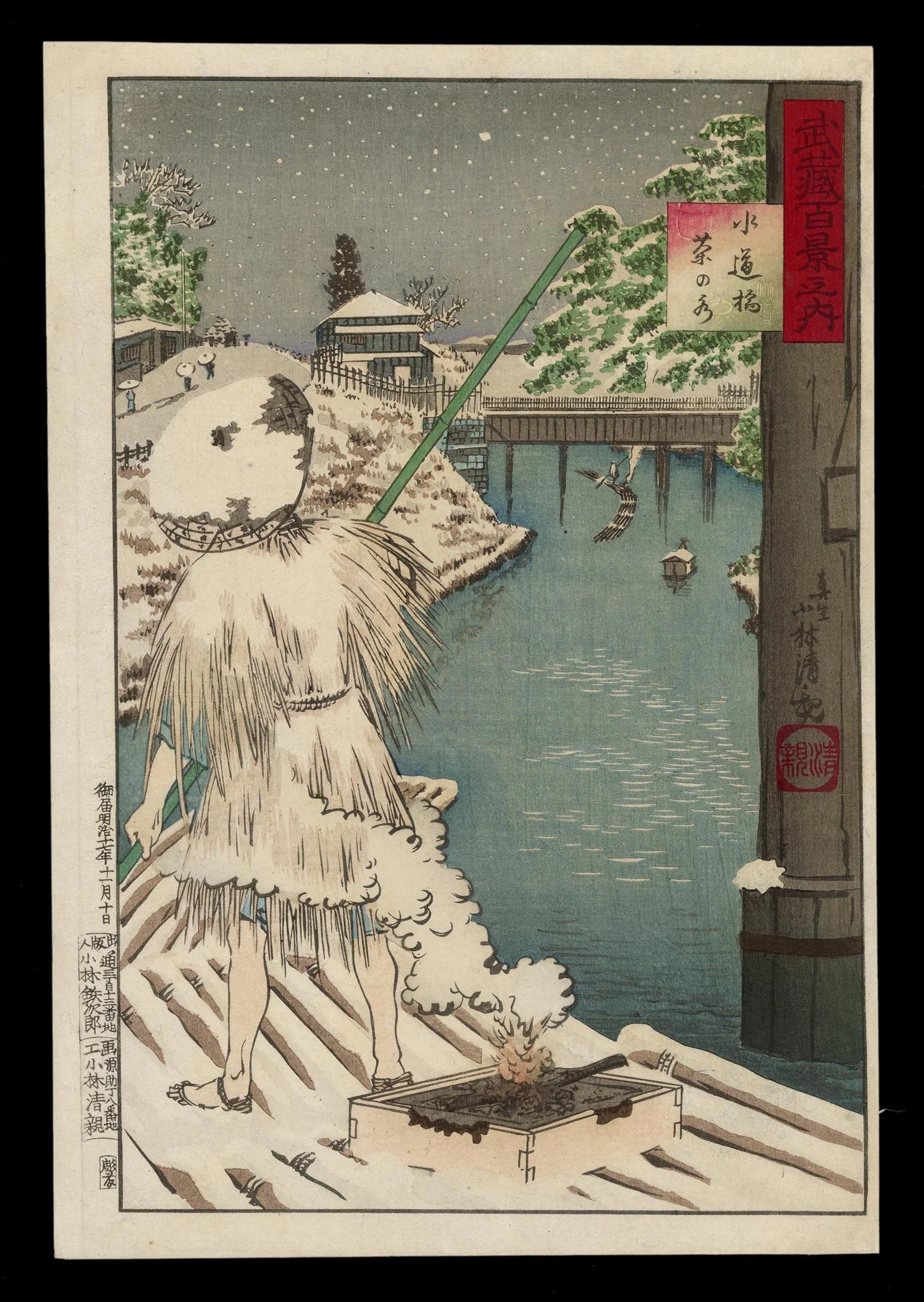
In Snow at Suidobashi, Kobayashi Kiyochika transports the viewer into a moment of arresting stillness within Meiji-era Tokyo. A lone figure, wrapped in a traditional straw mino cloak and hat, stands at the snowy water’s edge, warming his bare feet over a brazier that exhales a column of smoke—rising gently like an offering to the pale winter sky. The banks of the canal are blanketed in snow, muting the landscape, while distant buildings, bridges, and a solitary crane in flight unfold with quiet dignity. The blue-toned water serves as a mirror for the cold sky, anchoring the composition in contemplative tranquility.
This image is part of Kiyochika’s rare and incomplete series, One Hundred Views of Musashi, a clear homage to Hiroshige’s monumental One Hundred Famous Views of Edo. But where Hiroshige rendered a nostalgic Edo at twilight, Kiyochika’s series records a changing Tokyo, often under snow, moonlight, or mist—his signature atmospherics infusing everyday settings with a haunting lyricism. In this print, the convergence of warm smoke, snowbound landscape, and a figure on the edge of modernity creates a quietly theatrical moment steeped in the impermanence of things.
Connoisseur's Note
Kobayashi Kiyochika stands as a singular figure in Meiji-era printmaking—bridging the ukiyo-e tradition with the sensibilities of modern reportage and Western chiaroscuro. In Snow at Suidobashi, he employs a masterful play of light and shadow, drawing on Western techniques of tonal modeling while maintaining the flat color harmonies and linework of Japanese print tradition. The man’s obscured face and frozen posture speak to the anonymous labor and solitude of city life during a time of great social transformation.
The series Musashi hyakkei no uchi remains unfinished, with only 34 prints issued by Kobayashi Tetsujirō between 1884 and 1885. This scarcity, paired with the series' ambitious blend of documentary and poetic intent, places each extant print among the most desirable of Kiyochika’s oeuvre. The present impression is particularly fine, with pristine snowfall and softly billowing smoke rendered in exceptional preservation. A quiet meditation on endurance and the passage of time, this work reveals Kiyochika’s unique vision: neither nostalgic nor progressive, but reverent toward the fleeting textures of the everyday.
More prints by Kobayashi Kiyochika:
1885
$2,000
Snow at Suidobashi
Kobayashi Kiyochika (1847–1915)
SERIES: Musashi hyakkei no uchi (One Hundred Views of Musashi)
DATE: 1885
MEDIUM: Woodblock Print
DIMENSIONS: 13 ½ x 9 1/8 inches
CONDITION: Excellent color and impression; light backing
NOTE: First state, Published by Kobayashi Tetsujiro
$2,000.00
Contact us to purchase