

 Image 1 of 1
Details
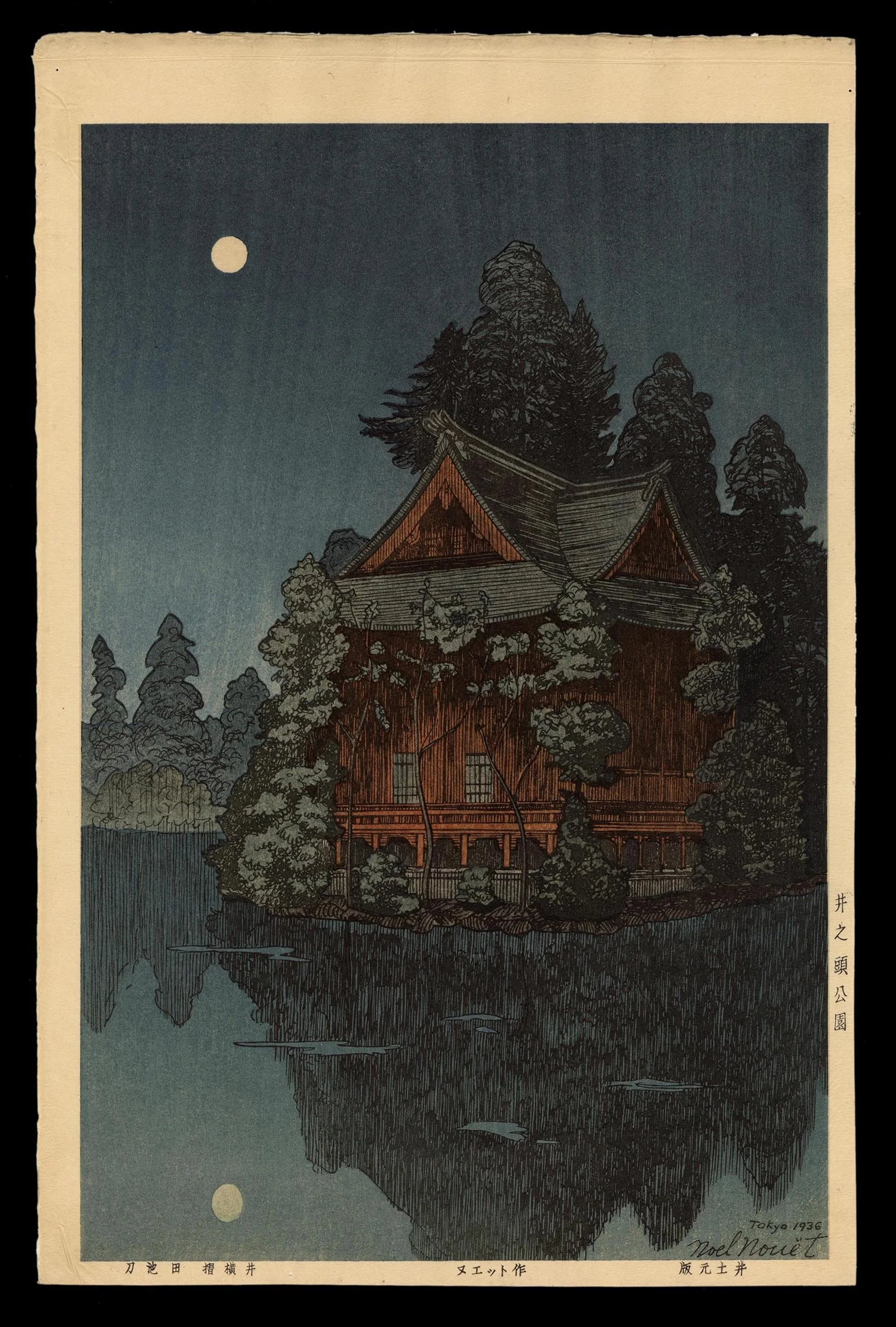
In Inokashira Park, French artist Noel Nouet captures the tranquil mystery of a moonlit night at one of Tokyo’s most beloved gardens. The scene centers on the Benzaiten shrine pavilion, its warm-toned wooden structure nestled among thick foliage, its elevated verandas casting gentle shadows across the mirrored water below. The full moon rises silently in a cloudless indigo sky, its soft reflection glimmering in the rippling surface of the pond.
A masterful play of vertical and horizontal elements defines the composition—slender tree trunks and architectural posts contrast with the horizontal sweep of the eaves and the still waterline. The calm, meditative mood is enhanced by the deep palette of blues and umbers, punctuated by the natural warmth of the shrine’s timber. Reflections in the pond are rendered with restraint, creating a delicate symmetry that blurs the boundary between real and reflected.
Connoisseur's Note
Noel Nouet, a French Jesuit priest and artist, was a rare foreign contributor to the Japanese shin-hanga tradition. Living in Japan for decades, Nouet developed a deeply respectful eye for its landscapes, temples, and everyday scenes. Inokashira Park is part of a small but prized body of prints he created in collaboration with Japanese craftsmen, blending Western compositional sensibilities with traditional Japanese technique.
This particular print is notable for its elegant depiction of stillness and light. While the subject is quintessentially Japanese, the treatment of the scene—its framing, its emphasis on shadow and form—reflects Nouet’s unique cross-cultural perspective. The inclusion of both the moon in the sky and its faint double in the water below creates a quiet poetic duality: a natural reflection of Shinto beliefs in the mirrored world, the visible and the unseen.
Inokashira Park was published by the esteemed Doi Publishing House, known for its finely crafted woodblock prints during the early Shōwa period. This impression is from the first state, identifiable by the absence of the carver and printer seals in the margins that appear on later editions. These early states, often produced under closer supervision, are increasingly scarce and prized for their crisp impression and subtle color fidelity.
Printed in 1936, Inokashira Park stands as both a devotional landscape and a document of place—testament to the serenity of Kichijōji’s temple garden, preserved under the silver hush of moonlight. It is a striking example of Nouet’s rare and refined contribution to modern Japanese woodblock printmaking.
1936
$3,000
Ryogoku Bridge
Noel Nouët (1885-1969)
SERIES: Scenes of Tokyo, Twenty-four Views
MEDIUM: Woodblock print
DATE: 1936
DIMENSIONS: 15 1/2 x 10 1/2 inches
CONDITION: Excellent, no problems to note
NOTE: Published by Doi Eiichi
LITERATURE: Scenes of Tokyo, Twenty-four Views
$3,000.00