

 Image 1 of 1
Details
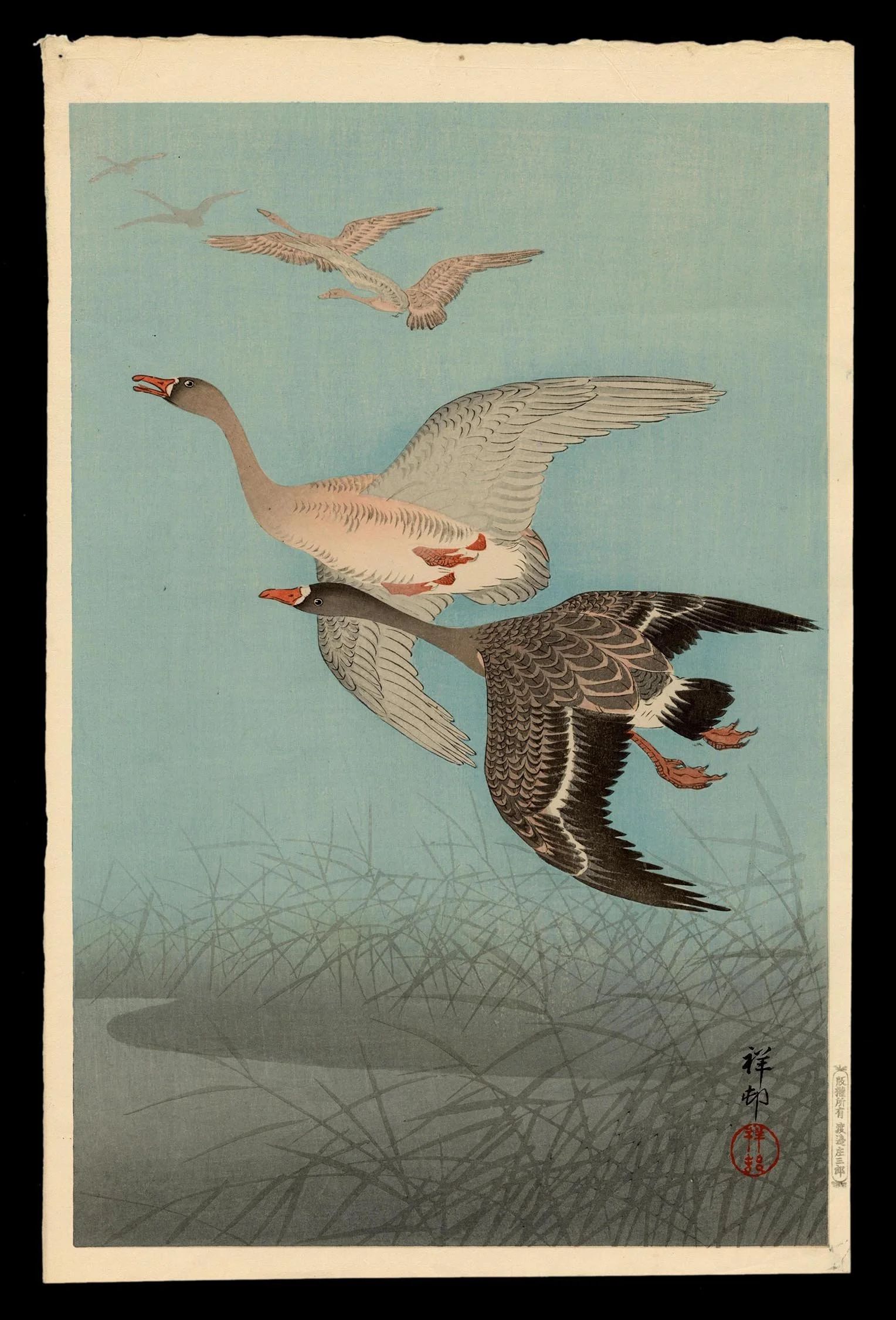
In Wild Geese, a pair of geese in mid-flight cut sharply across a cerulean sky, wings spread in full tension, rendered with the crisp exactitude that characterizes Ohara Shoson’s most refined work. Above them, ghostlike silhouettes of distant geese fade into the pale gradient of air, while delicate reeds and an inky waterline mark the threshold of marshland below. Executed in 1926, this composition belongs to the golden age of Shin-Hanga, where naturalism meets lyrical abstraction.
The juxtaposition of movement and serenity—frozen flight above a still wetland—exemplifies the print’s quiet drama. The plumage is minutely carved and shaded: the feathers on the lower bird bear dark, almost calligraphic contouring, while the upper bird’s lighter form lifts slightly, drawing the eye skyward. There is no background beyond the shifting hues of air and water—no distraction from the elegant simplicity of form in motion.
Connoisseur's Note
Ohara Shoson (also known as Koson), trained initially in kacho-ga (bird-and-flower painting), became a seminal figure in the Shin-Hanga movement, bridging the painterly realism of the West with the aesthetic poise of classical ukiyo-e. In Wild Geese, Shoson distills a scene of migration into a composition of remarkable balance and grace. The placement of the geese—one rising, one descending—suggests not only flight but an elemental choreography, a visual haiku of nature’s seasonal passage.
Symbolically, geese in flight have long connoted transition, longing, and distance in Japanese literature and painting. Yet there is no sentimentality here—only an enduring calm. The sense of space, reinforced by subtle bokashi (gradation) and expertly restrained palette, allows the viewer to enter the print with a meditative gaze. For collectors of Shin-Hanga, Wild Geese offers a wonderful example of Shoson’s technical mastery and poetic restraint—an image at once exact and ephemeral.
More prints by Ohara Shoson:
20th Century
$400
Ducks in Flight
Ohara Shoson (1877–1945)
MEDIUM: Woodblock Print
DATE: 20th Century
DIMENSIONS: 10 1/8 X 7 inches
CONDITION: Excellent; faint soiling at right
$400.00
Contact us to purchase