

 Image 1 of 1
Details
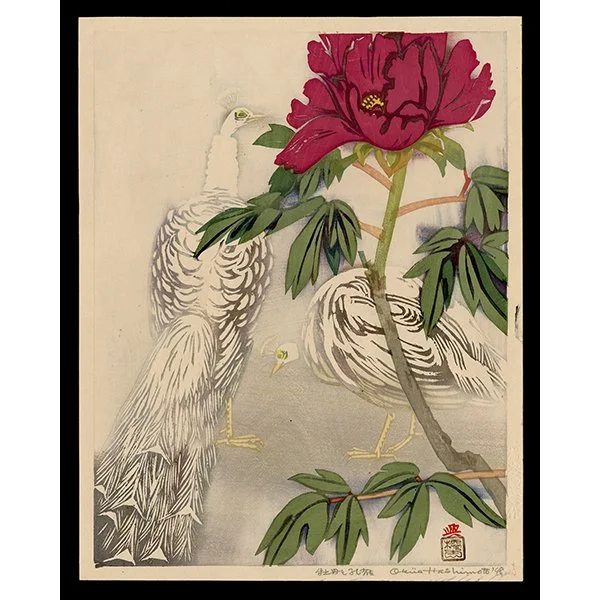
In White Peony, Okiie Hashimoto captures the tender vitality of a blossoming peony, its petals unfurling in an elegant, spontaneous cascade. The central bloom, rendered in soft white with subtle blue-gray shading, radiates outward from a bright yellow heart, set against a lush backdrop of green leaves. The composition is at once deliberate and free-flowing, conveying the spirit of nature not through rigid depiction but through an organic, intuitive hand.
This rare, early work—dated 1941—embodies the core ideals of the Sosaku Hanga ("creative prints") movement: personal expression, hand-crafted execution, and a prioritization of emotional resonance over mere representation. Hashimoto's approach here reflects the powerful influence of his mentor, Koshiro Onchi, whose emphasis on freedom of form and organic freeform spontaneous inspired texture shaped the young artist’s early vision. The vibrancy and looseness of the printing style lend the scene a tactile immediacy, as if the peony itself continues to breathe on the paper.
Connoisseur's Note
White Peony stands among the rarest and most evocative of Okiie Hashimoto’s early prints. Executed in 1941, before his later more architecturally focused works, it captures the youthful energy of an artist still fully immersed in the organic aesthetic of the sosaku hanga pioneers.
The loose, expressive handling of pigment and the slightly uneven, human quality of the carving highlight the piece’s handmade origins—a hallmark of Hashimoto’s early period. Collectors especially prize impressions like this for their unguarded vitality and historical importance, tracing a direct lineage from Onchi's visionary leadership to Hashimoto’s own mature, refined language of modern Japanese printmaking.
More prints by Okiie Hashimoto:

1950
$3,000
Waterfall
Okiie Hashimoto (1899–1993)
EDITION: Artist’s Proof (A.P.)
DATE: 1950
MEDIUM: Woodblock Print
DIMENSIONS: 31 ½ x 22 inches
CONDITION: Excellent impression, color, and condition; No problems to note
NOTE: Rare large scale and early work
$3,000.00
Contact us to purchase