

 Image 1 of 1
Details
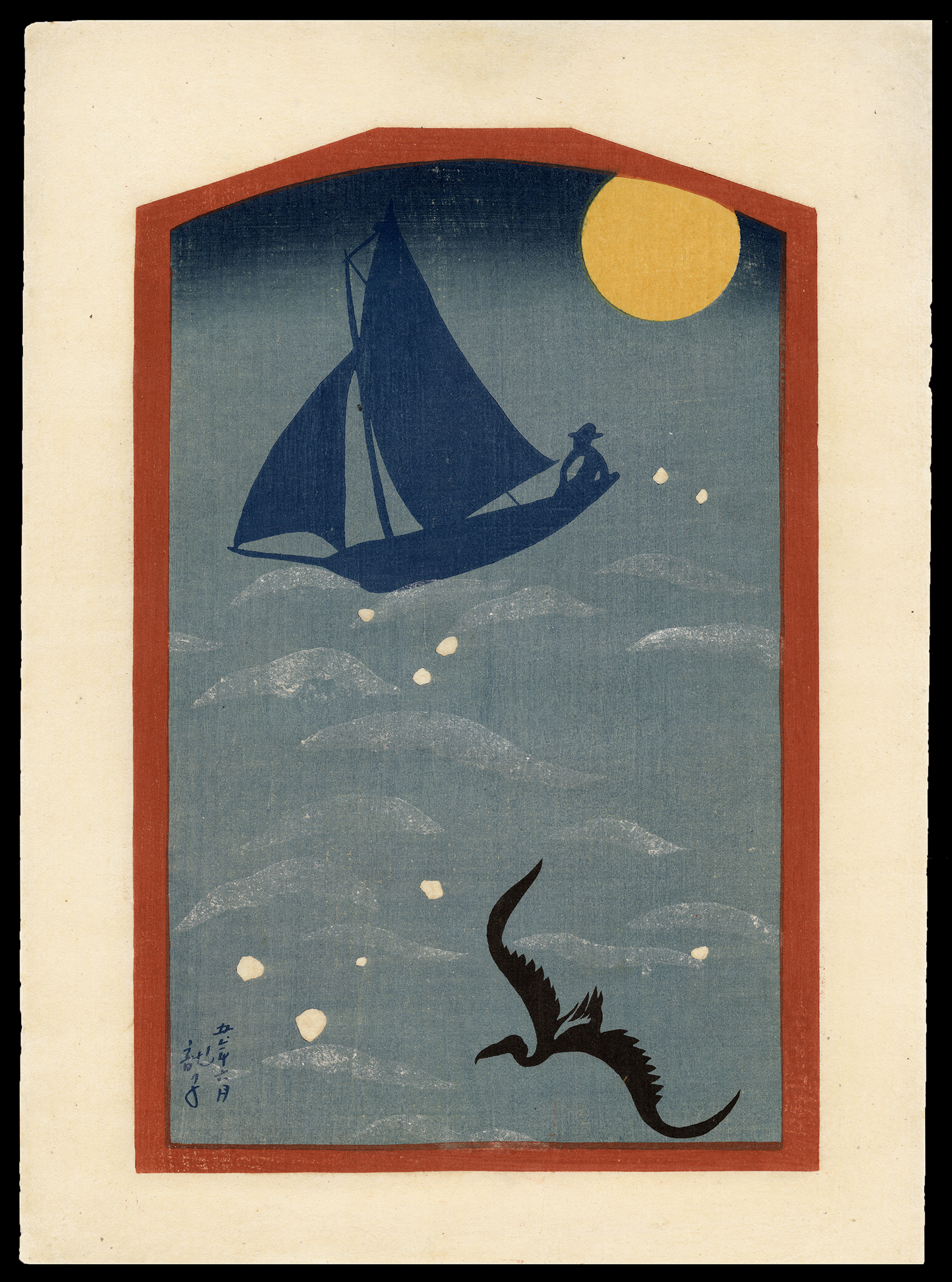
Kawabata was known primarily as a Nihonga-style painter who was active during the Taisho and Showa eras. He produced a handful of prints circa 1916 with a group of artists experimenting with western style aesthetics; among these was the founder of Sosaku Hanga, Kanae Yamamoto. In this work, Kawabata presents a dream-like seascape of a sailboat afloat in the ocean bathed in moonlight with a large graceful bird gliding past the viewer’s grasp. Most of the elements in the composition are shown in silhouette in a highly stylized format that borrows from early Japanese graphic art. The work exudes the playful and poetic quality that is indicative of the Taisho era. There is a subtle application of silver mica throughout the design, mimicking waves that advance the work’s dreamlike quality.
Connoisseur's Note
Of the handful of designs produced by Kawabata, this work is his most successful and sought-after design. The print was produced at the pivotal time when Sosaku Hanga was still in its infancy, and professionally trained artisans were producing some self-directed designs. Though Kawabata did not carve or print this work, the design was most certainly executed solely by the artist.
This print is quite scarce, as is the case with the handful of designs produced by Kawabata. Much like the Sosaku Hanga of the period, these designs were produced in small numbers and never reissued, ensuring this work is among the rarest of the woodblock prints produced in this early period of the 20th century.