

 Image 1 of 1
Details
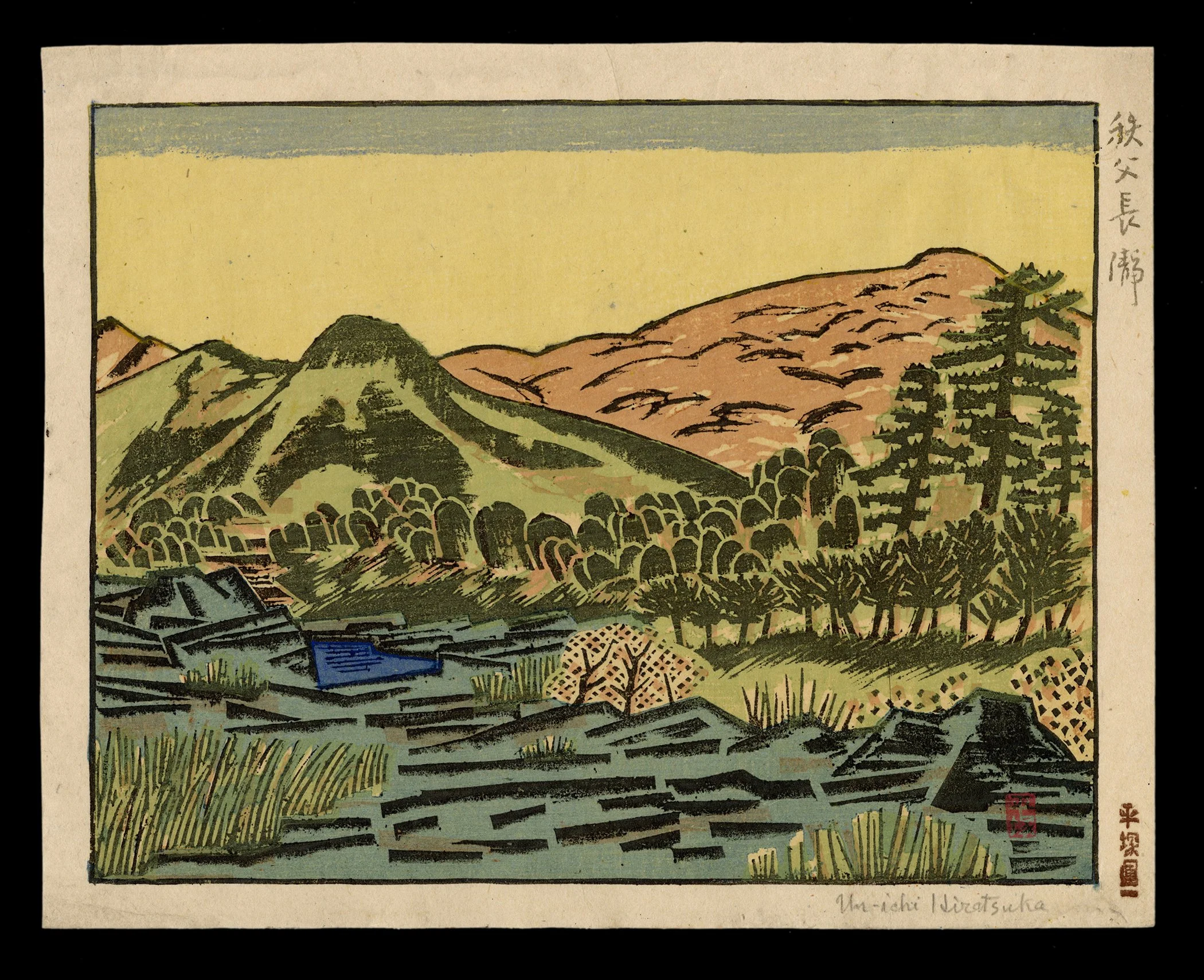
In Chichibu Nagatoro, Un’ichi Hiratsuka captures the rugged serenity of Saitama Prefecture’s celebrated natural landscape with bold, geometric clarity. The steep green hills rise against a soft yellow sky, their edges softened by a rhythmic chorus of trees. Angular stone formations in the riverbed below cut sharply through the composition, their deep blues and grays grounding the scene with a sense of permanence. A lone patch of blue — perhaps a boat or still water — glimmers amidst the stone, suggesting quiet human presence dwarfed by the grandeur of nature.
Created in 1935, this print reflects Hiratsuka’s early exploration of color woodblock printing before he ultimately turned to the monochromatic black-and-white works for which he later became best known. Here, his hand-carved lines retain a raw vitality, emphasizing structure and movement over polished illusion. The natural forms are abstracted just enough to reveal the essential rhythms of landscape itself — a world shaped not only by erosion and growth but also by the quiet spiritual energy permeating the land.
Connoisseur's Note
The bright, almost pastel palette seen in Chichibu Nagatoro reflects the influence of Kunzo Minami, whose prints Hiratsuka first encountered by chance in the window of a Tokyo department store. Struck by their luminous beauty, he was compelled to enter the shop and study them closely. This serendipitous encounter set Hiratsuka on the path of printmaking — a journey that would lead him to become one of the founding figures of the Sosaku Hanga movement. His ethos of designing, carving, and printing entirely by hand is palpable in every facet of this work.
Color prints from Hiratsuka’s early period, such as Chichibu Nagatoro, are especially rare and valued today. They capture an important transitional moment: an artist still exploring the expressive possibilities of color while steadily honing the structural clarity and rhythmic line that would later define his mature style. In this print, Hiratsuka pays tribute not only to the enduring beauty of the Japanese landscape but also to the transformative power of a single, chance encounter with art.
More prints by Umetaro Azechi:
1923
$1,000
Portrait of my Wife, Teruno, 1923
Unichi Hiratsuka (1895–1997)
MEDIUM: Woodblock print
DATE: 1923
DIMENSIONS: 11 ¾ x 8 ½ inches
CONDITION: Excellent, no problems to note
NOTE: Rare early work
LITERATURE: Hiratsuka: Modern Master, pl. 5
$1,000.00