

 Image 1 of 1
Details
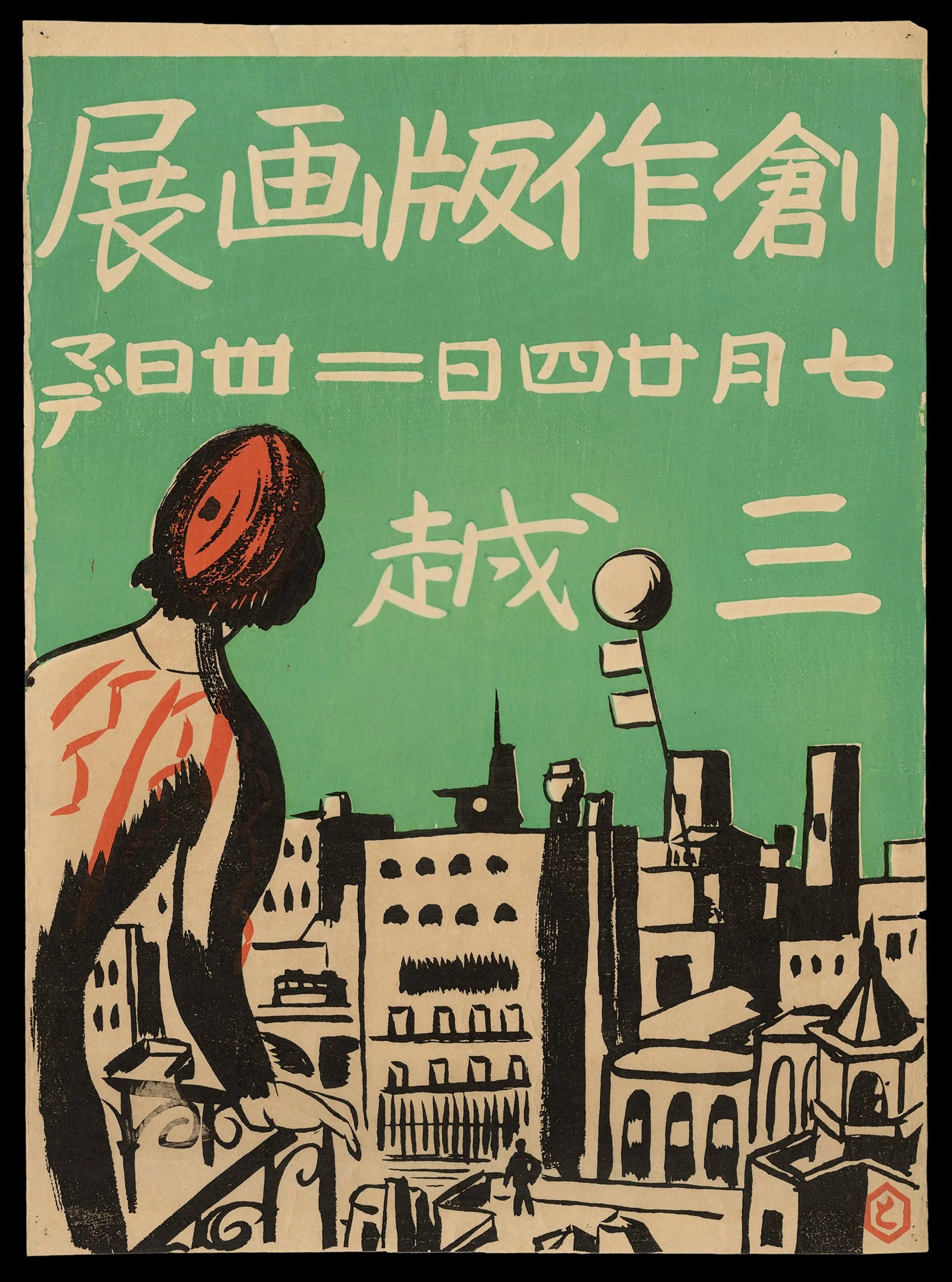
This boldly simplified poster advertises an upcoming print exhibition through a composition of remarkable graphic clarity and urban atmosphere. A solitary modern woman stands at a balcony overlooking a dense cityscape of silhouetted buildings, smokestacks, towers, and commercial architecture rendered in stark black forms against a luminous turquoise sky. Her back is turned toward the viewer, emphasizing both distance and contemplation, while her short bobbed hairstyle and red cloche hat firmly identify her as a figure of contemporary metropolitan culture. Above the city floats an advertising balloon, a quintessential symbol of modern commercial spectacle during the late Taishō and early Shōwa periods.
The composition captures the expanding visual culture of Japanese cities during the early 1930s, when rooftops, electric signage, department store towers, and aerial advertising transformed the urban skyline into a theater of modern commerce. Rather than presenting the city as chaotic or oppressive, the artist conveys a sense of fascination and possibility. The elevated viewpoint allows the viewer to experience the metropolis as the modern woman herself might have encountered it: as a space of movement, anonymity, aspiration, and participation in an increasingly interconnected urban world.
Produced as a promotional poster for a sōsaku hanga exhibition, the work also reflects the movement’s embrace of artistic individuality and experimental design. Unlike the collaborative production model of traditional ukiyo-e publishing, sōsaku hanga artists emphasized personal expression through self-designed and often self-carved works. The poster’s rough-hewn linework, flattened forms, and highly reductive architecture embody this modern aesthetic vocabulary. At the same time, the composition demonstrates how sōsaku hanga artists absorbed influences from European modernism, poster design, and contemporary illustration while adapting them to Japanese printmaking traditions.
Connoisseur's Note
Perhaps the most compelling quality of this poster lies in its extraordinary command of silhouette and negative space. The artist reduces the city to interlocking geometric masses, allowing the skyline to function almost rhythmically across the lower half of the composition. Buildings dissolve into abstract forms while still retaining enough specificity to evoke the rapidly modernizing districts of interwar Tokyo. This tension between abstraction and recognizability reflects the growing influence of avant-garde design principles entering Japan through architecture journals, graphic arts magazines, and international exhibitions during the late 1920s.
The figure itself is handled with remarkable sophistication. By positioning the woman with her back toward the viewer, the designer avoids portraiture entirely and instead transforms her into a surrogate observer through whom the modern city is experienced. Her simplified form anchors the composition emotionally without disrupting its graphic balance. The red hat serves as the visual fulcrum of the sheet, activating the otherwise restrained palette and drawing the eye immediately toward the human presence within the sprawling urban environment.
Posters produced for print exhibitions of this period survive only rarely, particularly those associated with smaller or temporary events. Intended for public display rather than preservation, most examples disappeared shortly after use. As surviving objects, they offer invaluable insight into how artists of the sōsaku hanga movement presented themselves to contemporary audiences—not only as printmakers, but as participants in a broader culture of modern graphic communication. The present work is especially notable for the elegance with which it merges commercial design, urban imagery, and artistic self-consciousness into a single highly resolved composition.