

 Image 1 of 1
Details
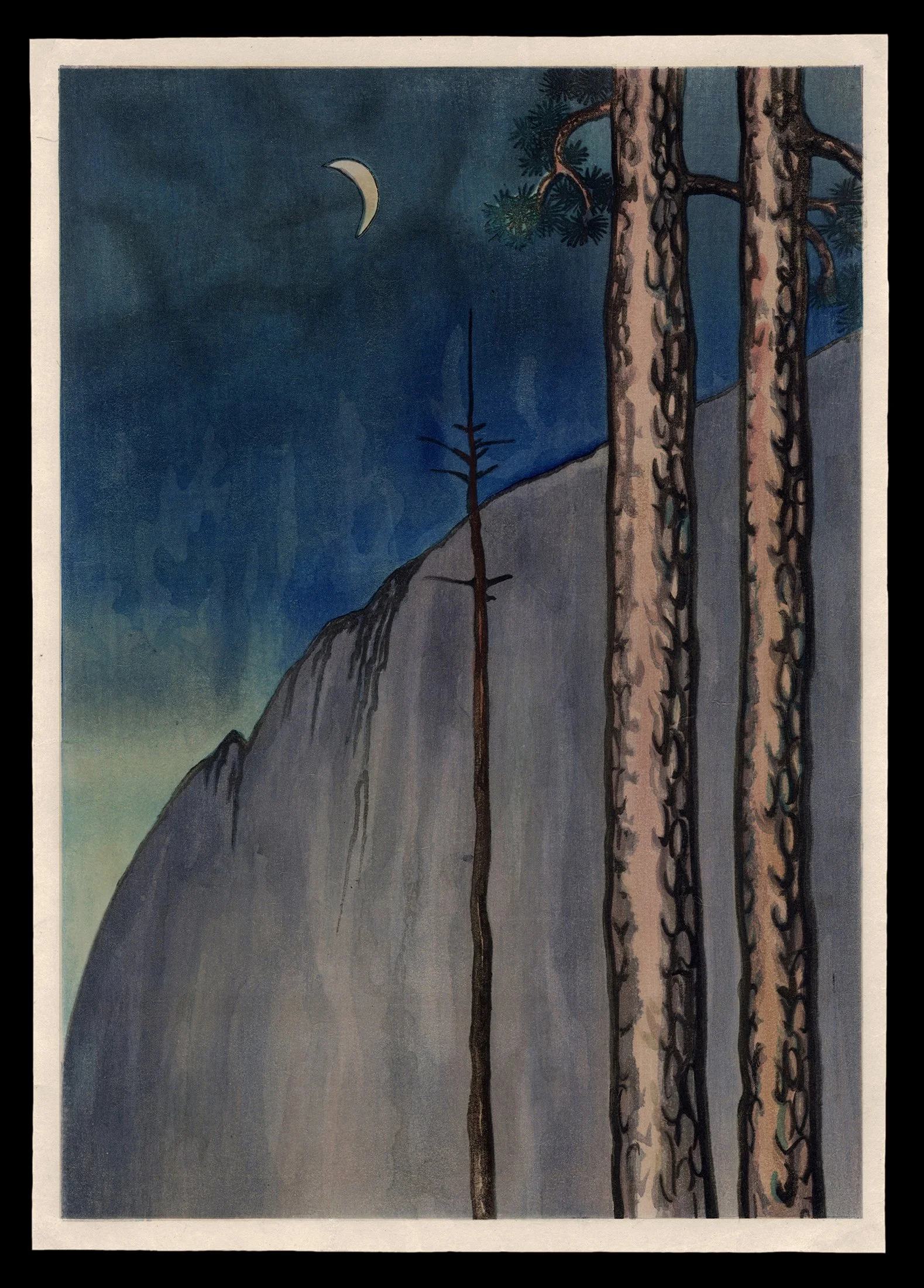
Evening Moon at Yosemite stands as one of the most meditative and lyrically subdued compositions within Chiura Obata’s landmark World Landscape Series – America. The print captures the twilight hush over Yosemite Valley, where towering pines, rendered with rhythmic contour and calligraphic bark, stand sentinel before the face of a granite monolith. A sickle moon floats serenely above, casting an otherworldly glow across the dusky blue firmament. The balance between vertical trees and the sloping bulk of the cliff creates a poised stillness—an image not merely seen but felt, suspended in reverent quietude.
Executed in Tokyo by the artisans of the Takamizawa publishing house and overseen personally by Obata, this woodblock print transforms his original sumi and watercolor sketches into a work of timeless grace. Here, Obata does not dramatize the Yosemite landscape but distills it to its most essential forms—limbs, light, and sky—inviting the viewer into a contemplative communion with nature. The gradated sky, achieved through subtle bokashi shading, testifies to the technical mastery of the carvers and printers working in harmony with Obata’s painterly vision.
Connoisseur's Note
Obata’s treatment of Yosemite reveals his deep reverence for nature’s quiet dramas—those subtle contrasts between endurance and fragility, between the seen and the sensed. In Evening Moon at Yosemite, the bare, weathered pine standing beside its sturdier neighbors speaks to the cycles of life and time, a reminder of nature’s delicate balance between resilience and impermanence. It is not a scene of grandeur for its own sake, but one that invites silent reflection on the passage of seasons and the dignity of stillness.
The moon, suspended in a deepening sky, lends the image a sense of timeless observation. Rather than illuminating the landscape, it hovers distantly, casting an emotional rather than physical light. This compositional restraint is deliberate: Obata offers the viewer space—space to pause, to breathe, to feel. It is in that space that the emotional depth of the scene unfolds, not through dramatic gesture, but through the careful placement of form and the serenity of natural rhythm. The result is a landscape that feels less like a place and more like a state of mind—an atmosphere of quiet wonder that lingers long after the viewing.
More prints by Chiura Obata:
1930
RESERVED
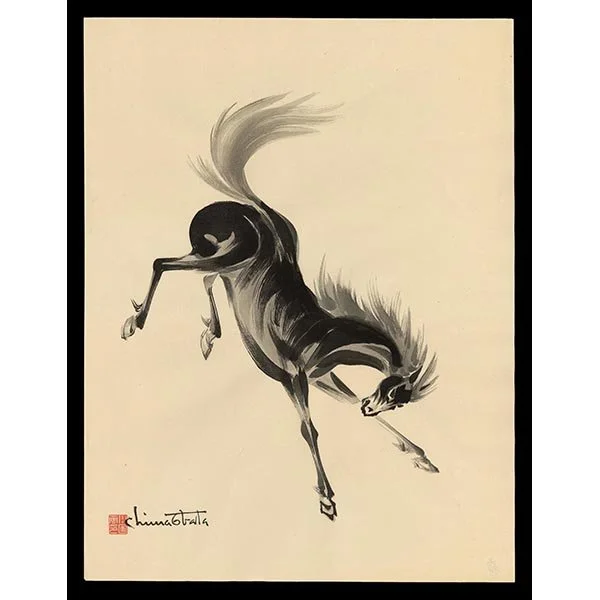
Leaping Horse (Left)
Chiura Obata (1885–1975)
DATE: 1930
MEDIUM: Woodblock Print
DIMENSIONS: 20 ½ x 15 ¼ inches
CONDITION: Excellent impression and color; no issues to note
NOTE: Brush signature and seal of the artist lower left
$800.00 <RESERVED>
Contact us to purchase