

 Image 1 of 1
Details
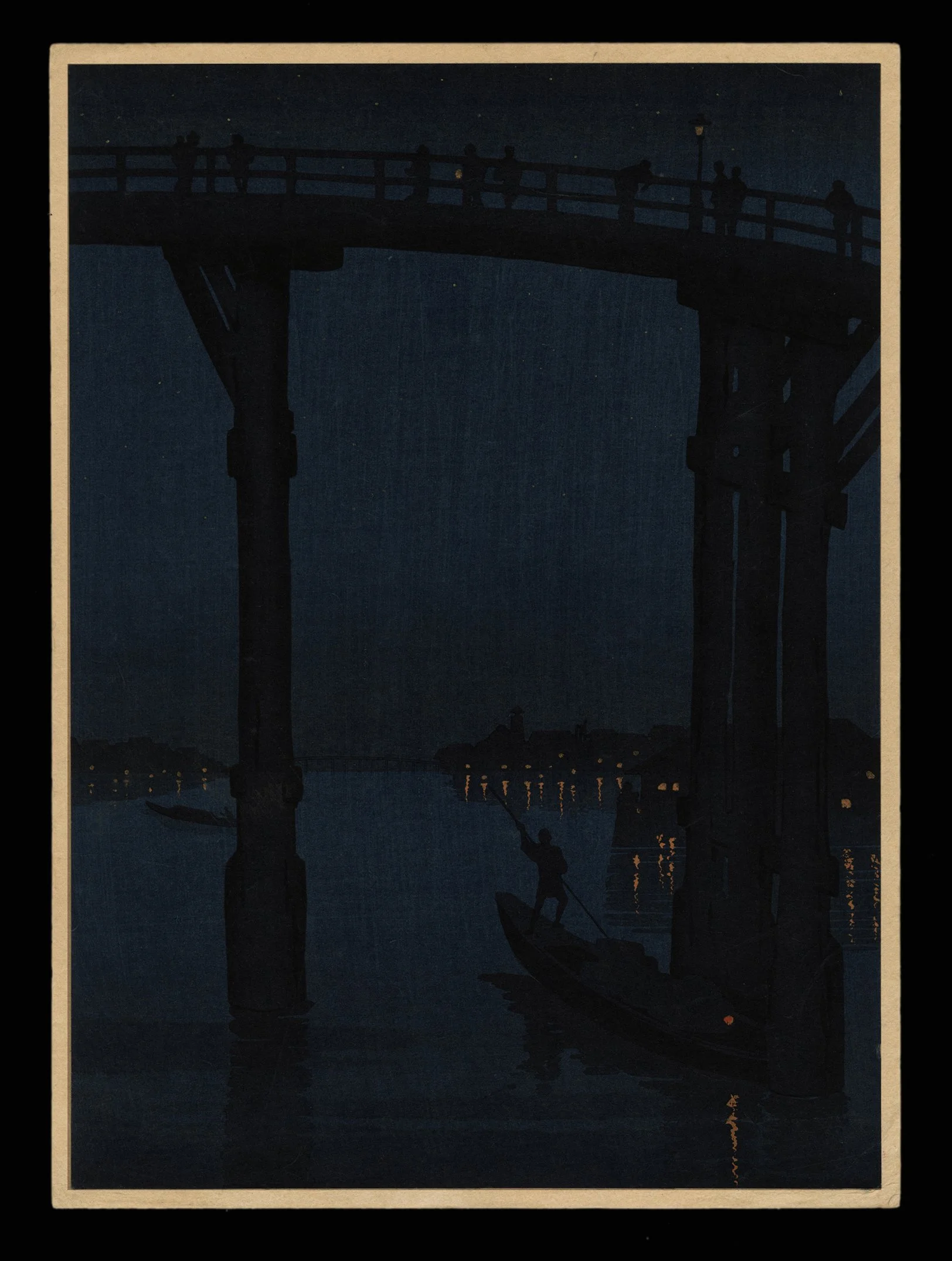
In High Bridge at Night, Eijirō Kobayashi offers a masterful composition of luminous stillness and poetic restraint. A single arched span stretches across the upper half of the composition, its silhouetted form populated by faint figures who pause in quiet observation or move across in slow procession. Below, the darkened waters of the river reflect flickering lantern lights from a distant shoreline, while a lone boatman, mid-pole, glides silently beneath the towering bridge supports.
Rendered in a monochromatic palette of deep indigos and warm glints of orange, the print evokes the still hush of night broken only by the gentle rhythm of water and passing footsteps. The perspective is bold and architectural—the vertical bridge supports framing the scene like a proscenium stage, emphasizing both the human scale and the spiritual hush of twilight.
Connoisseur's Note
High Bridge at Night was published by the Hasegawa Publishing Company as part of their Night Scenes series—an important body of work in the Shin-Hanga tradition that sought to blend Western-style atmospheric effects with traditional Japanese woodblock techniques. Kobayashi was among the leading artists of this movement, and this design exemplifies his quiet sensitivity and compositional daring.
The work pays homage to a lineage of artistic influence that stretches across continents. The nocturnal palette and sense of tonal abstraction recall the Nocturnes of James McNeill Whistler, who himself was deeply inspired by Japanese woodblock prints, especially those of Utagawa Hiroshige. Whistler’s painting of Battersea Bridge, in particular, shares with Kobayashi’s print a dramatic vertical emphasis, silhouetted structures, and the evocation of silence through space and light. This layered exchange—Japanese prints influencing Whistler, and Whistler’s vision returning full circle into Kobayashi’s work—demonstrates the rich interplay of East and West during the early 20th century.
Kobayashi’s High Bridge at Night is more than a view; it is a mood captured in wood and ink—a meditation on light, shadow, and solitude, echoing across cultures and time. Impressions from the original Hasegawa blocks are now increasingly scarce, making this work an elegant and historically resonant addition to any collection of Shin-Hanga or cross-cultural printmaking.