

 Image 1 of 1
Details
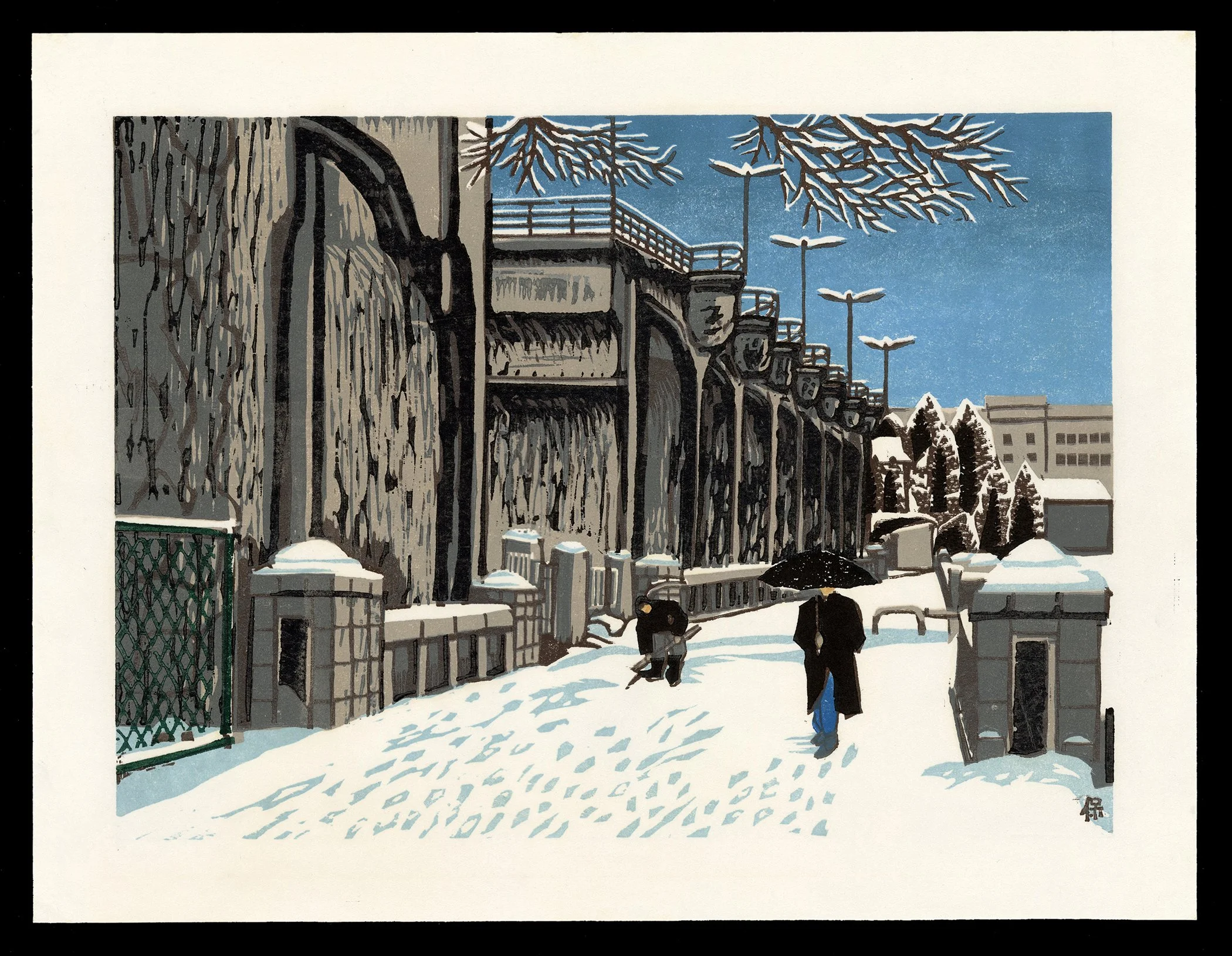
A snow-covered street curves gently alongside the imposing, rhythmic wall of the historic water gate, its façade lined with repeating supports and crowned with industrial piping. Two figures in dark coats traverse the white expanse—one standing with an umbrella flecked with snow, the other crouching as if engaged in a quiet task—adding human intimacy to the cold, geometric grandeur of the built environment.
The striking composition features Hayashi Tamotsu’s hallmark attention to urban realism, capturing mid-century Tokyo’s infrastructural legacy with the lens of a contemplative observer. The shadows on the snow, rendered in soft blue, offset the stark verticality of the gate, while branches overhead break the rigid lines with natural delicacy. Like many postwar Japanese artists, Tamotsu viewed the modern cityscape as a subject of both pride and reflection—its textures shaped not only by development but also memory and season.
Connoisseur's Note
Hayashi Tamotsu trained as an architect before turning to printmaking, and his deep understanding of spatial perspective and urban detail informs much of his oeuvre. This particular work is an exemplar of machikado hanga—prints of city corners—where overlooked intersections of infrastructure and daily life are elevated to subjects of contemplative beauty. While not formally affiliated with the Sōsaku Hanga movement, Tamotsu’s work echoes its values: self-designed, self-carved, and self-printed, each piece bears the unique hand of the artist.
Old Kamaguchi Water Gate likely depicts a now-vanished or transformed corner of Tokyo’s waterways, a nod to the city’s layered histories and ongoing change. Scarce in the market and often produced in small runs, Tamotsu’s prints remain under-recognized gems—collected by those drawn to the quiet dignity of his lines and the stillness they evoke within the hum of the metropolis.
c. 1950
$950
Old Kamaguchi Water Gate
Hayashi Tamotsu (b. 1925)
DATE: c. 1950
MEDIUM: Woodblock Print
DIMENSIONS: 12 5/8 × 16 ½ inches
CONDITION: Excellent impression, color, and condition; no issues to note
$950.00
Contact us to purchase