

 Image 1 of 1
Details
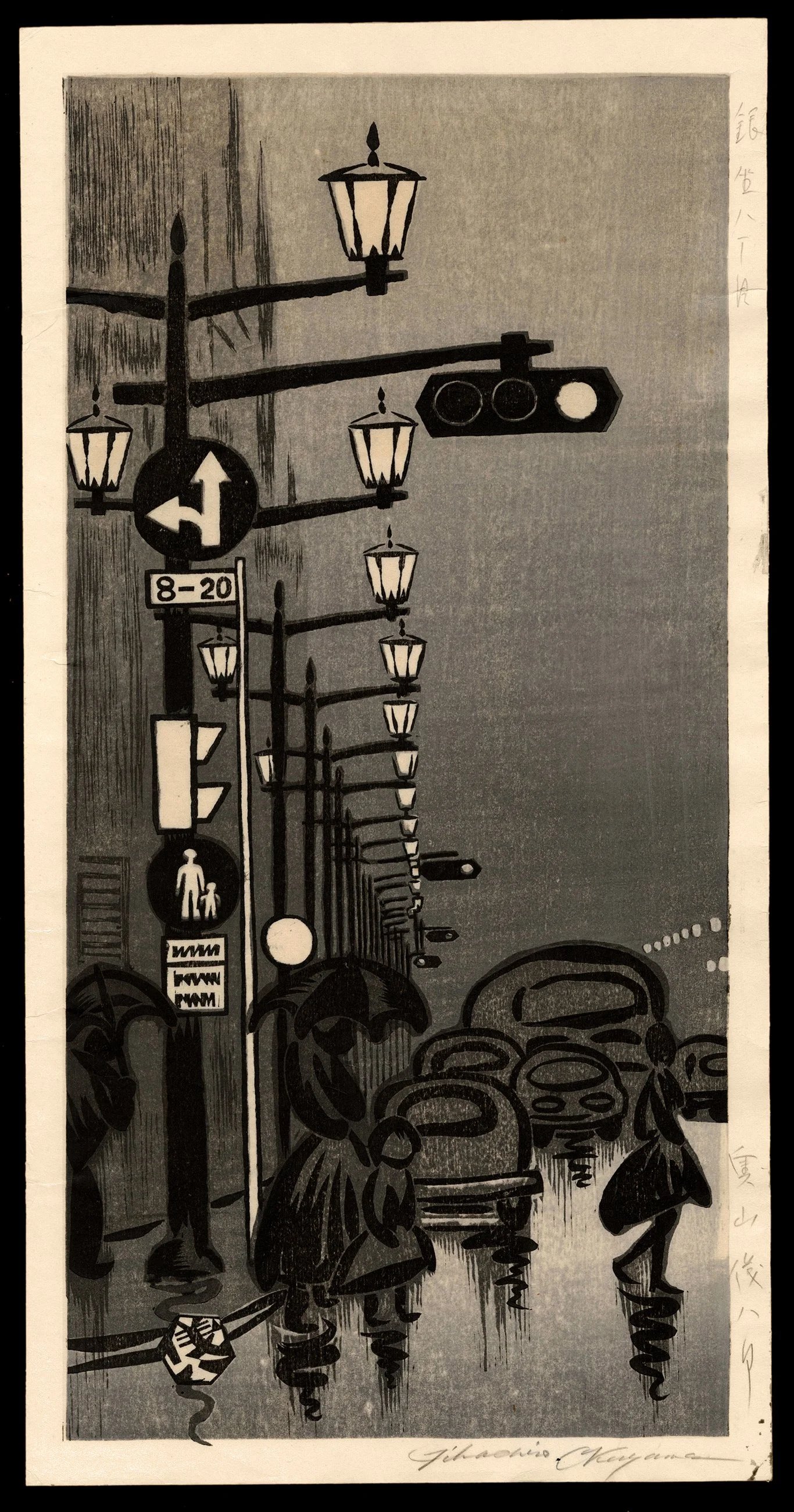
This compelling city scene by Gihachiro Okuyama captures Ginza on a damp, brooding day—its modern silhouette softened by falling rain and the low, silvery light of a winter afternoon. The print’s vertical format intensifies the linear march of streetlamps receding into the hazy distance, while the silhouette of umbrellas and the oval forms of vehicles hover like dark falling blossoms caught in mid-descent. The interplay of reflection and silhouette creates a subtle, atmospheric rhythm as pedestrians and automobiles dissolve gently into the sheen of wet pavement.
Okuyama’s work often blends the quiet harmony of traditional Japanese design with a documentary clarity of the modernizing postwar cityscape. In this image, his reverence for structure is evident in the repetition of verticals—poles, figures, lamplight—and yet the composition never feels static. A sense of introspection pervades the street: it is a moment of pause between destinations, where the still air and softened footsteps echo like memory. The glow of the lamps, caught between dusk and mist, carries a subdued lyricism in its muted procession.
Connoisseur's Note
Okuyama, an artist who straddled the Shin-Hanga and Sosaku Hanga movements, frequently depicted modernizing cityscapes with the gravitas of traditional Japanese aesthetics. Here, his eye for architectural rhythm meets an emotional quietude reminiscent of sabi—the beauty of aging and transience. The design suggests both movement and stasis: umbrellas tilt forward with momentum, yet the scene is suffused with stillness. His decision to leave much of the sky uncarved allows the subtle gray gradient to float like breath, balancing modern urban energy with subdued serenity.
This impression is one of the earliest states of the design, identifiable by the bold tonal contrast throughout the composition—particularly in the gray-black layering that gives depth to the lamplight and figures. Later editions of this print tend to appear with more subdued inking and flatter tonal range. Most notably, this impression bears the artist’s hand-signed pencil signature in the bottom margin—further confirming its early provenance and its appeal to serious collectors of postwar Japanese modernism.