

 Image 1 of 1
Details
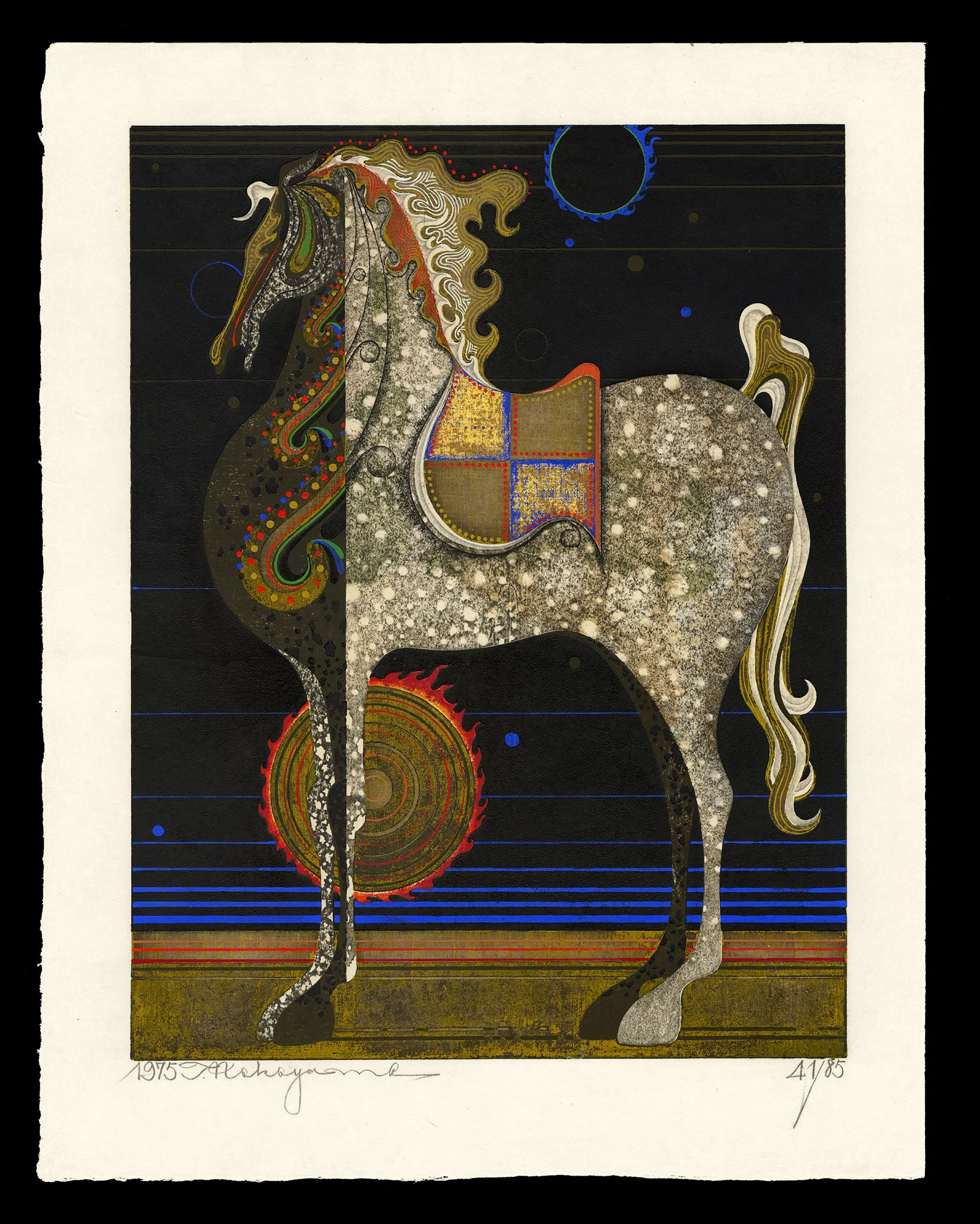
In Riding Horse in the Afternoon, C, Tadashi Nakayama creates a stunning vision of timeless elegance—a regal horse rendered in intricate line and radiant color, poised in an otherworldly space. Nakayama’s hallmark layering of detailed patterns, glistening textures, and complex color harmonies is on full display. The flowing mane, a tapestry of golds, reds, and silvers, unfurls in rhythmic, almost musical undulations, while the body is divided into richly textured fields that shimmer with subtle metallic tones.
The influence of Byzantine art is unmistakable. Like the jeweled mosaics of Ravenna or Constantinople, Nakayama’s surface shimmers with an inner light—the result of meticulous layering of metallic pigments, mica powders, and fine woodblock impressions. This jewel-like quality imparts an aura of sanctity to the figure, elevating the horse from mere subject to mythic symbol. The deep cosmic background, studded with celestial bodies and crossed by vivid blue bands, furthers the sense of a timeless, sacred space.
Connoisseur's Note
Nakayama’s lifelong fascination with the Silk Road, Persian miniatures, and Buddhist ornamentation finds in Riding Horse in the Afternoon, C a resplendent synthesis. Yet it is his subtle incorporation of Byzantine mosaic aesthetics—the intricate patterning, and the saturated brilliance of color—that distinguishes this work among his horse series.
Here, the horse becomes a cosmic voyager, an eternal being inhabiting a world where East and West, ancient and modern, mysticism and formality converge. Nakayama’s technical virtuosity—his masterful control of metallic and mica-infused inks—imbues the print with a luminosity that shifts with the viewer’s movement, much like the flicker of light across a Byzantine tesserae surface.
More prints by Tadashi Nakayama:
1977
$3,000
Riding Horse in the Afternoon, C
Tadashi Nakayama (1927–2014)
EDITION: 44/85
DATE: 1977
MEDIUM: Woodblock Print
DIMENSIONS: 28 ¼ x 22 inches
CONDITION: Excellent impression and color; no issues to note
NOTE: Gold and bronze metallic pigments
$3,000.00
Contact us to purchase