

 Image 1 of 1
Details
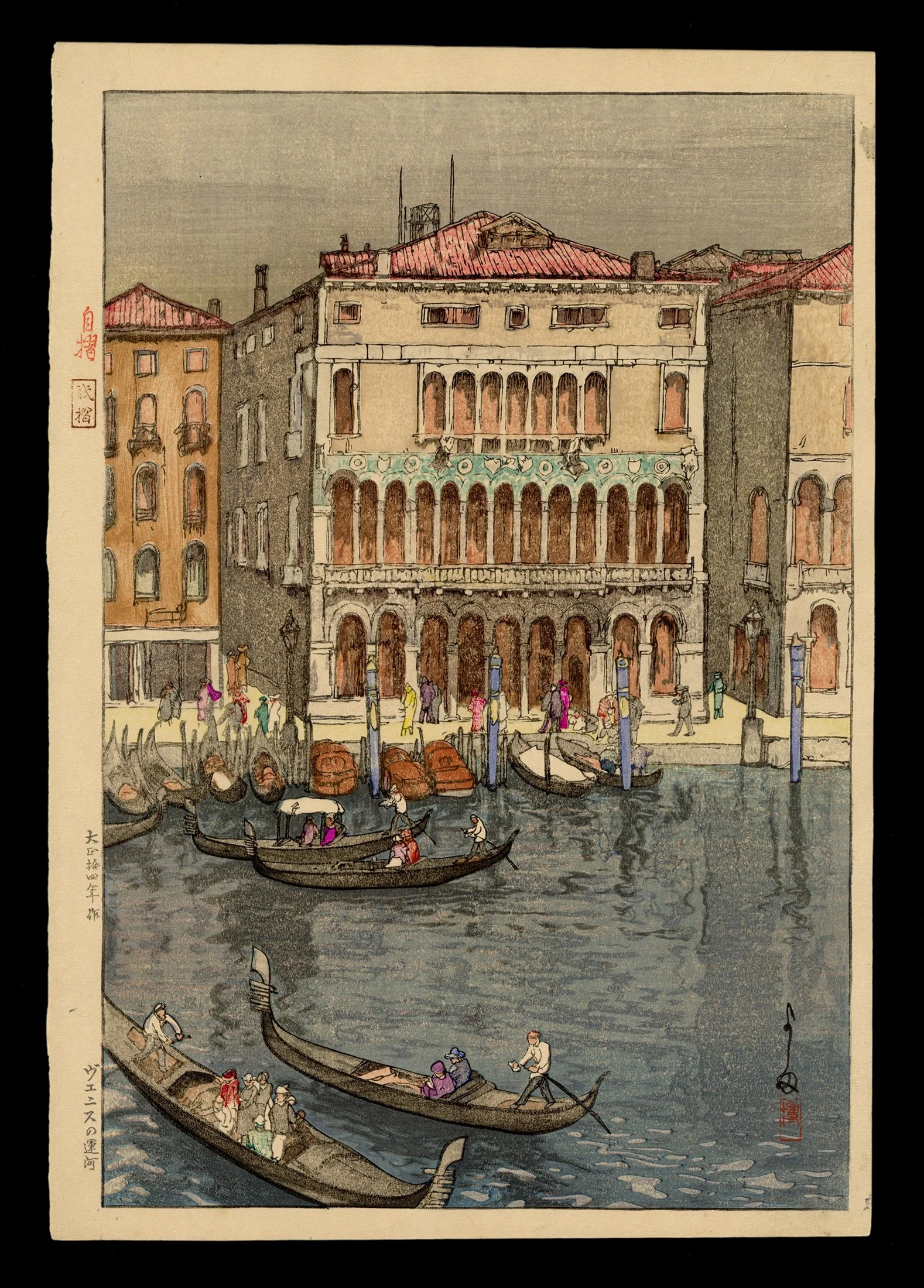
In Venice, Hiroshi Yoshida renders the timeless pageantry of the Grand Canal with the precision of an architect and the lyricism of a traveler enchanted. The composition centers on the elegant Ca’ d’Oro palace, its Venetian Gothic façade softened by atmosphere and reflection. Gondolas drift across the canal’s silken surface, bearing visitors past this living museum of stone and water. Yoshida’s deft use of line and tone evokes the meditative rhythm of oar-strokes and footsteps, as the palette moves from warm umbers and salmon reds to cool silvers and lavender greys.
Executed in 1925 during the artist’s extensive European tour, Venice demonstrates Yoshida’s mastery in bridging East and West. The composition employs linear perspective learned from Western models, yet the color harmonies and restrained elegance reflect a deeply Japanese sensitivity. Every architectural detail—arcade, balustrade, cornice—is softened by a veil of moisture and light, echoing the Japanese ideal of keshiki, or mood. The figures are gestural, animated yet anonymous, lending the scene a timeless serenity.
Connoisseur's Note
This particular impression is a rare trial proof, executed in a variant color scheme that departs notably from the more commonly issued version. The color palette here is subtler, more muted with pops of brighter tones of color, enhancing a sense of diffuse light and atmospheric depth. The textures of both water and masonry emerge with heightened clarity, suggesting Yoshida’s experimental concern with how color, ink density, and surface interact. This gives the print a tactile quality absent in later standard editions—subtle shading in the gondolas, a granular wash to the building façades, and a silken shimmer across the canal.
The presence of the jizuri seal affirms that this proof was produced under Yoshida’s direct supervision, a further marker of its rarity and artistic fidelity. For collectors and scholars of Shin Hanga, this impression offers an unusually intimate glimpse into Yoshida’s creative process: not merely a record of place, but a dialogue between technique and perception. It stands as both a work of finished beauty and a document of exploration—a Venetian scene seen through the precise, contemplative eye of a Japanese master abroad.
More prints by Hiroshi Yoshida:


1927
$35,000
Hodakayama After Rain
Hiroshi Yoshida (1876-1950)
DATE: 1927
MEDIUM: Woodblock Print
DIMENSIONS: 23 3/4 x 31 1/2 inches
CONDITION: Excellent; faint abrasion at the margins
LITERATURE: Ogura, Yoshida Hiroshi Zenhangashu (The Complete Woodblock Prints of Hiroshi Yoshida), Abe Shuppan, Tokyo, 1987, pl. 99
$35,000.00
Contact us to purchase