

 Image 1 of 1
Details
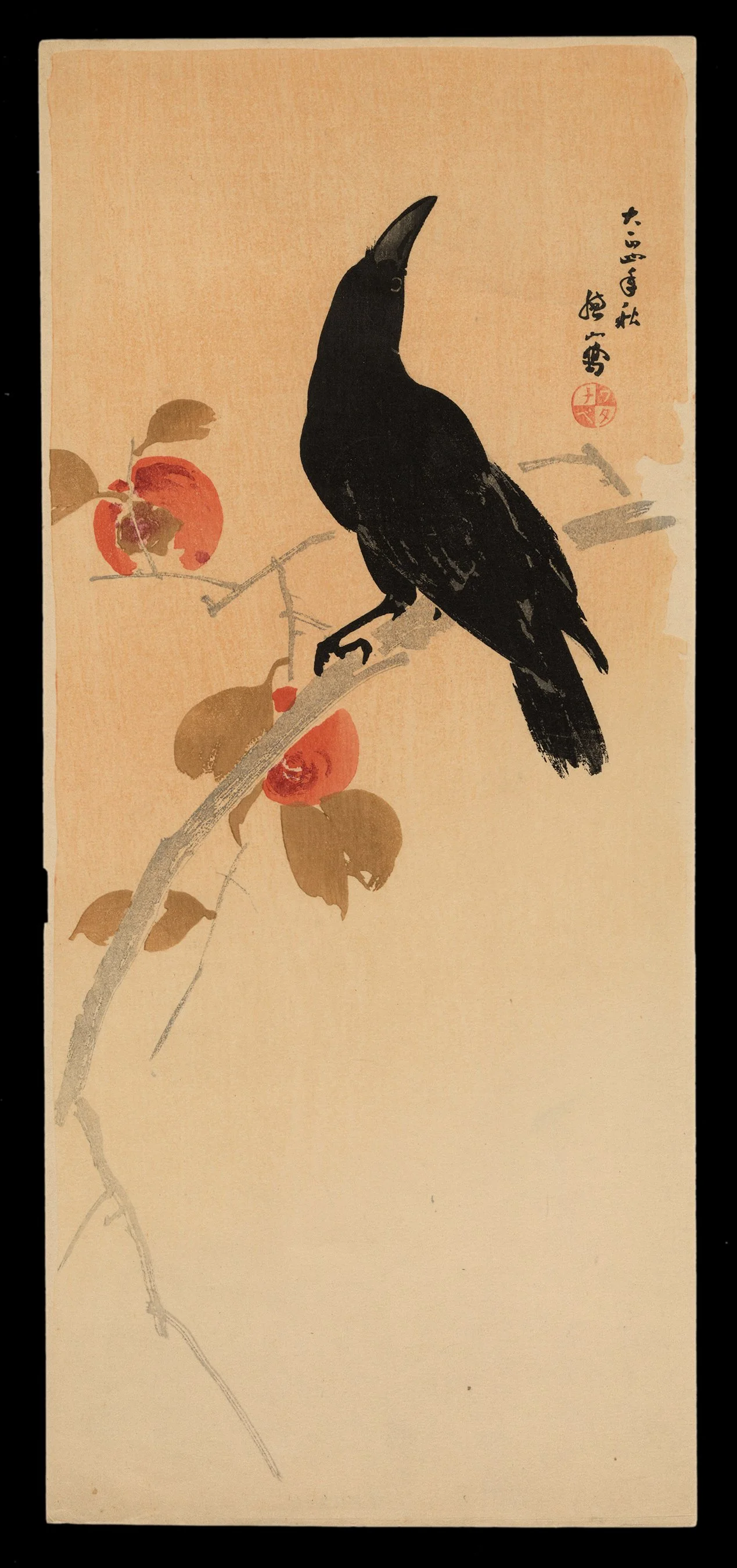
In Persimmon and Crow, Ito Sozan distills a fleeting seasonal moment into an elegant and minimal composition. A solitary crow perches confidently on a gnarled persimmon branch, its matte black form a dramatic contrast against the warm, glowing background and the soft red-orange fruit. The bird’s posture is alert yet still, its beak slightly raised, as though attuned to distant sound or movement.
The persimmon’s round, ripening fruit and gently curling leaves are rendered in earthy, restrained tones, while the background is suffused with a pale orange wash that evokes the fading warmth of autumn light. Sozan’s elegant sense of line and space allows the subject to breathe—each element suspended in a quiet balance between nature and silence.
Connoisseur's Note
This early work by Ito Sozan was published by Watanabe Shozaburo during the first flowering of the Shin Hanga movement, and it showcases the artist’s gift for understated kacho-e (bird-and-flower prints). This particular impression is a rare and pristine example of the design, retaining the soft, subtle light-orange background wash that has typically faded in most surviving copies. The delicate tonal field behind the crow is essential to the mood of the composition, casting a warmth that gently offsets the stark black of the bird and the cool gray of the branch.
This impression also bears the large, round Watanabe seal in red—an early pre-earthquake publisher’s mark used before the destruction of Watanabe’s Tokyo workshop during the Great Kantō Earthquake of 1923. Adding to its rarity, the print is preserved as an uncut sheet with the original kento (registration notch) visible in the left margin—evidence of its early printing.
As with many of Sozan’s most successful works, Persimmon and Crow is a fine example in compositional simplicity, natural observation, and technical refinement. It stands as a quiet but powerful testament to the early years of Shin Hanga—before catastrophe reshaped the studios and sensibilities of modern Japanese printmaking.