

 Image 1 of 1
Details
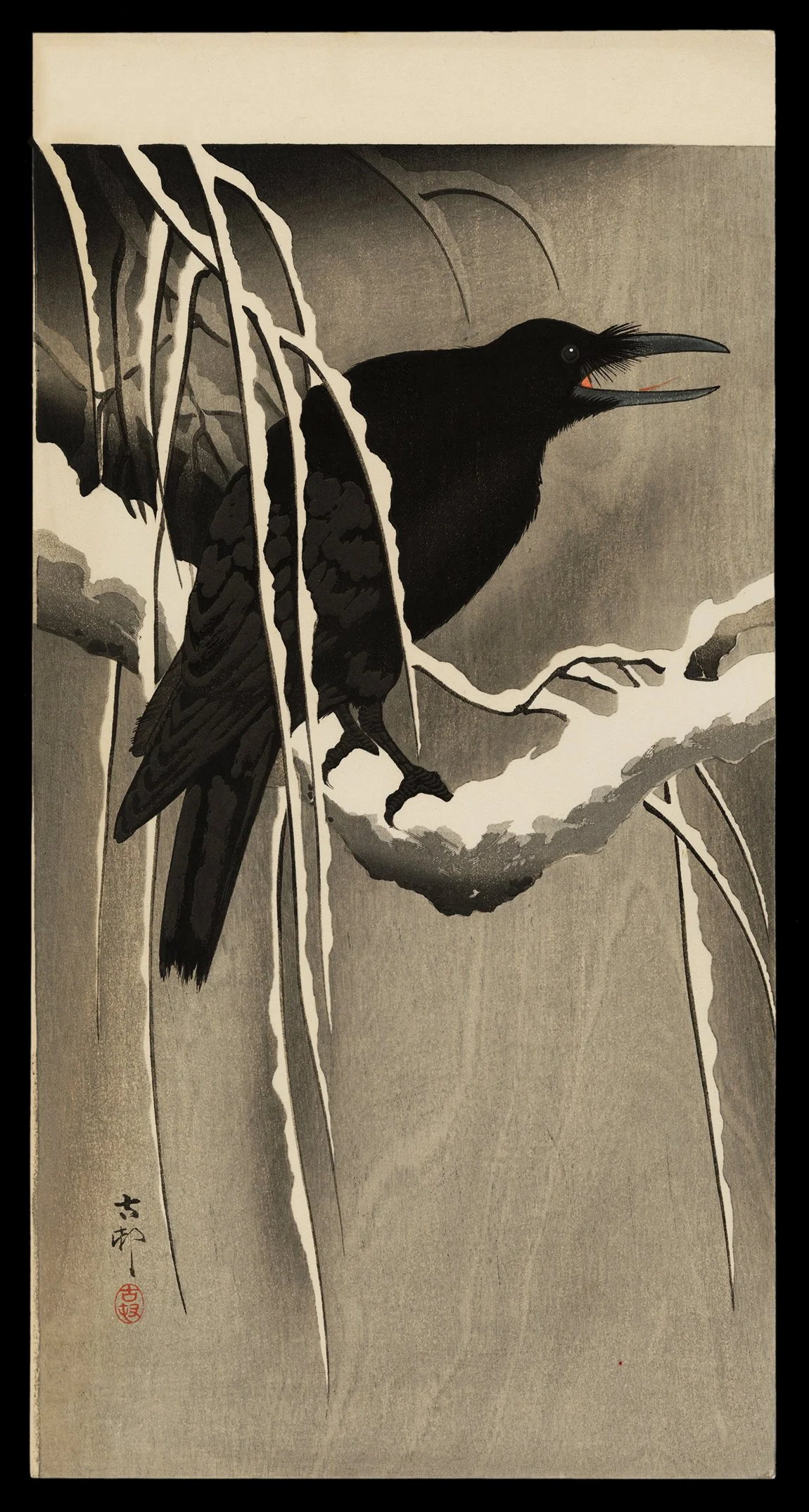
In this masterfully restrained print, Ohara Koson captures the solitary presence of a crow perched among snow-laden branches. Rendered in a palette of muted greys, deep blacks, and soft whites, the composition evokes both stillness and latent energy. The vertical icicles and angular limbs introduce a tension broken only by the crow’s open beak—a silent caw suspended in the hush of snowfall.
Koson’s exceptional handling of black is evident in the treatment of the feathers, which shimmer with layered pigments. Notably, the printer applied a lacquer-like ink to certain areas of the plumage, producing a visual texture that mimics the oily iridescence of real crow feathers. This subtle interplay of matte and gloss adds dimension to an otherwise flattened pictorial space, a hallmark of Shin Hanga refinement.
Connoisseur’s Note
Crows in Japanese culture often represent messengers or mediators—between the worlds of gods and men, the living and the dead. Their appearance in snowy landscapes adds a layer of poetic ambiguity: a creature of shadow against the purity of snow, resilient amidst the quietude of winter. In Shinto and Buddhist lore, crows can also embody divine intervention or serve as agents of change, echoing nature’s cycle of death and rebirth.
Koson, a prominent figure in the Shin Hanga movement, devoted much of his career to kachō-ga—pictures of birds and flowers. Yet in prints such as this, his compositions transcend mere naturalism, becoming contemplative studies of form, mood, and fleeting beauty. The solitary crow, rendered with reverence and quiet drama, invites the viewer into an emotional terrain shaped by both nature and memory—a perfect embodiment of the aesthetic of sabi, the beauty of solitude and impermanence.
More prints by Ohara Koson:


20th Century
$1,200
Peacock on a Bough of Pine Tree
Ohara Koson (1877-1945)
MEDIUM: Woodblock Print
DATE: 20th Century
DIMENSIONS: 14 ¼ x 7 ½ inches
CONDITION: No condition problems to note
LITERATURE: Amy Newland et al., Crows, Cranes & Camellias: The Natural World of Ohara Koson 1877-1945, 2001, Cat K38.18
$1,200.00
Contact us to Purchase