

 Image 1 of 1
Details
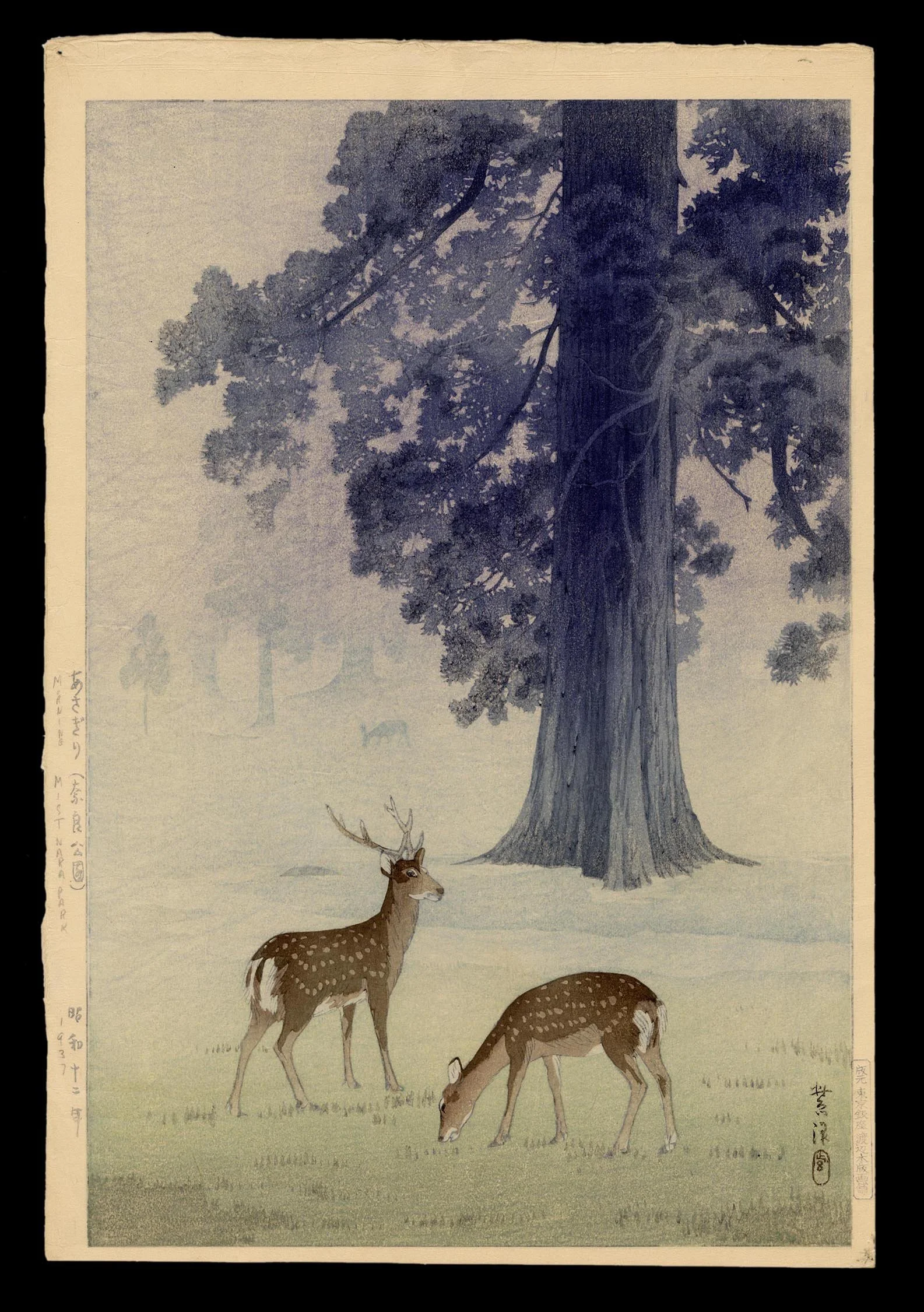
In Morning Mist at Nara Park, Kasamatsu Shiro evokes a world suspended between waking and dream, where two deer graze in silent communion beneath the ancient trees. Executed in 1937, this work belongs to Shiro’s early period with publisher Watanabe Shōzaburō and demonstrates the artist’s gift for distilling mood through economy of form. The vertical trunk dominates the composition like a sacred pillar, while the soft veil of mist envelops the landscape in near-monochrome washes of blue and violet-grey.
The deer—emblems of Shinto purity and divine messengers according to tradition—appear with naturalistic gentleness, their dappled coats rendered in delicate contrast to the cool air that surrounds them. Behind them, a third form emerges faintly from the fog, as if to remind us that this park, and its sacred grove, belongs as much to myth as to morning. The silence of the image is profound, its stillness a meditation on both presence and absence.
Connoisseur's Note
Kasamatsu Shiro (1898–1991), a student of Kaburagi Kiyokata, was a central figure in the Shin-Hanga movement, which sought to revitalize traditional woodblock printing with the sensibilities of modern Japanese life and landscape. In this print, Shiro seamlessly merges the reverence of traditional Nara—a city deeply embedded in both Shinto and Buddhist spiritual heritage—with the modern taste for atmospheric realism.
The precision of the carving and the nuanced bokashi (gradation) in the mist exemplify the technical excellence achieved by Watanabe’s workshop. Yet it is Shiro’s compositional restraint and poetic tone that elevate the scene beyond illustration. This print offers not only an image of Nara, but a quiet evocation of the sacred: where animals and landscape alike are rendered with the dignity of icons. For collectors of Shin-Hanga, Morning Mist at Nara Park stands as a luminous example of the genre’s ability to hold reverence and realism in perfect balance.
More prints by Kasanatsu Shiro:
1964
$1,500
Waterfall
Kasamatsu Shiro (1898–1991)
EDITION: 42/100
MEDIUM: Woodblock Print
DATE: 1964
DIMENSIONS: 16 5/8 × 11 ¼ inches
CONDITION: Excellent color and impression; no problems to note
NOTE: Self-carved and self-printed
$1,500.00
Contact us to purchase