

 Image 1 of 1
Details
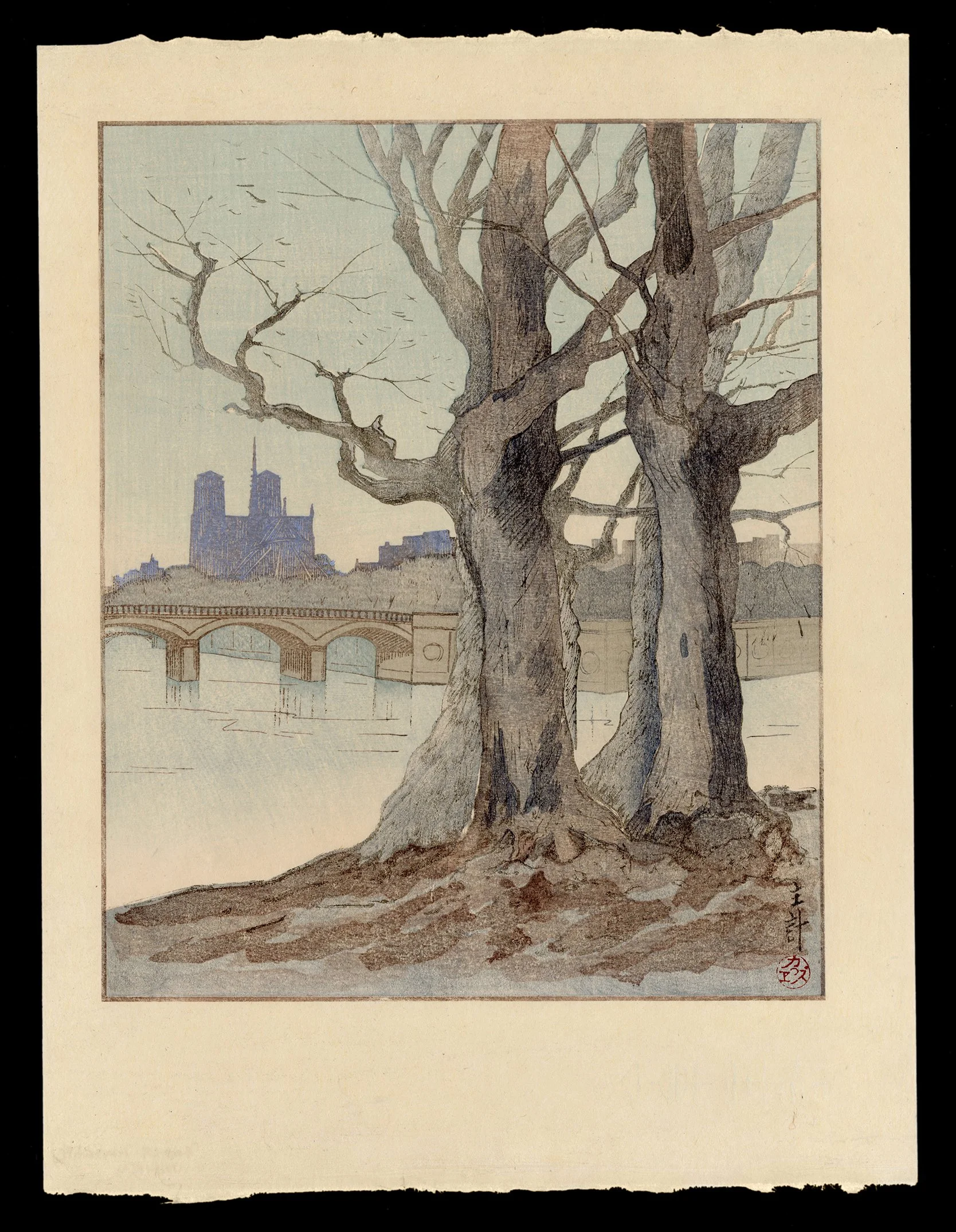
Two great plane trees rise like weathered sentinels on the banks of the Seine, their limbs bare and reaching, echoing the tracery of winter branches drawn in ink and memory. Behind them, softened by distance and atmospheric hush, the towers of Notre Dame emerge like a fading dream, their silhouette tinged in twilight lavender—a gentle whisper of stone and reverence. The bridge that spans the river cuts across the middle ground with architectural grace, its arches mirrored faintly in the rippling current below.
Yamagishi’s touch is both precise and evocative: bark rendered in delicate gradations of grey and ochre, riverbank in tones of umber and soft rust. The negative space—sky, water, and city haze—is not emptiness, but breath, a pause that amplifies the presence of things. The composition is balanced yet asymmetrical, allowing nature to loom large in the foreground while Paris recedes, as if observed through a quiet veil of memory Here, line and wash whisper rather than declare, suggesting not only the chill of early spring but also a deeper stillness—the stillness of a traveler halted, absorbing a foreign city's soul with the inward gaze of one shaped by Japanese aesthetics. It is a landscape both distant and intimate, where time slows and the eye lingers.
Executed circa 1930, this work emerges from Yamagishi’s European sojourn (1926–1929), undertaken at the behest of Japan’s Ministry of Education. During this period, he traversed the West as both an ambassador of traditional Japanese woodblock technique and a curious observer of foreign aesthetics. The bridge and buildings depicted here may reflect his appreciation of Western symmetry, yet the compositional restraint—bare limbs of winter trees, the reduction of detail to form—remains deeply rooted in Japanese artistic consciousness.
Connoisseur's Note
Yamagishi Kazue occupies a fascinating dual role within 20th-century Japanese printmaking: the consummate carver of Shin-Hanga masterpieces and, simultaneously, a self-directed artist of the Sōsaku-Hanga movement. That this print was both carved and printed by the artist himself is no mere footnote—it places this image within the lineage of creative independence that underpinned Sōsaku-Hanga ideals. In its quiet composure and delicately controlled linework, Notre Dame from the Banks of the Seine embodies a rare synthesis of discipline and lyricism.
There is, too, a philosophical subtlety present in this view. The trees—leafless, weathered—echo wabi in their noble imperfection. The cathedral, its form muted, becomes less a monument than a memory: distant, softened by time and atmosphere. As a document of travel, this print transcends mere record. It is a meditation on the foreign through the lens of the familiar; a Japanese printmaker seeing Paris not as a European tourist might, but through the reverent eyes of a carver attuned to the spirit of line and space.
c. 1930
$3,000
Notre Dame from the Banks of the Seine
Kazue Yamagishi (1891-1984)
DATE: c. 1930
MEDIUM: Woodblock Print
DIMENSIONS: 16 ¾ x 12 ½ inches
CONDITION: Excellent impression and color; no problems to note
$3,000.00
Contact us to purchase