

 Image 1 of 1
Details
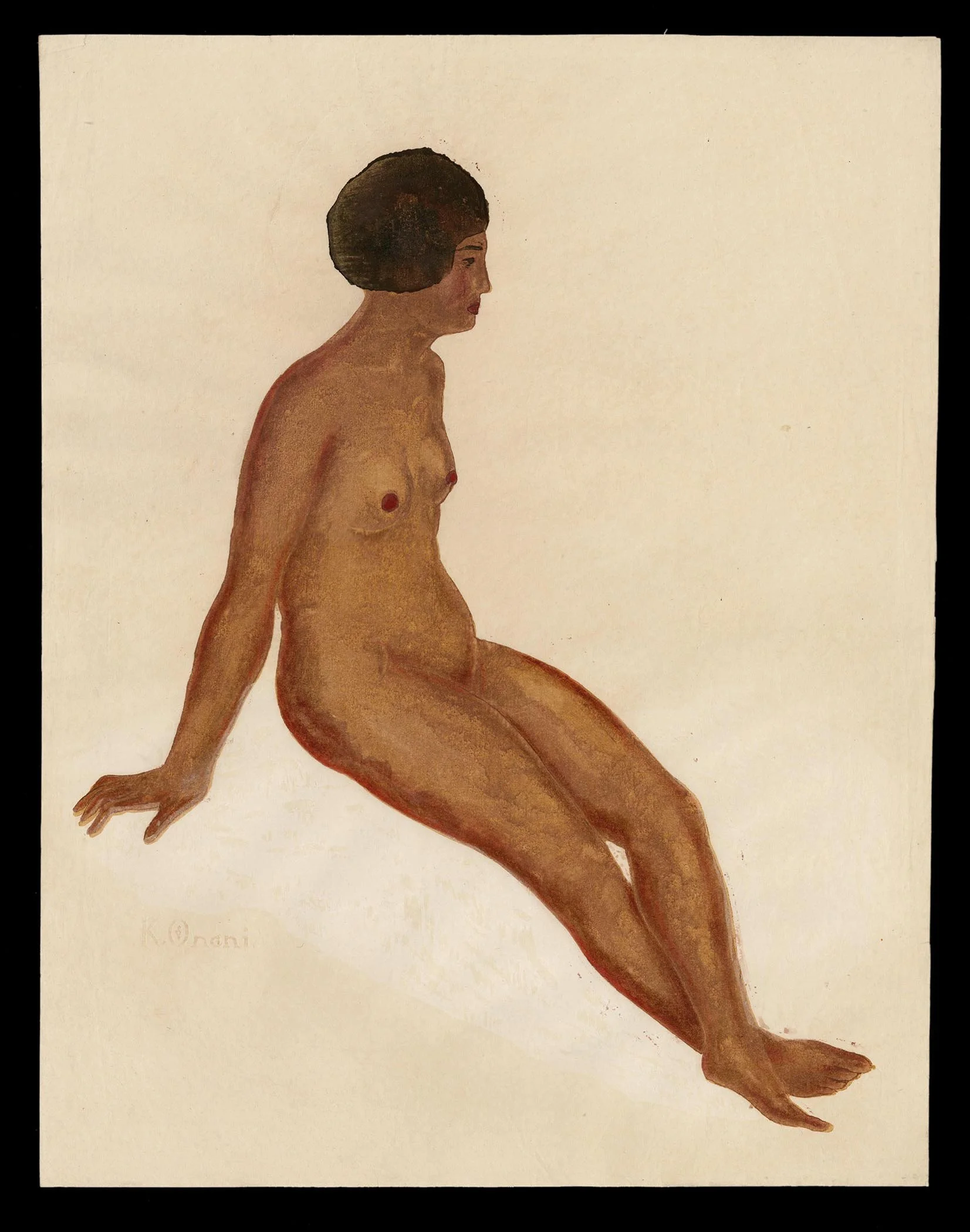
In Rest, Koshiro Onchi presents a nude young woman seated upon a white cloth, her body shown in profile against an almost entirely unarticulated ground. One arm extends behind her for support while her legs reach forward in an attitude of casual repose. The composition is remarkably spare: the warm, earthy modeling of the figure, the dark mass of her cropped hair, and the broad expanse of pale paper provide nearly all of the work’s visual structure. The absence of conventional surroundings gives the image an unusual intimacy and directs attention toward the sitter herself.
The woman can be understood as a moga, or “modern girl,” one of the defining cultural figures of urban Japan during the 1920s and early 1930s. Emerging alongside the cafés, cinemas, department stores, dance halls, illustrated magazines, and fashionable streets of Japan’s expanding cities, the moga represented a distinctly new vision of Japanese femininity. Her Western-influenced clothing, bobbed hair, greater social visibility, and perceived independence made her both an embodiment of cosmopolitan modernity and a subject of considerable contemporary fascination and debate.
Onchi’s sitter possesses one of the moga’s most recognizable attributes: the fashionable short bob. Yet he removes virtually every other external signifier of modern urban life. There is no fashionable dress, café interior, cigarette, or bustling Ginza street. Instead, the woman is presented nude and alone. Modernity is consequently expressed not through accessories but through her physical presence—the cropped hair, relaxed posture, and striking sense of bodily self-possession.
This distinction gives Rest much of its psychological power. The moga was frequently represented in the popular visual culture of the period as a public spectacle: fashionable, conspicuous, and emblematic of rapidly changing social behavior. Onchi instead turns inward. His woman appears neither theatrical nor coquettish. Her nudity is treated with an unusual directness and restraint, and her pose suggests neither an academic studio exercise nor an overtly eroticized presentation. She simply occupies the space.
The print is equally revealing of the broader artistic zeitgeist of the 1920s and 1930s, when Japanese artists were negotiating an increasingly complex relationship between inherited aesthetic traditions and international modernism. Onchi, one of the central figures of the sōsaku hanga movement, was particularly receptive to modern modes of expression. Here the figure is modeled through softened contours and broad, muted passages of brown, ochre, and red rather than through exacting academic description. The dark, almost geometric shape of the bobbed hair provides a powerful visual counterweight to the elongated sweep of the body.
Especially effective is Onchi’s use of empty space. The white cloth beneath the woman nearly disappears into the surrounding paper, so that the figure seems suspended within a luminous, undefined field. This deliberate lack of setting moves the image away from anecdote and toward something more distilled. The sitter becomes at once an individual woman and an emblem of a changing age.
Created in 1928, Rest captures a moment when ideas surrounding femininity, sexuality, personal freedom, fashion, and artistic expression were being reconsidered with extraordinary speed. Onchi takes one of the most recognizable figures of interwar Japanese modernity—the moga—and removes her from the public arena. What remains is a quieter and more contemplative vision of the modern woman: independent, corporeal, and entirely present.
Connoisseur’s Note
This particular impression is especially compelling as a rare self-printed work by Onchi, in which the act of printing becomes an integral part of the image. The impression displays the artist’s spontaneous, almost wet-like printing technique, with subtle variations of pigment lending warmth and animation to the woman’s body. A delicate splatter remains visible across the paper surrounding the figure—a wonderfully immediate trace of Onchi’s working process that reinforces the experimental and distinctly handmade character of the print.
These qualities also distinguish this impression from known examples in the Honolulu Museum of Art and the British Museum. Here, the nuanced modulation of color and softly shifting passages across the flesh give the sitter an unusually life-like presence; she appears less as a printed silhouette than as a body emerging gradually from pigment and paper. Such impression-to-impression variation is central to appreciating Onchi as a creative printmaker, for whom printing was not simply a means of reproducing an established design but an expressive act in itself. In Rest, the immediacy of the artist’s own printing, combined with the quintessentially modern moga subject, makes this impression a particularly evocative and desirable expression of Onchi’s art.
More prints by Koshiro Onchi:
1928
$20,000
REST
Koshiro Onchi (1891–1955)
MEDIUM: Woodblock print
DATE: 1928
DIMENSIONS: 18 1/8 × 14 1/8 inches
CONDITION: Excellent, no problems to note
LITERATURE: Prints of Onchi Koshiro, Tokyo: Keishosha, 1975, pl. 118
$20,000.00