

 Image 1 of 1
Details
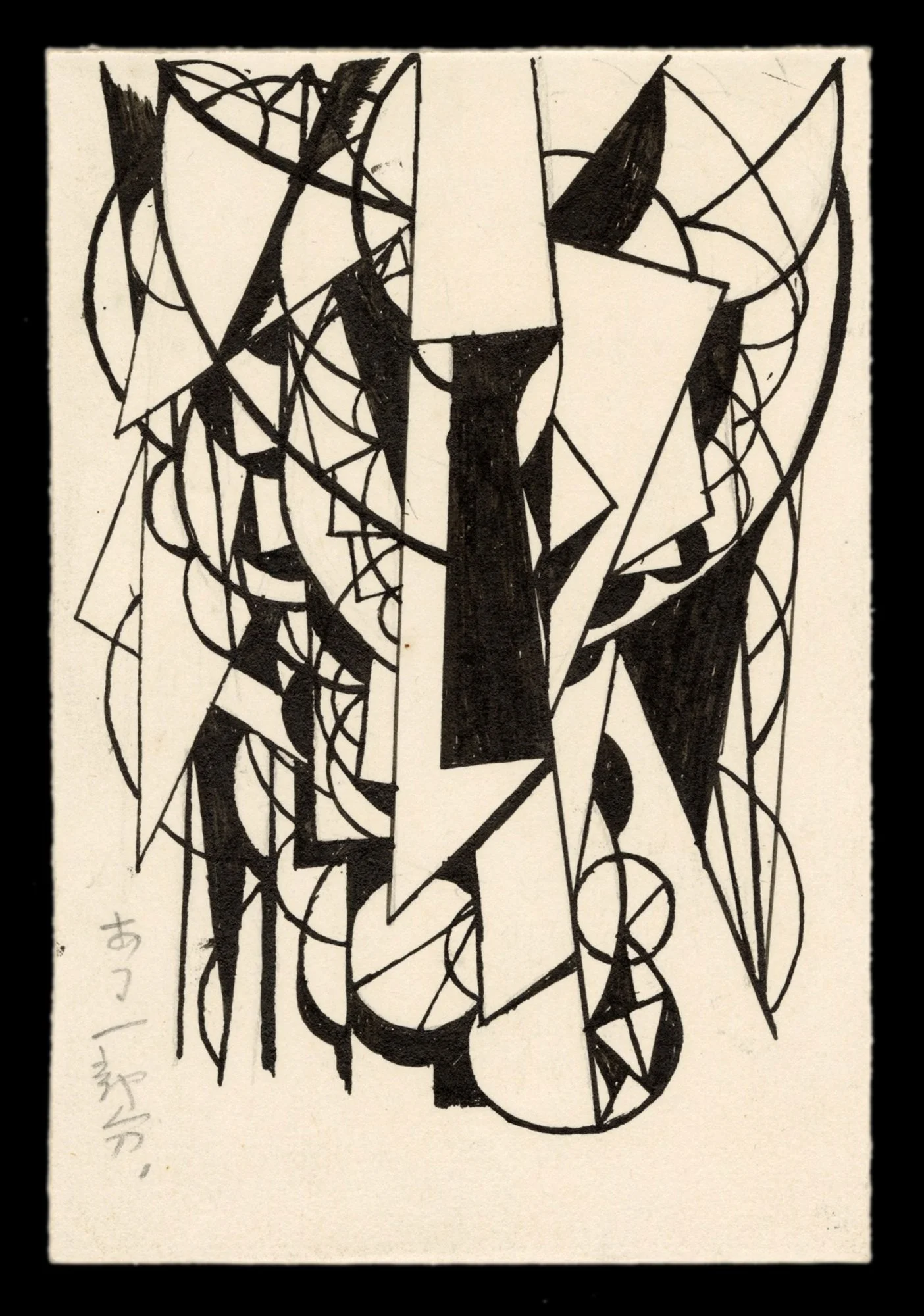
This untitled work by Onchi Koshiro represents a pivotal moment in the evolution of Japanese modernism—an early and earnest inquiry into pure abstraction by one of its most visionary practitioners. Composed around 1918, the drawing is part of a small, exploratory series in which Onchi investigated the dynamic possibilities of form, structure, and rhythm using only black ink and negative space. The work hums with a kinetic intensity, its planes, arcs, and intersections suggesting movement, emotion, and inner geometry unbound by figuration.
Unlike the narrative or representational traditions of earlier Japanese draftsmanship, this composition embraces a language of form rooted in modernist experimentation. Interlocking curves and jagged diagonals converge and break across the surface, creating tension and balance in equal measure. There is no single focal point—only an invitation to engage visually with the compositional field in its totality, evoking not what is seen, but what is felt.
Connoisseur's Note
This drawing, executed while Onchi was in his late twenties, reflects his early exposure to and absorption of European modernist currents—Futurism, Cubism, and Expressionism—filtered through his uniquely Japanese sensibility. It predates his more widely known abstract prints and photographic experiments of the 1930s and 1940s, offering rare insight into the genesis of his abstract language. The work is not preparatory, but complete in its own logic—an autonomous graphic statement crafted with surgical line and compositional intent.
For collectors and scholars of the Sosaku Hanga movement, this drawing holds particular resonance. It embodies the intellectual spirit of self-expression (jiga) that would come to define the movement, while eschewing both Western imitation and traditional Japanese motifs. As such, it stands as a bridge between Onchi’s early graphic explorations and his later role as the father of Japanese abstract printmaking—a quietly radical work born from ink, discipline, and a restless desire to invent.
More prints by Kiyoshi Saito:
1938
$3,000
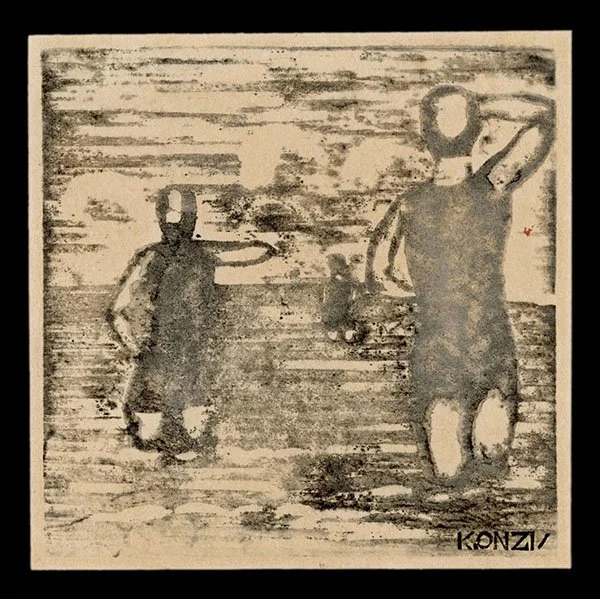
Yuigahama Beach, Kamaura
Koshiro Onchi (1891–1955)
SERIES: New 100 Scenic Views of Japan
MEDIUM: Woodblock print
DATE: 1938
DIMENSIONS: 9 x 12 ¼ inches
CONDITION: Excellent, no problems to note
$3,000.00