

 Image 1 of 1
Details
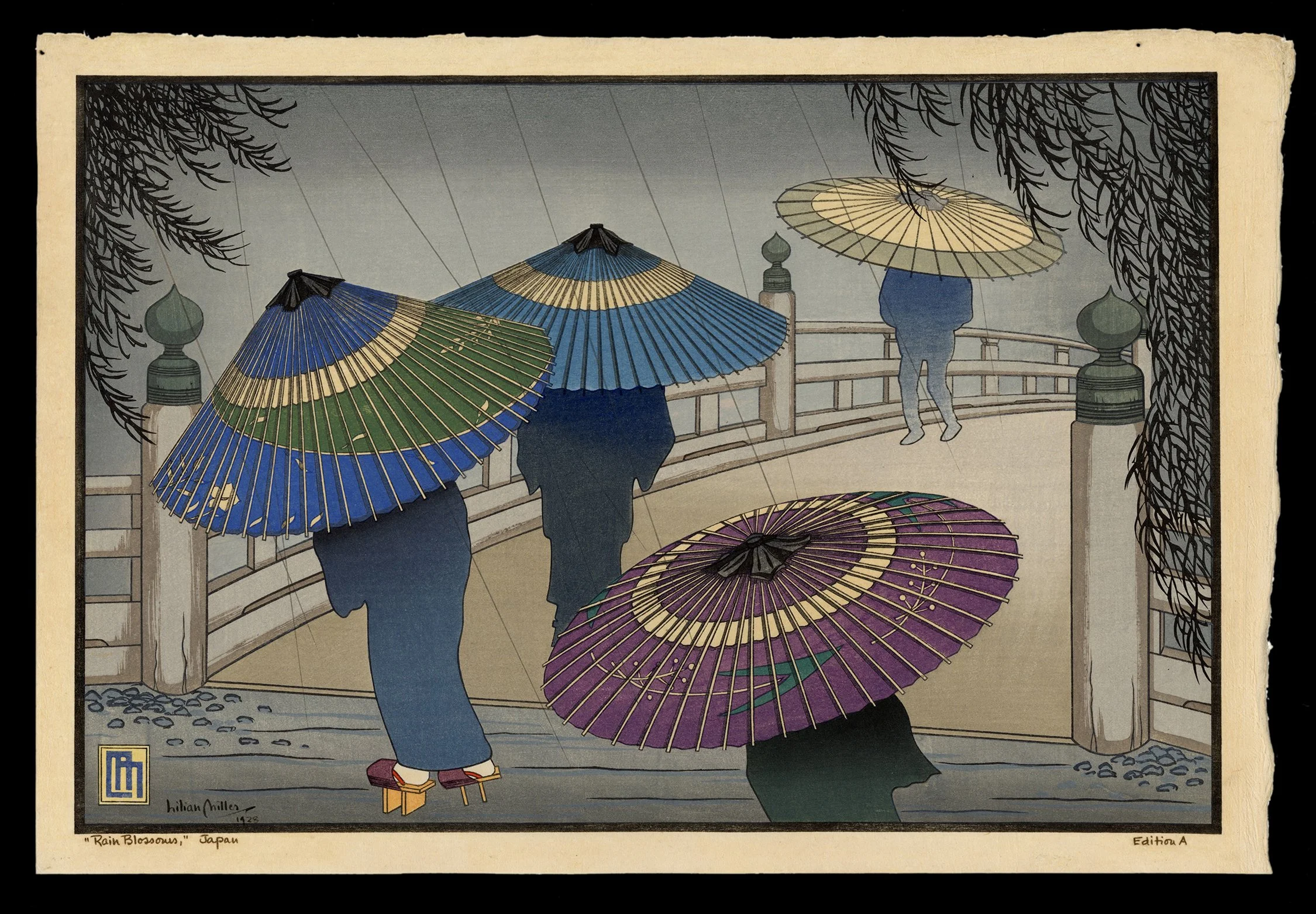
Rain Blossom A is among Lillian Miller’s most celebrated designs, a quietly lyrical study in seasonal nuance and tonal harmony. Produced in 1928, the composition depicts four figures crossing a bridge beneath the soft touch of spring rain, each shielded beneath the spread of a Japanese parasol—elegant, graphic forms that bloom like chrysanthemums in the muted weather. The print’s title is itself poetic, suggesting not merely protection from rain but a blossoming because of it—resilience, grace, and ephemeral beauty expressed through the simplest gesture.
This particular impression, known as Edition A, is defined by its rich and varied palette: a deep violet umbrella in the foreground, cerulean and jade greens to the left, and a pale butter yellow umbrella poised above a figure at the bridge’s edge. A framing tangle of willow branches offers a subtle sense of enclosure and depth, guiding the eye through the gentle arc of the bridge and into the misty quiet beyond. The composition conveys the hush of a rainy day, where each figure becomes a study in silhouette, absorbed in quietude.
Connoisseur's Note
What distinguishes Rain Blossom A—beyond its exquisite design—is its status as one of two known color variants printed from the same key blocks. Miller, who both carved and printed her own designs in the tradition of the Sosaku Hanga movement, used this opportunity to explore atmospheric variation. In Edition A, the palette suggests early spring or a clearing rain, with warmer undertones and a gentle light that filters through the greys. Its counterpart, Rain Blossom B, rendered in a cooler tonal range, will offer a dramatically different mood despite its structural sameness.
Miller, born in Tokyo to American diplomatic parents, spent her life navigating—and celebrating—the borderlands between cultures. Her prints, while informed by traditional Ukiyo-e and Japanese aesthetics, are thoroughly modern in their vision: abstracted, clean-lined, and emotionally resonant. Rain Blossom A is a testament to her ability to transform a moment of daily life into a visual poem—at once stylistically precise and emotionally tender.
1938
$1,200
Nikko Garden
Lilian May Miller (1895-1943)
MEDIUM: Pigment on paper
DATE: 1938
DIMENSIONS: 12 5/8 x 12 1/4 inches
CONDITION: Minor staining and foxing to mount—painting itself is in fine condition
NOTE: Dedication and poem on verso
$1,200.00
Contact us to purchase