

 Image 1 of 1
Details
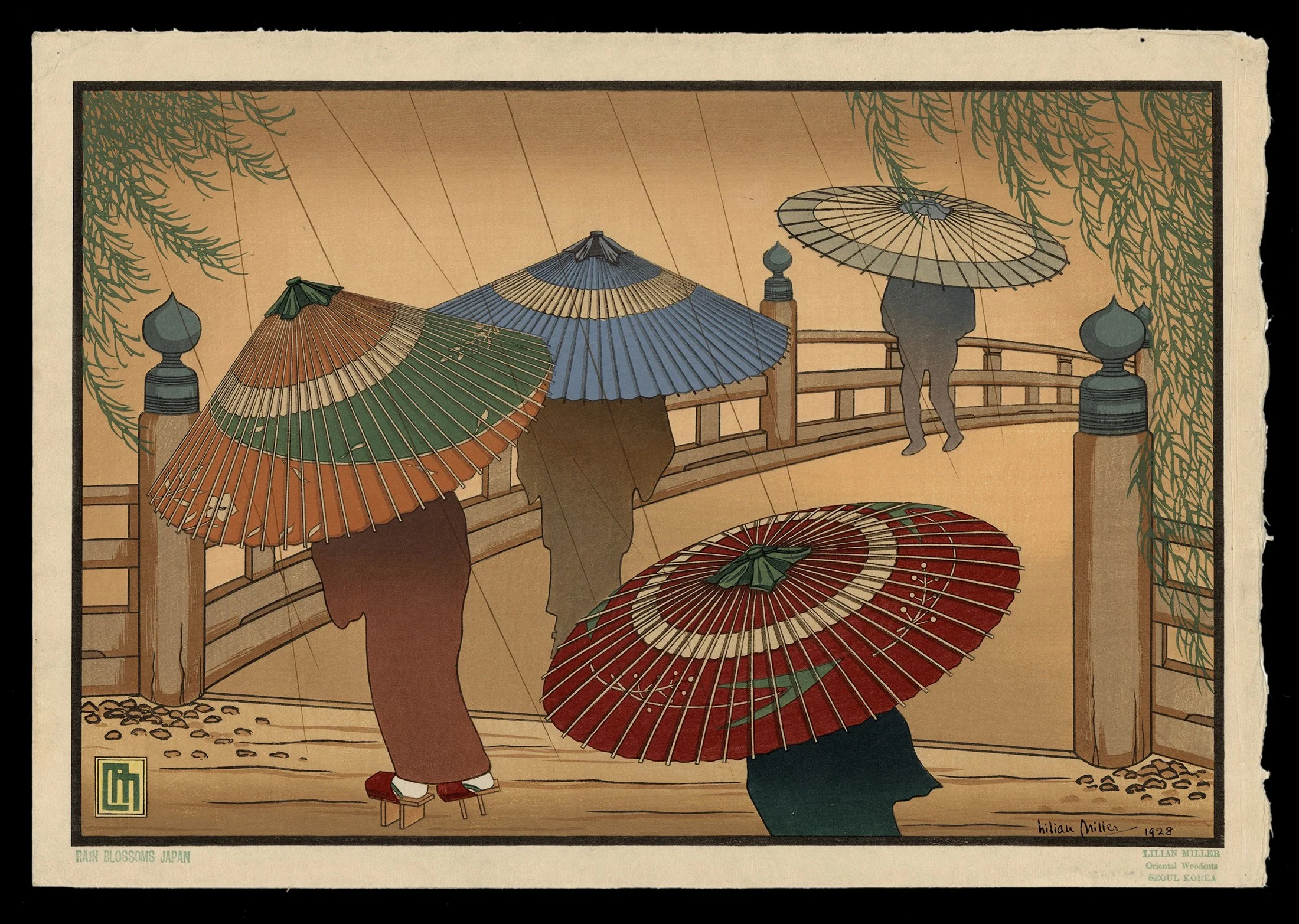
In Rain Blossom B, Lilian Miller revisits the same elegant composition as her companion piece, Rain Blossom A, but imbues it with an entirely different mood through a transformative reworking of color. Here, the scene is bathed in warm, golden tones—umbrellas in russet, sage, cream, and indigo float like petals in a light-dappled drizzle. The bridge remains the same, as do the figures, yet the atmosphere shifts from cool serenity to luminous reverie, as though the rain has given way to late-afternoon light breaking through thinning clouds.
The formal beauty of the composition—a masterwork of symmetry, curve, and silhouette—is enriched by the earthy palette and a sense of gentle motion. The skillful us of bokashi, color gradation, in the background contributes to the sensation of diffuse light and damp air. Willow branches trail softly across the corners, framing the scene like a theater curtain drawn back to reveal a quietly unfolding tableau. The viewer becomes a silent witness to this elegant procession, defined as much by its stillness as by the suggestion of movement.
Connoisseur's Note
Rain Blossom B is one of two rare variants printed from the same set of carved blocks, a creative decision that reflects Miller’s participation in the Sosaku Hanga ethos of the artist as sole designer, carver, and printer. Where Rain Blossom A conveys the quiet chill of spring rain, this version offers a warmth and glow that feels more like a lingering late summer shower. The differing palettes allow the same structural image to express an entirely distinct emotional register—an experiment in chromatic storytelling that highlights Miller’s artistry.
As with the alternate version, Rain Blossom B is signed in pencil and marked in the margin. A Japanese-born American who spent most of her life in Japan and Korea, Miller occupied a unique position in the world of Shin Hanga—one of the few women working independently in the medium. This print not only exemplifies her technical finesse and refined sensibility, but also her deep understanding of Japanese aesthetic principles: impermanence, subtlety, and beauty revealed in restraint.
More prints by Lilian May Miller:
1938
$1,200
Nikko Garden
Lilian May Miller (1895-1943)
MEDIUM: Pigment on paper
DATE: 1938
DIMENSIONS: 12 5/8 x 12 1/4 inches
CONDITION: Minor staining and foxing to mount—painting itself is in fine condition
NOTE: Dedication and poem on verso
$1,200.00
Contact us to purchase