

 Image 1 of 1
Details
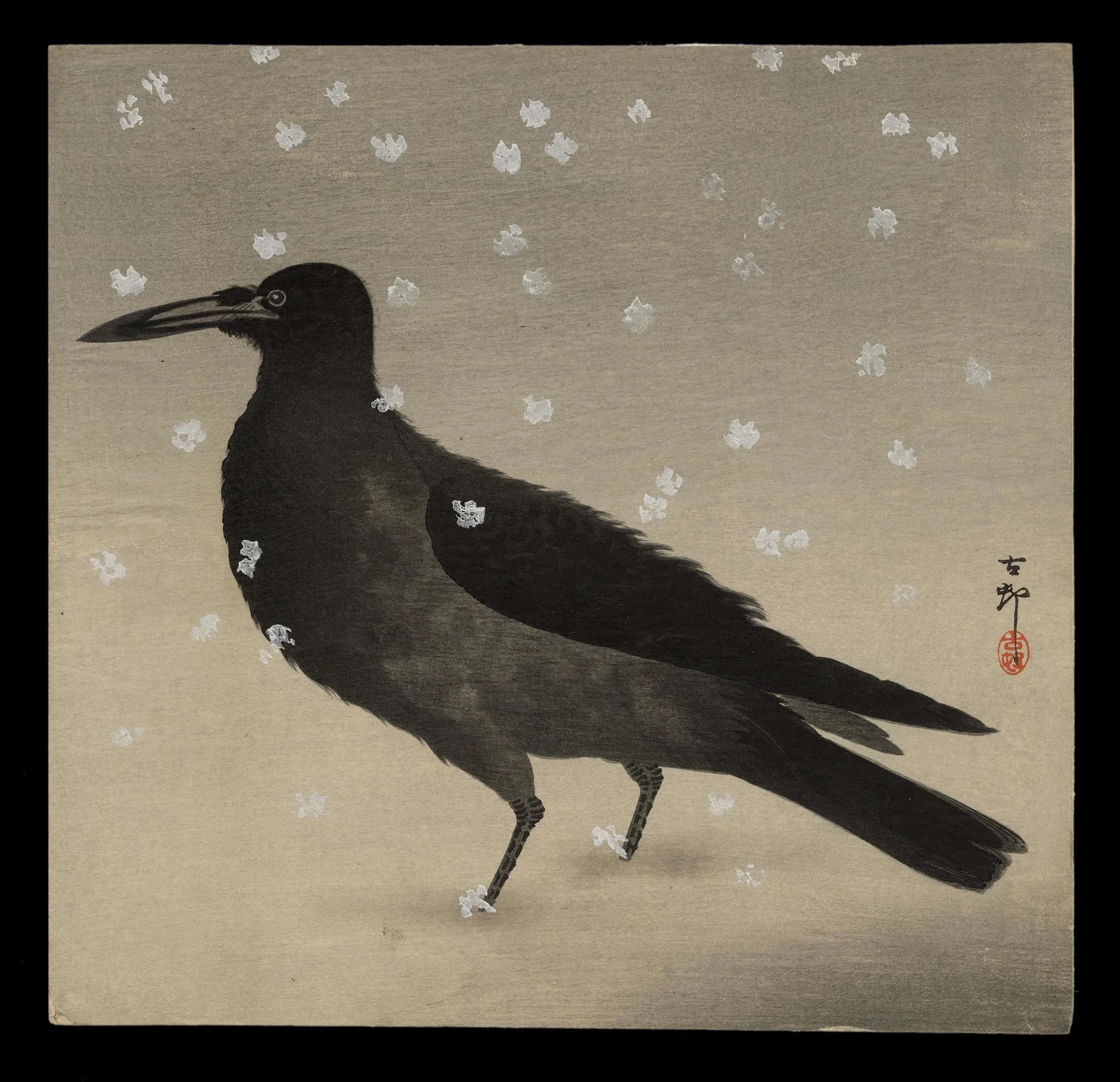
In Crow in Snow, Ohara Koson delivers a striking image of poetic solitude. Against a soft, muted background that shifts subtly from warm gray to a light pale ochre, a single crow stands poised—alert, dignified, and still. Snow falls gently in scattered flakes, rendered in raised white gofun (powdered shell) that adds a delicate texture to the scene. The crow’s plumage is printed in rich gradations of black and highlights of black lacquer pigment, with meticulous detail in the eye, beak, and feathers—evoking both the softness of natural form and the quiet resilience of the subject.
The compositional focus is absolute. There is no superfluous background, no branches or perches—only the figure of the bird and the fall of snow. This simplicity is where the power lies: in the contrast between darkness and light, stillness and motion, solitude and atmosphere.
Connoisseur's Note
Ohara Koson, known also by the names Shōson and Hōson throughout his career, was the undisputed master of kacho-ga (bird-and-flower prints) in the Shin-Hanga movement. While he produced a wide array of birds—cranes in flight, sparrows in bamboo, and owls in twilight—his images of crows remain among the most arresting and poetic in his entire body of work.
In Crow in Snow, Koson draws on traditional Japanese aesthetics of wabi-sabi—the beauty of impermanence and quiet melancholy. The crow, a symbol often associated with intelligence, vigilance, and at times, loneliness, becomes here a solitary figure amidst a quiet flurry. The lack of overt drama is what gives the piece its emotional resonance; the viewer is invited not to observe action, but to feel presence.
Printed with exquisite restraint and subtle modulation of tone, this impression is a superb example of Koson’s painterly sensitivity and technical control. The raised snowflakes, created with hand-applied gofun, shimmer softly under light and provide a tactile counterpoint to the velvety feathers of the bird.
Crow in Snow is a timeless meditation on season, silence, and solitary grace. It is an essential work for any serious collector of kacho-e or Shin-Hanga, and a quiet masterwork in Koson’s enduring legacy.
More prints by Ohara Koson:


20th Century
$1,200
Peacock on a Bough of Pine Tree
Ohara Koson (1877-1945)
MEDIUM: Woodblock Print
DATE: 20th Century
DIMENSIONS: 14 ¼ x 7 ½ inches
CONDITION: No condition problems to note
LITERATURE: Amy Newland et al., Crows, Cranes & Camellias: The Natural World of Ohara Koson 1877-1945, 2001, Cat K38.18
$1,200.00
Contact us to Purchase