
 Image 1 of 1
Details
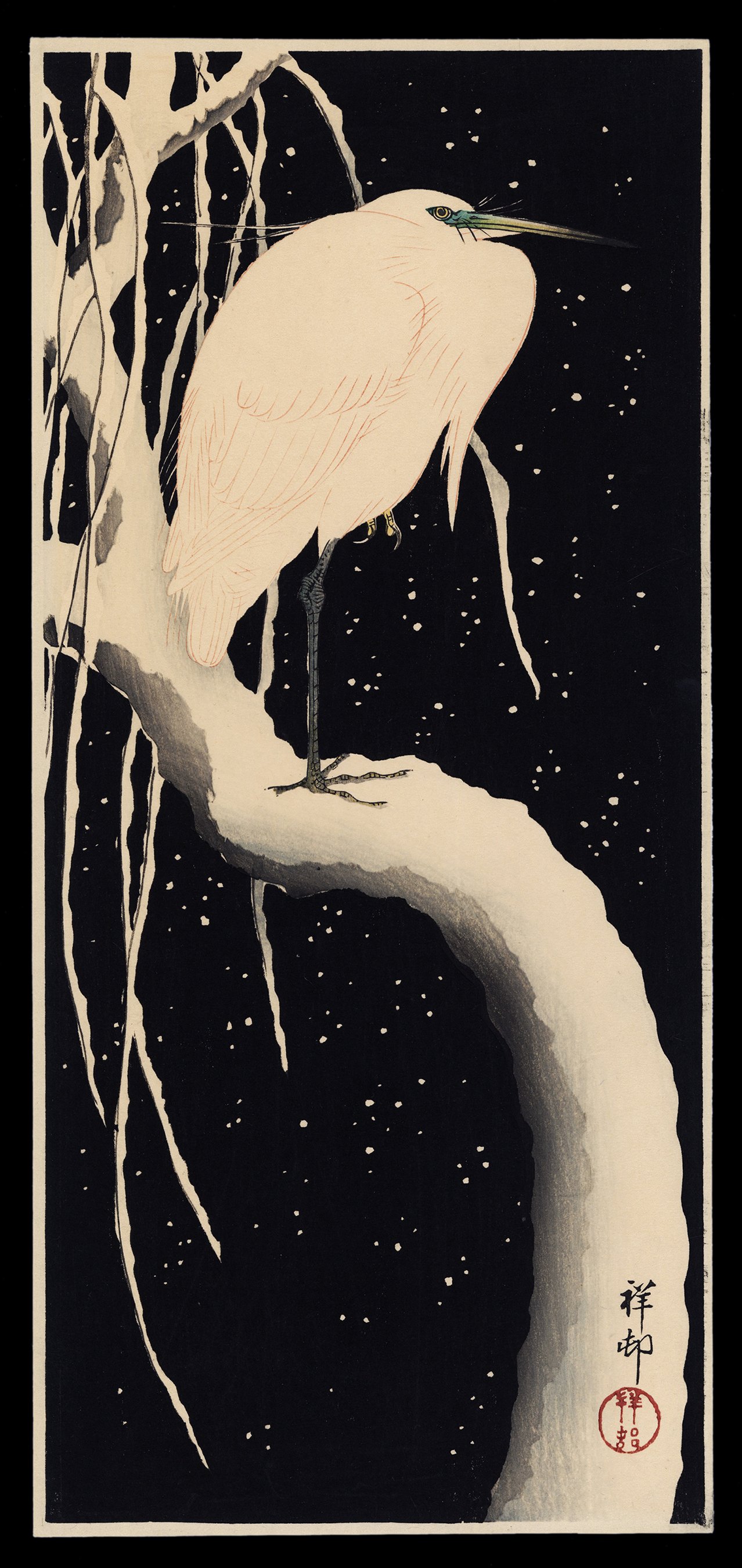
In Egret on a Snow-Covered Branch, Ohara Shōson captures the haunting stillness of a winter night with exquisite restraint and clarity. A solitary white egret, its plumage faintly tinged with soft rose outlines, perches delicately on the curve of a thick snow-laden branch. Set against a velvety black sky peppered with falling snowflakes, the bird becomes an embodiment of stillness amid motion, silence amid the soft whisper of snowfall.
The sinuous arc of the branch adds a dynamic visual rhythm to the composition, echoed by the draping forms of bare, snow-covered twigs. The egret’s form is finely embossed, its feathers rendered with subtle detailing that contrasts beautifully against the deep negative space of the background. The simplicity of the palette—dominated by ivory, black, and muted greys—serves to intensify the emotional resonance of the scene.
Connoisseur's Note
Ohara Shōson (also known as Koson or Hōson, depending on the publisher of the design) is widely regarded as the preeminent bird-and-flower artist of the Shin Hanga movement. While his oeuvre spans a broad range of avian subjects, it is his images of white egrets—often poised in snow—that are among the most iconic and enduring.
Printed around 1910, this early work predates many of Shōson’s later collaborations with Watanabe and reveals his command of classical Japanese aesthetics, particularly the principle of yūgen—a sense of mysterious depth. The compositional minimalism, stark contrasts, and solitary subject all speak to a profound sensitivity to nature’s quieter, more introspective moods.
This impression’s technical mastery is evident in every element: from the careful bokashi shading of the snow-shadowed branch, to the meticulous embossing of plumage, to the softly mottled snowfall. The vertical format emphasizes elegance and elongation, evoking the vertical hanging scroll tradition from which these woodblock designs evolved.
Egret on a Snow-Covered Branch is not merely an image of winter—it is an evocation of atmosphere, solitude, and purity. A refined and contemplative print, it stands as one of the quintessential expressions of Shōson’s poetic realism and the Shin Hanga movement’s reverence for natural beauty.
More prints by Ohara Shoson: