

 Image 1 of 1
Details
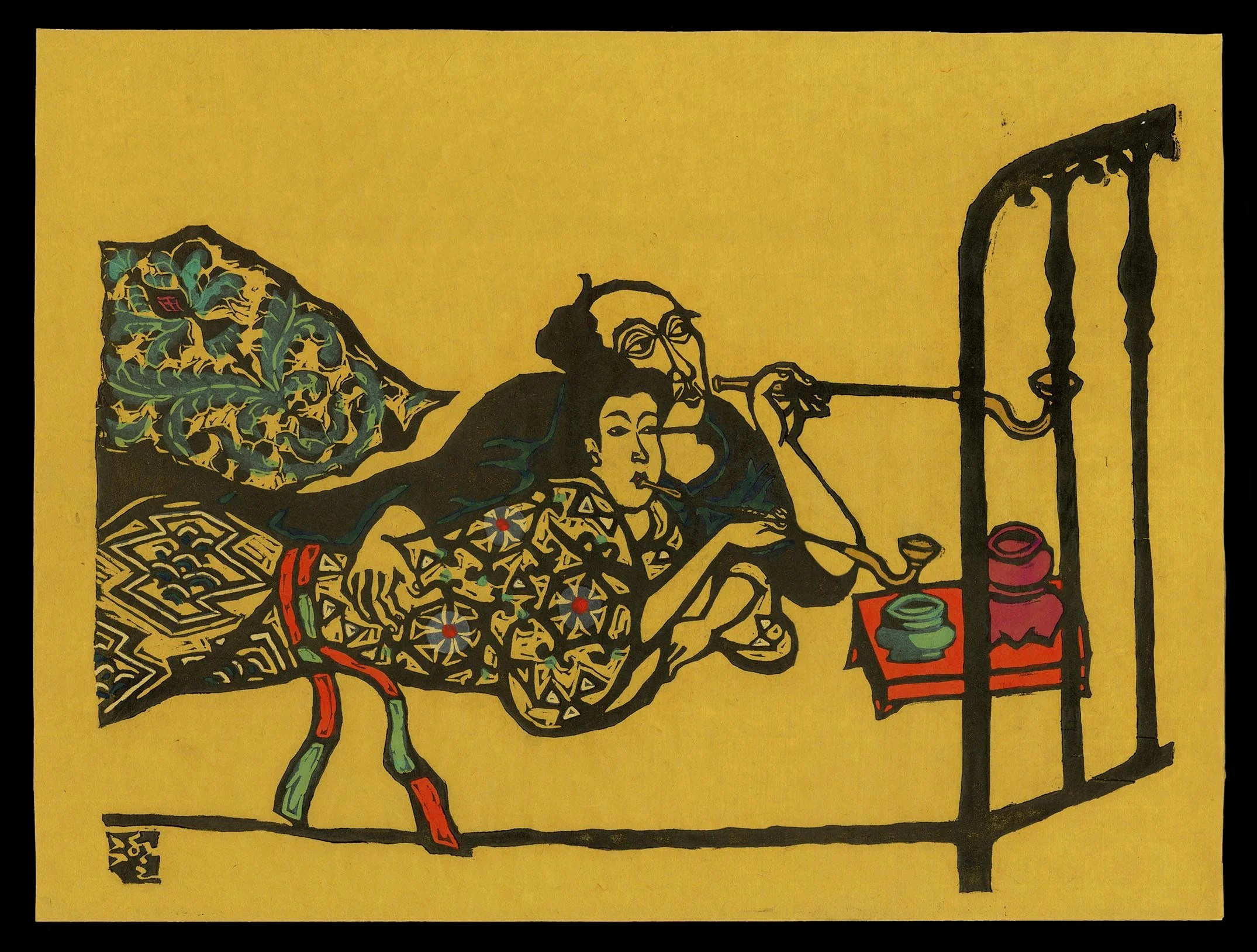
In Nanbanesque Behavior, Sumio Kawakami presents a scene at once vivid, playful, and layered with cultural tension. A Western man, unmistakably Dutch in appearance, reclines alongside a Japanese courtesan, their figures entwined in relaxed intimacy. Both calmly smoke long-stemmed pipes, their expressions imbued with languid amusement. Rendered against a brilliant mustard-yellow ground, the sinuous black outlines and boldly patterned garments bring a rhythmic, almost theatrical energy to the composition. The sparse setting — a simple smoking stand and iron bed frame — sharpens the focus on the collision of worlds embodied by the two figures.
The title, "Nanbanesque Behavior," draws from the term Nanban — "Southern Barbarian" — historically used in Japan to describe early Western visitors, particularly the Portuguese and Dutch. Kawakami’s depiction reflects his lifelong fascination with the cultural entanglements of the Meiji period, which he had witnessed as a boy. In that era, Western customs, fashions, and technologies began to intermingle — and sometimes clash — with Japan’s traditional ways. These impressions left a lasting mark on Kawakami’s artistic imagination, emerging throughout his career in works that both celebrate and slyly critique the hybrid realities of modern Japan.
Connoisseur's Note
This print exemplifies the core tenets of the Sosaku Hanga movement. Kawakami carved a single keyblock to define the bold black contours, then meticulously applied all colors by hand — a process that underscored the Sosaku ideal of the artist’s total engagement in every stage of creation. Unlike the highly polished collaborative productions of Shin Hanga, Nanbanesque Behavior radiates the directness and individuality that Sosaku Hanga artists championed.
Nanbanesque Behavior became one of the flagship images of early Sosaku Hanga, embodying the spirit of invention, irreverence, and personal expression that defined the movement. Its significance is underscored by its selection as the cover image for Helen Merritt’s landmark study Modern Japanese Prints: The Early Years. Today, the print endures not only as a playful cultural tableau but as a vital historical document — capturing the restless creativity that propelled modern Japanese printmaking into a bold new era.
More prints by Sadao Watanabe:
1955
$3,500
Nanbanesque Behavior
Sumio Kawakami (1895-1972)
DATE: 1955
MEDIUM: Woodblock print with hand-applied colors
DIMENSIONS: 18 × 24 inches
CONDITION: Excellent impression and color; no problems to note
$3,500.00
Contact us to purchase