

 Image 1 of 1
Details
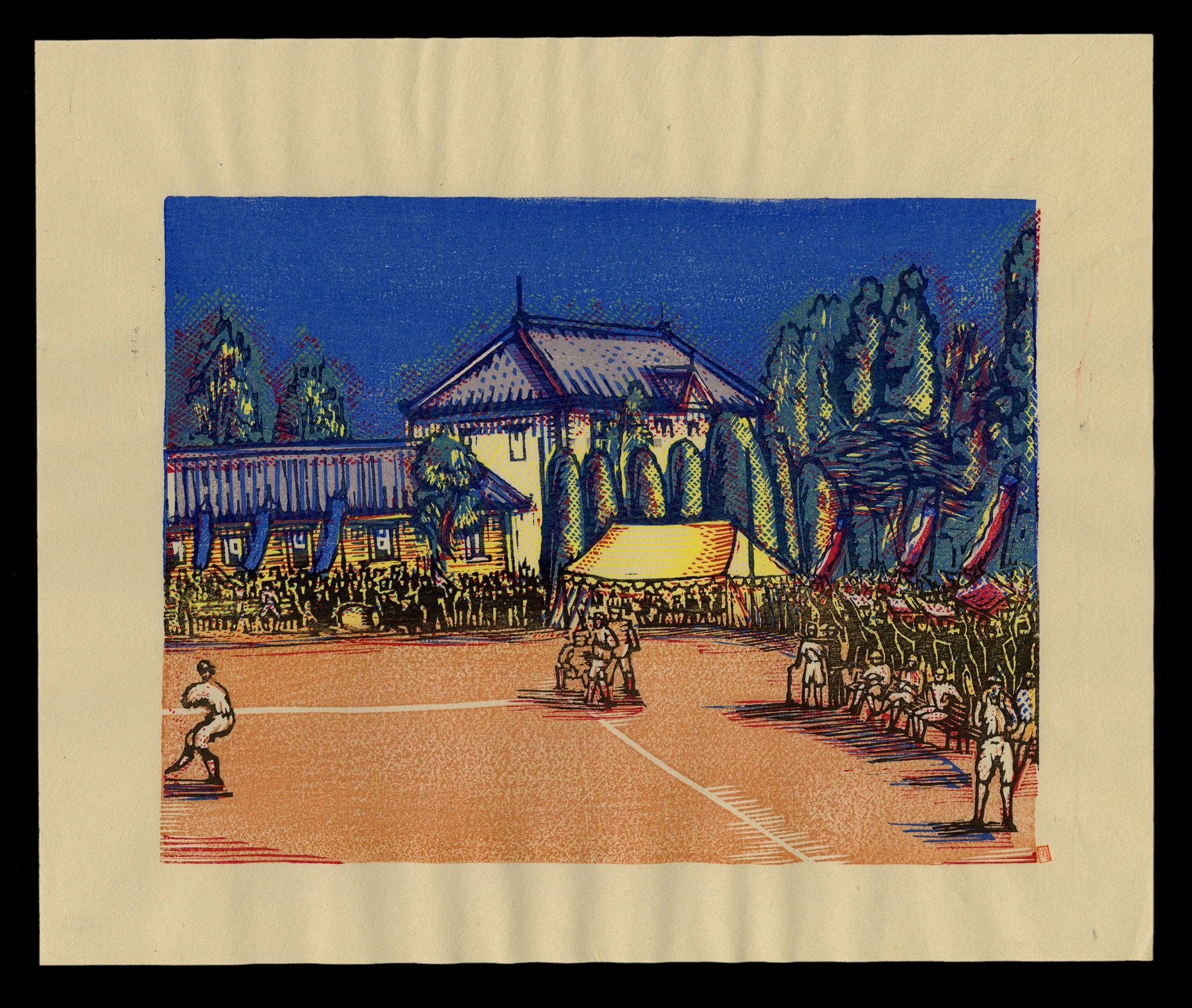
In Baseball Game, Sumio Kawakami captures a rare glimpse of modern Japan’s evolving cultural landscape during the early Shōwa period. The scene unfolds under an impossibly rich blue sky: a spirited ballgame played before a grand traditional building, likely a school or civic hall, framed by towering trees and colorful banners. The players — their gestures lively yet simplified — and the dense crowd of spectators convey the collective excitement of a public spectacle. Kawakami’s colors shimmer with a vivid immediacy, animating the moment with a rustic, almost celebratory energy.
Completed in 1932, this print reflects Kawakami’s lifelong fascination with the meeting of East and West. Baseball, newly imported from America, had already become a national obsession in Japan, and Kawakami renders it here not as a foreign curiosity, but as a fully integrated element of contemporary Japanese life. His bold outlines and dynamic use of perspective blur the boundary between reportage and personal vision, capturing both the novelty and the communal spirit that the game brought to his homeland.
Connoisseur's Note
Sumio Kawakami was a key figure in the early Sosaku Hanga (“creative print”) movement, which championed the full authorship of the printmaker — designing, carving, and printing each work independently. In Baseball Game, he uses multiple carved blocks with precision and flair, creating a richly colored composition that maintains his characteristic hand-hewn charm.
While much of early Japanese modern printmaking was focused on traditional subjects, Kawakami’s choice of a baseball game as his theme speaks to his remarkable openness to new realities. Here, he folds a quintessentially Western pastime into the language of Japanese folk art, merging old and new, native and foreign, into a seamless whole. Prints like Baseball Game remind collectors of the vibrant, transitional moment in Japanese history when tradition and innovation collided — and how Kawakami’s playful, humanistic vision helped document that spirited change.
More prints by Sumio Kawakami:
1955
$3,500
Nanbanesque Behavior
Sumio Kawakami (1895-1972)
DATE: 1955
MEDIUM: Woodblock print with hand-applied colors
DIMENSIONS: 18 × 24 inches
CONDITION: Excellent impression and color; no problems to note
$3,500.00
Contact us to purchase