

 Image 1 of 1
Details
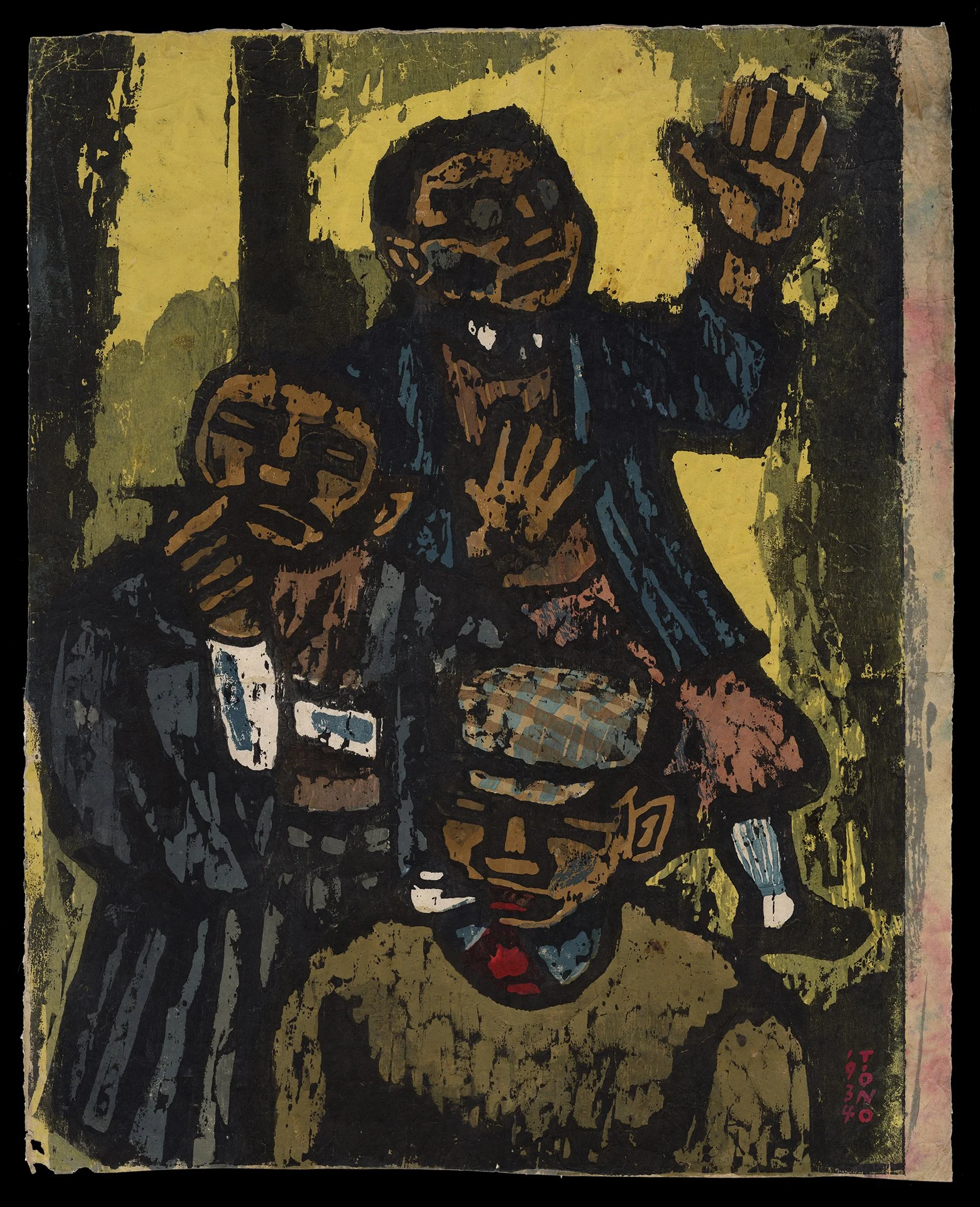
In The Men That Sell Men, Tadashige Ono presents a densely layered and emotionally charged image of human exploitation rendered through aggressively carved forms and heavily textured surfaces. Three looming figures occupy the composition, their faces fragmented into mask-like planes of shadow and light. One figure raises an arm in a gesture that oscillates between command, warning, and accusation, while the others appear self-concerned with smoking a cigar and the other a pipe. The compressed arrangement of bodies and the rough, uneven application of pigment create an atmosphere of suffocating psychological tension. Rather than offering narrative clarity, Ono constructs an image of social unease and moral dislocation.
The title itself carries profound political resonance. Produced in 1934, during a period marked by labor unrest, economic hardship, and increasing political repression, the print reflects anxieties surrounding systems of industrial labor and the commodification of human life within modern capitalist society. The figures appear less as individualized portraits than as embodiments of broader social conditions—workers, brokers, or agents trapped within structures of exploitation that reduce human beings to instruments of labor and exchange. Ono’s harsh visual language mirrors these themes directly: bodies fracture into jagged forms while faces dissolve into abstracted networks of carved marks, emphasizing alienation rather than individuality.
The print belongs to a broader movement of socially conscious Japanese printmaking during the interwar years, when artists increasingly turned toward social realism as a means of confronting contemporary inequality and labor conditions. While many images associated with modern urban culture celebrated cafés, department stores, nightlife, and fashionable cosmopolitanism, artists such as Ono revealed the harsher realities underpinning industrial modernity. Social realism became an important artistic tool for raising awareness surrounding workers’ rights, exploitation, poverty, and class tension. In this context, The Men That Sell Men functions not simply as an aesthetic object, but as an urgent visual critique of the human consequences of rapid modernization.
Connoisseur's Note
This remarkably early work already reveals many of the qualities that would later distinguish Ono’s mature printmaking: emotional intensity, physicality of carving, and an uncompromising engagement with social subject matter. Particularly striking is the extraordinary material construction of the print itself. Rather than working within standard woodblock dimensions, Ono stitched together four sheets of hosho paper to create this unusually large and imposing composition. The resulting scale amplifies the psychological pressure of the imagery, allowing the figures to confront the viewer with an almost mural-like immediacy uncommon within Sosaku Hanga printmaking of the period.
The joined paper surfaces also contribute materially to the work’s expressive force. Slight irregularities, seams, and variations across the large composition reinforce the sense of fragmentation already embedded within the imagery itself. Ono appears less concerned with technical polish than with preserving the raw physical energy of the carving process. Thick black contours, uneven pigment saturation, and aggressively cut forms create a surface that feels nearly wounded, reflecting the emotional violence of the subject matter. This tactile immediacy aligns the work closely with broader international currents in expressionism and politically engaged modernist printmaking during the 1930s.
Within the broader visual culture of interwar Japan, the print occupies a compelling counterpoint to the era’s imagery of urban sophistication and consumer modernity. Beneath the glamour of cafés, fashion, cinema, and commercial spectacle existed widespread labor instability and profound economic anxiety, particularly during the global depression years of the early 1930s. Ono’s The Men That Sell Men exposes these tensions with unusual directness, revealing how certain Sosaku Hanga artists transformed the woodblock medium into a vehicle for political consciousness and social critique. The work stands today not only as a remarkable artistic achievement, but also as a powerful historical document of dissent and human vulnerability within modern industrial society.
More prints by Tadashige Ono:
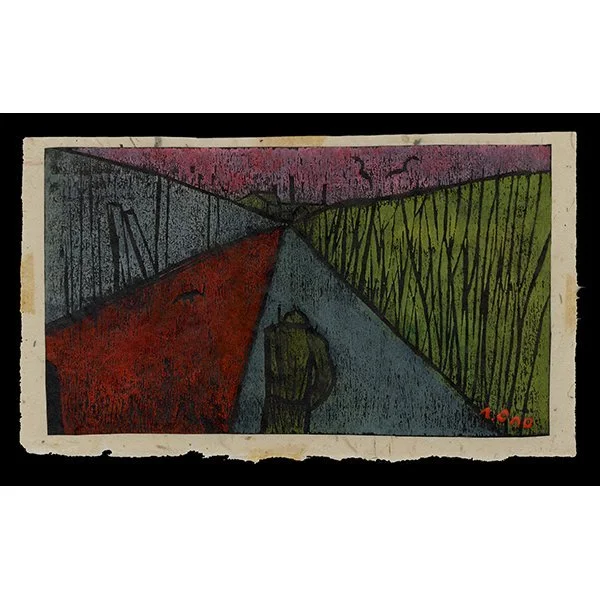
1938
$4,000
Landscape with Bear
Tadashige Ono (1909-1990)
DATE: 1938
MEDIUM: Woodblock Print
DIMENSIONS: 20 ½ x 24 ¾ inches
CONDITION: Excellent impression, color, and condition; light wrinkling to paper
NOTE: Exceedingly rare and early work, possibly unique; silver and gold metallic highlights
PROVENANCE: Ono Tadashige Museum
$4,000.00
Contact us to purchase