

 Image 1 of 1
Details
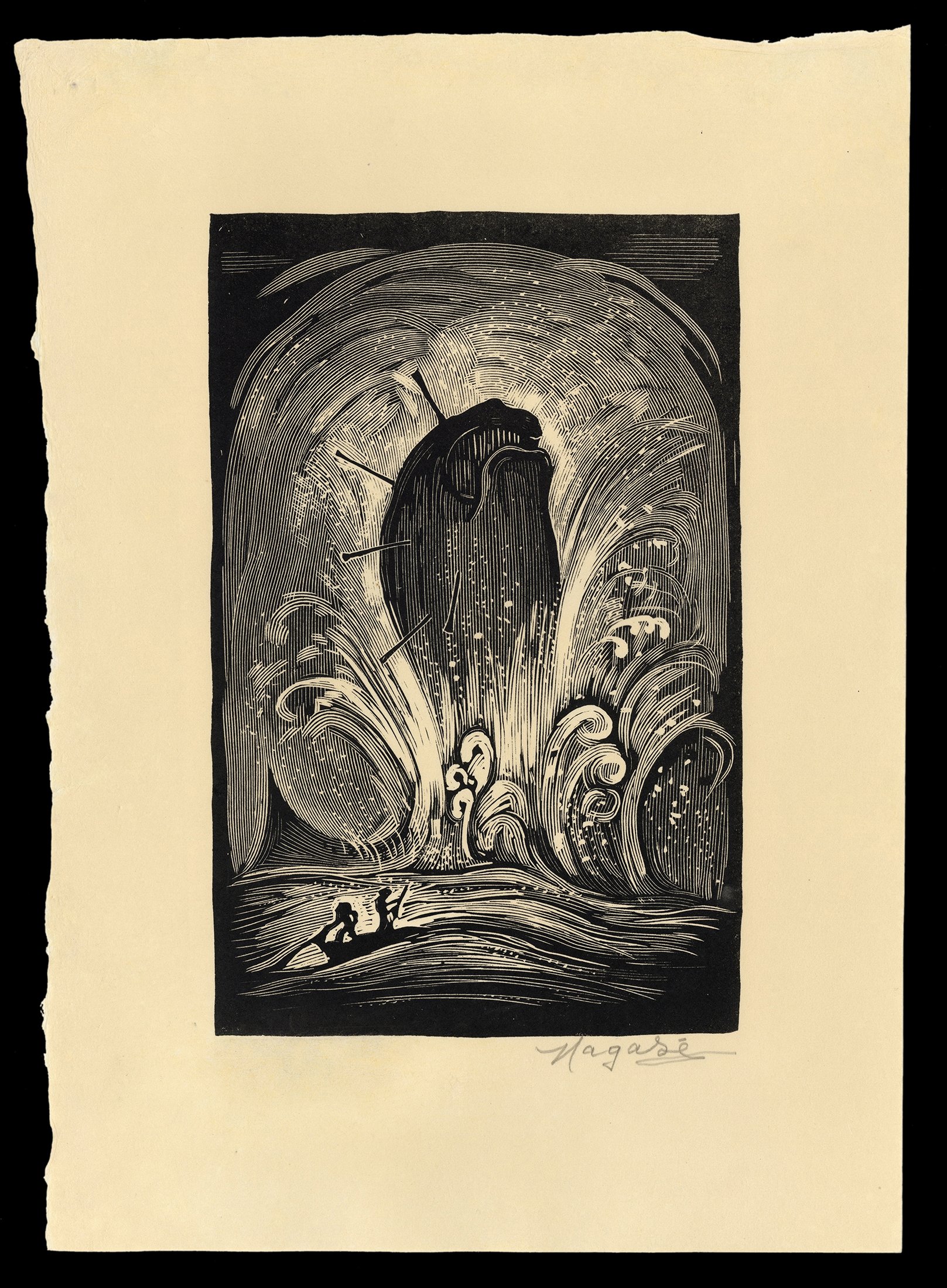
In Whale, Yoshiro Nagase captures the primal drama of nature with an intensity that feels almost mythic. A colossal whale, rendered in bold, surging lines, bursts from the ocean’s surface like a rocket — its massive form propelled straight upward, shattering the waves into arcs of foam and spray. Against the vertical thrust of the whale, a tiny canoe and figure struggle below, dwarfed by the elemental forces erupting around them. The scene is both ferocious and awe-inspiring, a moment suspended between chaos and transcendence. Nagase’s dense network of curving, incised lines gives the composition a breathless energy, drawing the eye upward in a sweeping, almost musical movement.
Carved not along the plank side of the wood but into the denser end grain — a technique known as wood engraving — this print reveals Nagase’s technical mastery. Wood engraving allows for extraordinary precision and fine detail, but demands exceptional control and patience. In Whale, Nagase exploits this medium to its fullest, achieving swirling textures and shimmering effects that would be near impossible in traditional woodcut. The result is a scene that feels both fiercely physical and eerily ethereal, teetering between two realms — earth and sky, matter and spirit.
Connoisseur's Note
Nagase’s early works, including Whale, are deeply indebted to the aesthetic innovations of German Expressionism, a movement that resonated strongly with many members of Japan’s emerging Sosaku Hanga (creative print) movement in the 1920s. Like his European contemporaries, Nagase embraced stark contrasts, raw emotional power, and a vigorous, almost sculptural handling of the printing block. His black-and-white prints from this period stand as some of the boldest examples of cross-cultural experimentation in modern Japanese art.
This impression, printed on slightly softer and warmer-toned paper, suggests it was likely pulled in the early 1950s from Nagase’s original 1920s block. While not a first printing, it remains a rare and desirable artifact of the artist’s most vital period. Collectors value these early Nagase prints for their sheer kinetic force, their technical daring, and their role in bridging Japanese and European modernist traditions. Whale captures not only the ferocity of the natural world, but the restless energy of an artist pushing the boundaries of form and medium.
c. 1925
$950
Whale
Yoshiro Nagase (1891–1978)
DATE: c. 1925
MEDIUM: Wood Engraving (Woodblock Print)
DIMENSIONS: 18 3/4 × 13 inches
CONDITION: Excellent impression and color; no problems to note
NOTE: This impression was executed c. 1950
$950.00
Contact us to purchase