

 Image 1 of 1
Details
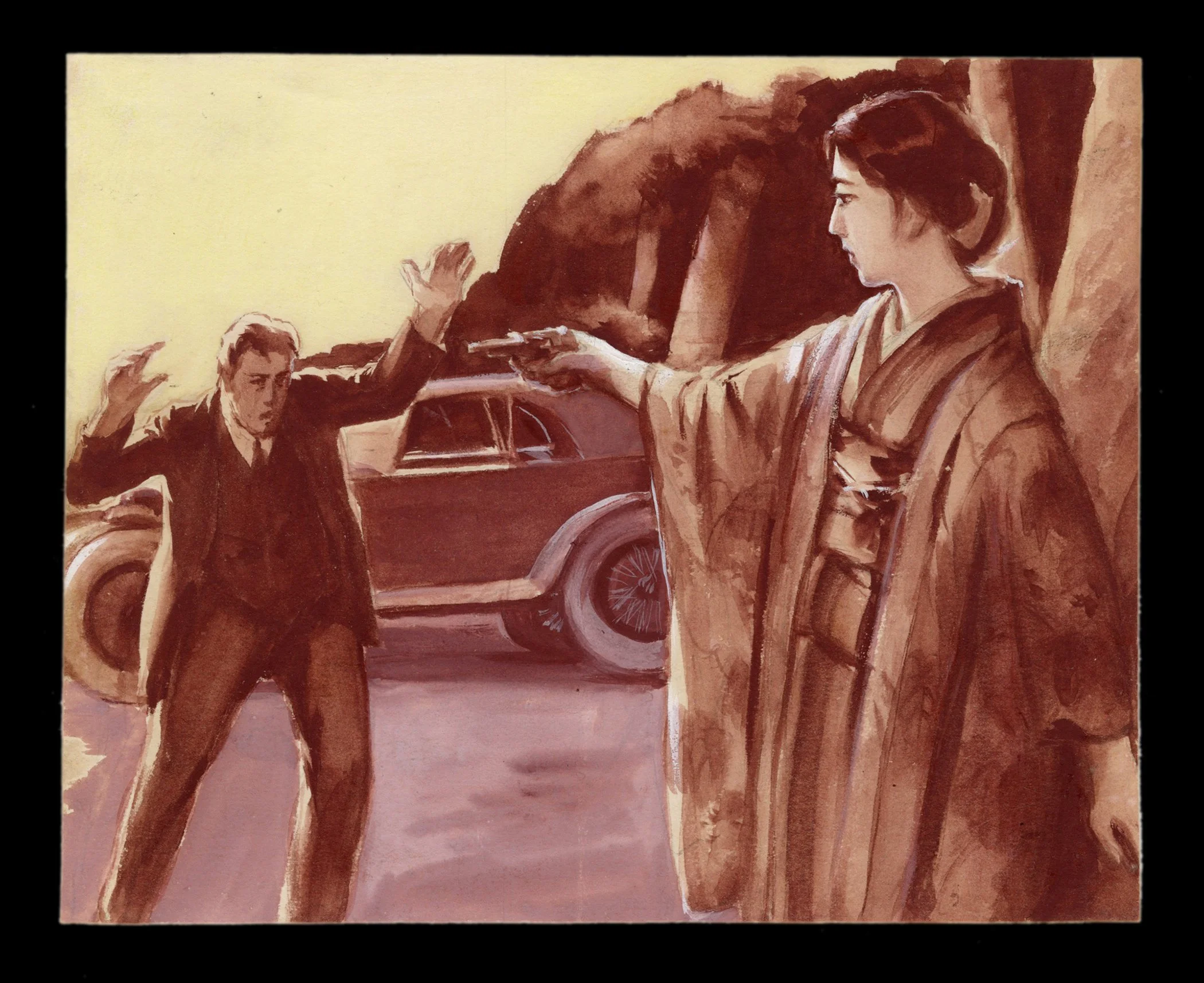
This dramatic and highly unusual painting depicts a kimono-clad woman confronting a male assailant at gunpoint beside a modern automobile. Executed in pigment on paper during the late Taishō or early Shōwa period, the composition possesses the immediacy and theatrical tension of a cinematic still or pulp fiction illustration. The woman stands firmly at the right edge of the image, extending her revolver outward with calm authority, while the suited male figure recoils defensively with raised hands. Behind them appears an automobile rendered through abbreviated but recognizable forms, situating the scene unmistakably within the rapidly modernizing urban world of interwar Japan.
The work was most likely created as a study or mock-up for a popular fiction publication, magazine illustration, or pulp novel cover design. During the 1920s, Japanese publishing experienced an enormous expansion in detective fiction, crime serials, and translated adventure literature influenced by both American and European popular culture. Alongside this literary transformation emerged new visual archetypes associated with danger, speed, urban nightlife, and modern criminality. Artists increasingly incorporated automobiles, firearms, detectives, and femme-fatale imagery into compositions intended for a rapidly expanding mass readership fascinated by contemporary metropolitan life.
What makes the present work particularly significant is its portrayal of female agency. Rather than appearing as victim or decorative companion, the woman dominates the composition psychologically and spatially. Her controlled posture, direct aim, and composed expression position her unmistakably as the central protagonist of the narrative. Such imagery reflects an important shift occurring within Japanese popular literature during the interwar period, when female heroines began emerging with increasing frequency in detective stories, serialized fiction, and urban adventure narratives. These women were often portrayed as intellectually independent, physically courageous, and socially unconventional — figures who challenged older literary expectations surrounding femininity and passivity.
Equally compelling is the tension between traditional and modern visual identity embodied by the female figure herself. Though armed with a revolver and situated within a contemporary urban setting, she remains dressed in kimono rather than Western attire. This juxtaposition creates a fascinating cultural ambiguity. The composition does not simply replace traditional femininity with imported modernity; instead, it merges them into a new hybrid image of female power shaped by the rapidly changing social environment of 1920s Japan.
Connoisseur's Note
The composition also reveals the growing influence of cinema on Japanese visual art during the 1920s. The dramatic staging, cropped spatial compression, and heightened narrative tension closely resemble contemporary film stills and promotional imagery associated with silent-era crime and adventure films. The automobile functions not merely as background detail, but as a symbol of modern velocity and urban transformation, reinforcing the atmosphere of danger and mobility central to interwar popular culture.
Particularly notable is the artist’s handling of gesture and directional force. The woman’s extended arm creates a sharp compositional axis that immediately organizes the viewer’s attention, while the recoiling male figure introduces instability and movement into the left side of the image. This dynamic opposition between calm control and defensive panic gives the painting much of its psychological intensity. Despite the economy of detail, the narrative feels immediate and fully realized.
Original surviving studies related to Japanese pulp fiction and popular illustration from the interwar years remain exceptionally scarce. Because such works were often produced quickly as preparatory material for inexpensive commercial printing, relatively few were preserved as autonomous artworks. The present painting therefore offers rare insight into the visual imagination surrounding Japan’s early detective and crime fiction culture during a formative moment in modern publishing history.
Beyond its striking imagery, the work stands as an important reflection of evolving gender representation within modern Japanese visual culture. During the 1920s and 1930s, mass-market fiction increasingly introduced women who operated outside traditional domestic roles — detectives, adventurers, criminals, and independent heroines navigating the modern city on their own terms. The present composition captures that cultural transition with remarkable clarity. Here, the woman is not peripheral to the action; she commands it.