

 Image 1 of 1
Details
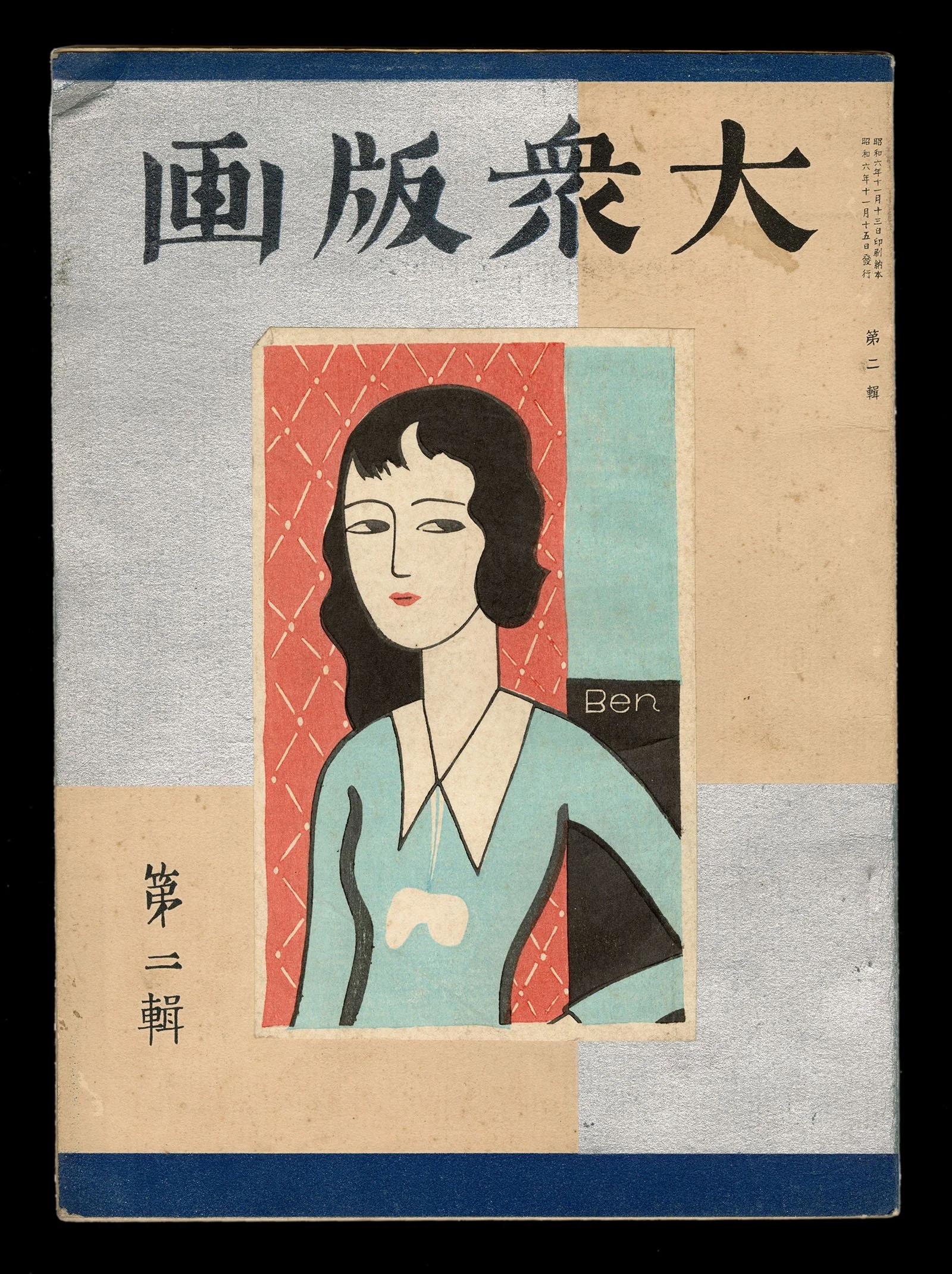
Published in November 1931, this second volume marked both the continuation and conclusion of Taishū Hanga (Popular Prints), the short-lived but influential magazine co-founded by Tomikichirō Tokuriki to promote creative printmaking in Kyoto. Although only two issues were ultimately produced, the publication served as a vital platform for artists committed to the ideals of Sosaku Hanga at a moment when independent printmakers sought greater visibility and support beyond established institutional circles. Like the inaugural issue, the magazine combined original prints, illustrations, and commentary that reflected the vitality of contemporary creative printmaking in western Japan.
The cover design by Benji Asada presents a striking image of modern femininity rendered through simplified geometric forms and a restrained yet sophisticated palette. The elongated figure, with her fashionable hairstyle, angular features, and contemporary dress, reflects the visual language of international Art Deco while remaining firmly rooted in the graphic sensibilities of Japanese print design. Unlike the youthful exuberance of Tokuriki’s modern girl on the first issue, Asada’s figure possesses a more poised and self-assured presence, embodying the increasingly cosmopolitan image of womanhood that permeated Japanese magazines, advertisements, and commercial art during the early 1930s. The cover itself functions as a concise statement of the movement’s engagement with modern design, urban culture, and contemporary aesthetics.
Connoisseur's Note
As the final issue of Taishū Hanga, this publication occupies a particularly important place in the history of Sosaku Hanga. Artist-produced magazines such as these were essential vehicles for sustaining creative exchange, circulating new ideas, and fostering connections among printmakers who often worked outside major commercial networks. Though its life was brief, Taishū Hanga helped maintain enthusiasm for the movement, introduced artists to one another’s work, and encouraged experimentation at a critical moment in the development of modern Japanese printmaking. The progression from Tokuriki’s modern girl on the first issue to Asada’s sophisticated Art Deco-inspired figure on the second also mirrors the broader evolution of urban visual culture in early Shōwa Japan, where fashion, graphic design, publishing, and fine art increasingly intersected. Today, the two surviving issues stand as rare and important documents of the collaborative spirit that helped shape the future of Sosaku Hanga.