

 Image 1 of 1
Details
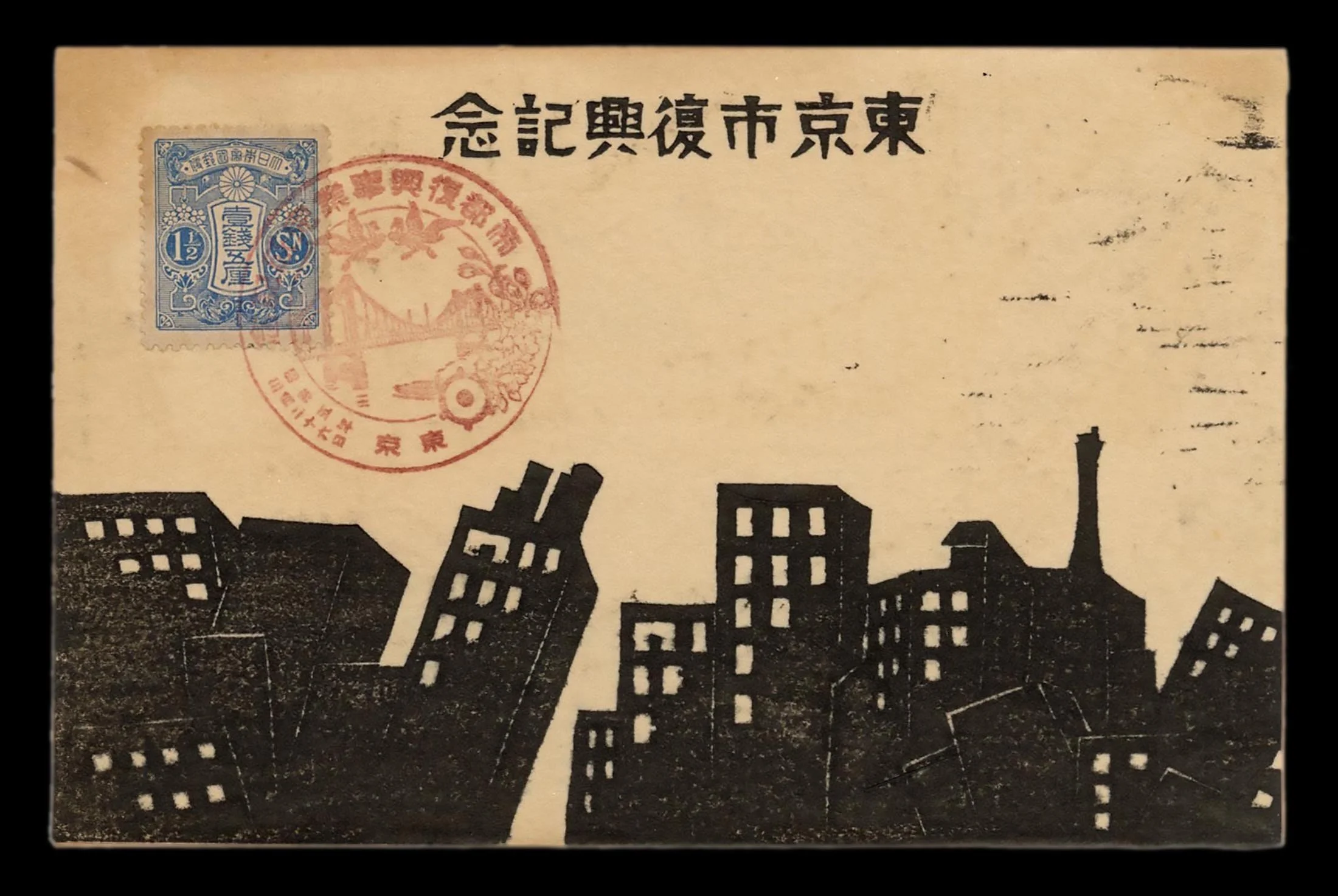
Tokyo rises from the lower edge of this striking postcard as a dense mass of black buildings, their irregular silhouettes pressing upward against an expanse of unprinted paper. Windows puncture the dark forms like scattered lights, while factory chimneys and a tall smokestack introduce the unmistakable vocabulary of the industrial city. Above this compressed urban panorama appears the inscription Tōkyō-shi fukkō kinen (東京市復興記念), “Commemoration of the Reconstruction of Tokyo City.”
The extreme economy of the design gives the image unusual power. Architecture has been stripped of ornament and individual identity; there are no celebrated monuments, picturesque temples, or recognizable landmarks. Instead, Tokyo is presented as a collective urban organism—a new metropolis defined by mass, verticality, industry, and density. The slightly tilting buildings and irregular rooflines lend the city an energetic instability, as though the reconstructed capital were still rising before the viewer’s eyes.
Connoisseur’s Note
Created in the aftermath of the Great Kantō Earthquake of 1923, the postcard belongs to the visual culture surrounding Tokyo’s remarkable reconstruction. By around 1930, the rebuilt capital had become a potent symbol of Japanese modernity, its transformed streets, bridges, commercial buildings, factories, and infrastructure celebrated as evidence of technological and civic renewal. The inscription explicitly identifies the image with this culture of reconstruction commemoration.
Yet the anonymous artist avoids the triumphal precision of an architectural record. The city is instead rendered as an almost abstract field of black forms. Buildings lean, overlap, and crowd one another, while the broad empty sky heightens the force of the dark skyline below. This tension between solidity and precariousness gives the composition a distinctly modern sensibility: Tokyo appears simultaneously monumental and restless.
The roughened surfaces, emphatic silhouettes, and deliberate simplification of form recall the expressive language associated with sōsaku hanga. Particularly compelling is the transformation of the metropolis itself into a graphic motif. Rather than commemorating a single reconstruction project, the artist celebrates the city as the achievement. Tokyo emerges from catastrophe not through a famous monument but as an immense accumulation of buildings, factories, light, and human enterprise—a newly minted metropolis announcing its return.