

 Image 1 of 1
Details
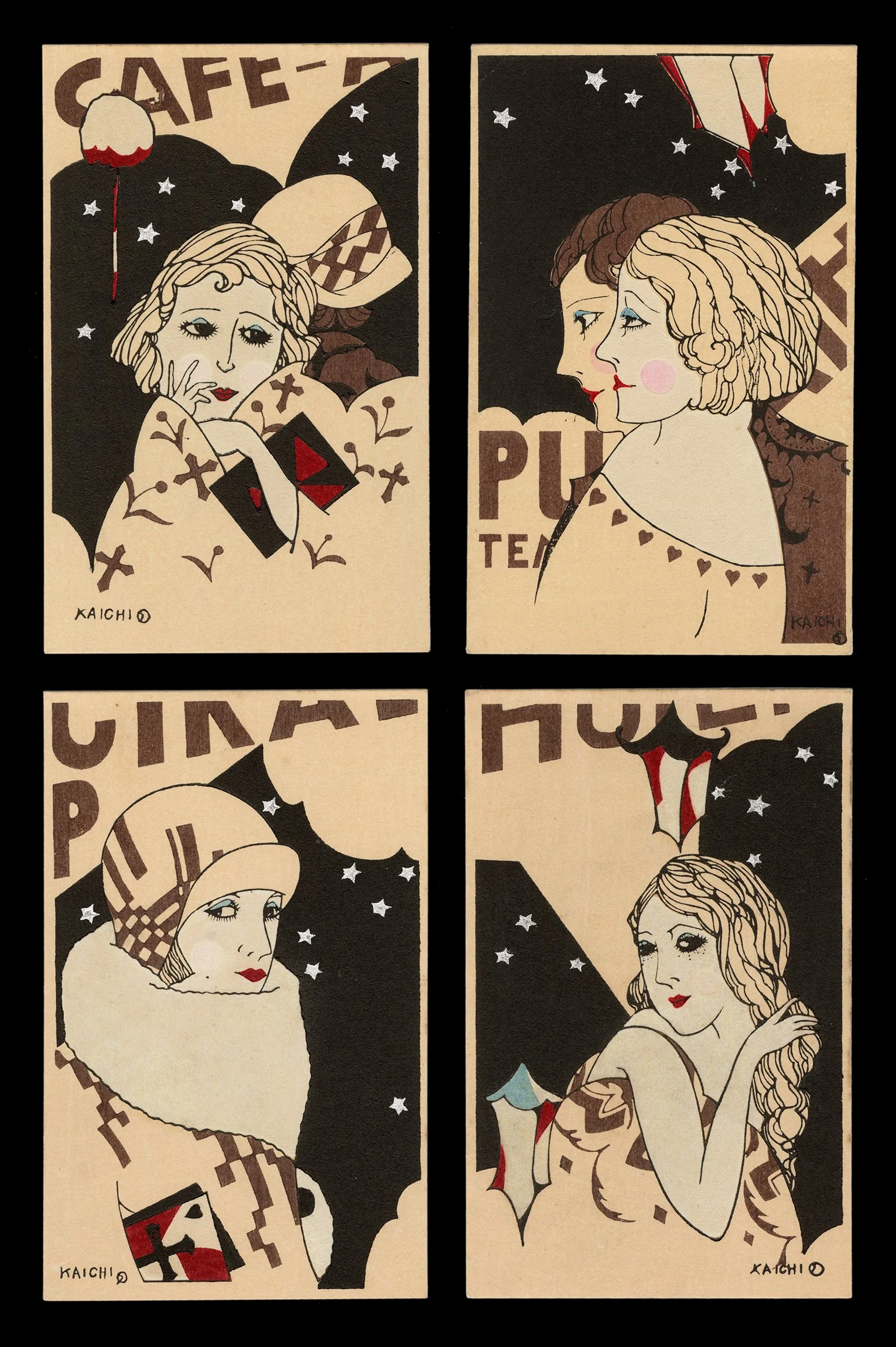
Produced around 1925–1926 by the Kyoto publisher Kyogoku Sakuraiya, this complete set of four woodblock-printed postcard designs by Kobayashi Kaichi captures the visual sophistication and emotional atmosphere of Japan’s emerging urban modernity during the Taishō and early Shōwa years. Though intimate in scale, the works possess extraordinary graphic presence. Each composition presents a highly stylized modern woman framed within theatrical arrangements of typography, geometric pattern, and nocturnal space, transforming the postcard format into a refined vehicle for avant-garde design.
The series reflects Kaichi’s distinctive synthesis of Art Deco aesthetics, commercial graphic culture, and poetic melancholy. Fashionably dressed women appear wrapped in patterned scarves, seated within café interiors, or suspended against darkened city-like abstractions punctuated by stars and angular forms. Fragmented lettering — “CAFÉ,” “TEA,” and other partially obscured text — functions not merely as decoration but as part of the composition itself, evoking the visual saturation of modern urban life. Kaichi treats typography as image, integrating commercial signage directly into the emotional structure of the prints.
Unlike conventional bijin-ga imagery, these women do not function as idealized beauties presented for admiration alone. Their distant gazes, reserved gestures, and carefully controlled expressions create an atmosphere of emotional ambiguity. The figures appear psychologically detached, absorbed within private thought despite the fashionable sophistication surrounding them. Such introspection became central to Kaichi’s work and distinguishes his prints from more commercially oriented depictions of modern femininity produced during the same period.
The postcard format itself plays a significant role in the series’ impact. Portable and intimate, the small scale encourages close viewing while simultaneously echoing the circulation of modern visual culture through cafés, department stores, magazines, and urban correspondence. Yet these are not mechanically reproduced postcards intended merely for communication. They are original woodblock prints, carefully designed and printed with considerable sensitivity to line, spacing, and color balance. The surviving original folder further reinforces the set’s integrity as a unified artistic production rather than a collection of incidental printed objects.
Connoisseur's Note
Complete Kaichi postcard sets with their original folders are scarce, particularly examples preserving strong impressions and full compositional clarity across all designs. Because many postcard-format works were separated, mailed, discarded, or damaged through use, intact surviving groups offer especially valuable insight into how Kaichi intended these images to function collectively. Seen together, the four designs reveal a carefully orchestrated rhythm of repeated motifs — stars, geometric patterning, abbreviated typography, and stylized coiffures — that create visual continuity across the suite.
The present set also occupies an important position within the broader development of modern Japanese graphic arts during the 1920s. Kaichi worked at the intersection of fine art printmaking, commercial design, and popular visual culture, yet his strongest compositions resist easy categorization within any single field. While the works borrow from the language of advertising and fashion illustration, they simultaneously maintain the handcrafted sensitivity of artist-produced woodblock printing. This duality contributes significantly to their enduring appeal.
Particularly striking is Kaichi’s treatment of negative space and darkness. Large passages of black create a theatrical compression around the figures, heightening the fragility of pale skin tones and delicate line work. The sparse use of red — lips, decorative accents, fragments of pattern — introduces moments of visual intensity without overwhelming the restraint of the compositions. Such control demonstrates Kaichi’s remarkable understanding of how minimal means could generate strong emotional atmosphere.