

 Image 1 of 1
Details
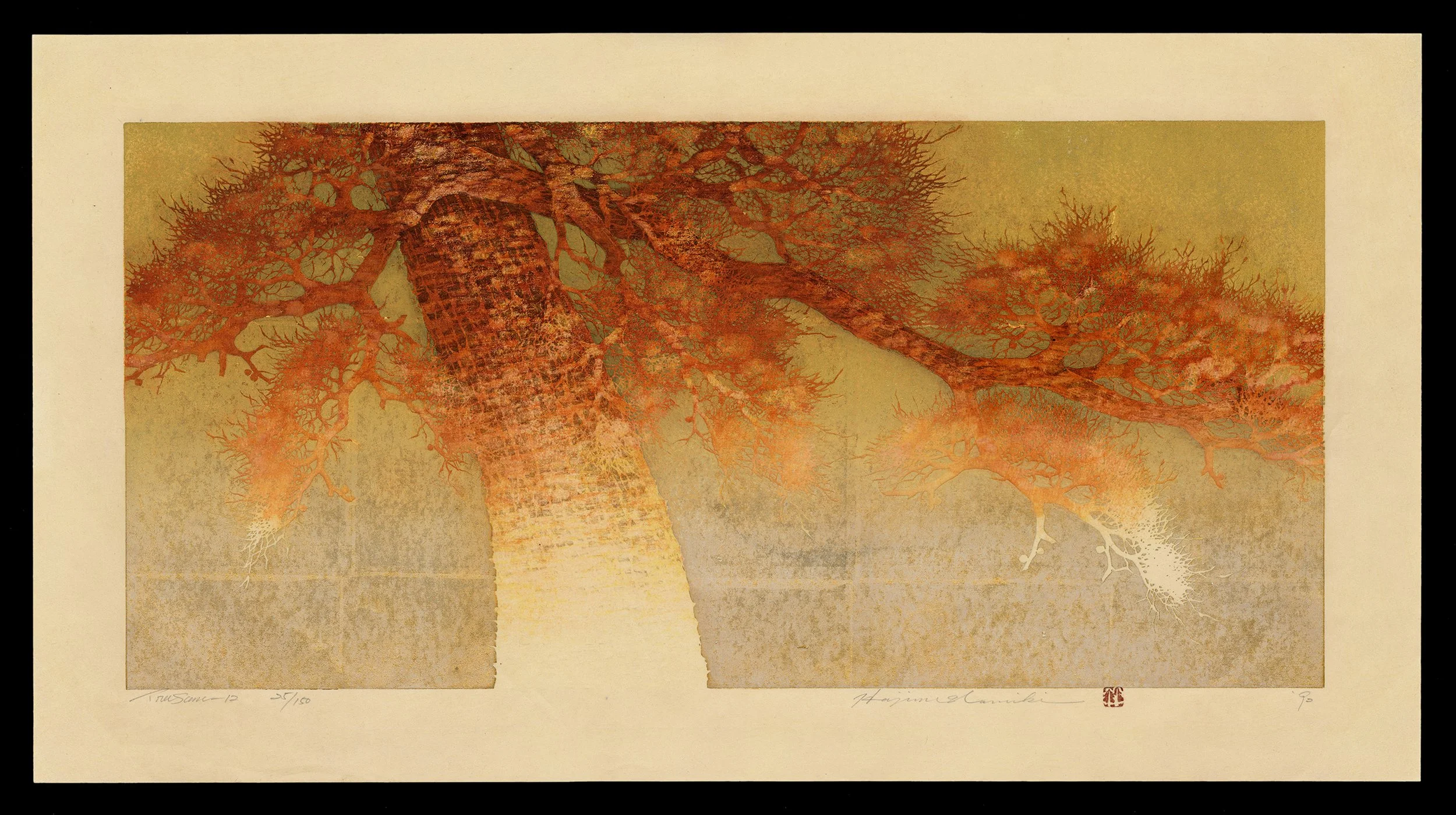
In Tree Scene - 12, Hajime Namiki composes a radiant and quietly majestic portrait of nature, capturing the upper canopy of a single towering pine tree rendered in fiery russet and gold tones. Against a shimmering field of gold leaf, the tree’s gnarled branches stretch in layered, reticulated arcs—both delicate and immense—evoking the slow and inevitable passage of time. The trunk, viewed from below, tapers toward the crown like a totem, grounding the composition in gravity while the canopy expands like a luminous aura.
This print is one of Namiki’s celebrated explorations of the shinrin (sacred grove) aesthetic—a contemporary interpretation of traditional reverence for trees within Japanese cultural and spiritual life. The use of gold leaf is not merely ornamental; it evokes the glowing background of Rinpa screen painting, particularly in the works of artists like Tawaraya Sōtatsu and Ogata Kōrin, where gold serves as both a unifying void and a spiritual atmosphere. Here, it elevates the tree from subject to icon.
Connoisseur's Note
Hajime Namiki trained as a sculptor, and his prints retain a sculptural clarity—every branch and fissure articulated with a rhythmic and meditative precision. His work belongs to the lineage of Sōsaku Hanga, yet his aesthetic sensibilities bridge far earlier traditions. The Rinpa school’s lavishness and abstraction are echoed in his luminous backgrounds and boldly cropped compositions, while the minimalism of Zen ink painting appears in his use of void and asymmetry. One may also sense echoes of Hasegawa Tōhaku’s ethereal pines or even Sesshū’s winter landscapes in the graceful recession of forms into mist.
Tree Scene - 12 is emblematic of Namiki’s masterful balancing act: simplicity and complexity, reverence and innovation, tradition and modernity. A quintessential example of his mature period, this print glows with visual serenity and conceptual depth—an ideal acquisition for collectors seeking the continuity of Japanese art history in contemporary form.
More prints by Hajime Namiji:
1990
$1,500
Tree Scene - 12
Hajime Namiki (b. 1947)
EDITION: 25/150
DATE: 1990
MEDIUM: Woodblock Print with gold leaf
DIMENSIONS: 14 ½ x 26 1/2 inches
CONDITION: Excellent impression and color; no issues to note
NOTE: Pencil signed, titled, dated, and numbered by the artist
$1,500.00
Contact us to purchase