

 Image 1 of 1
Details
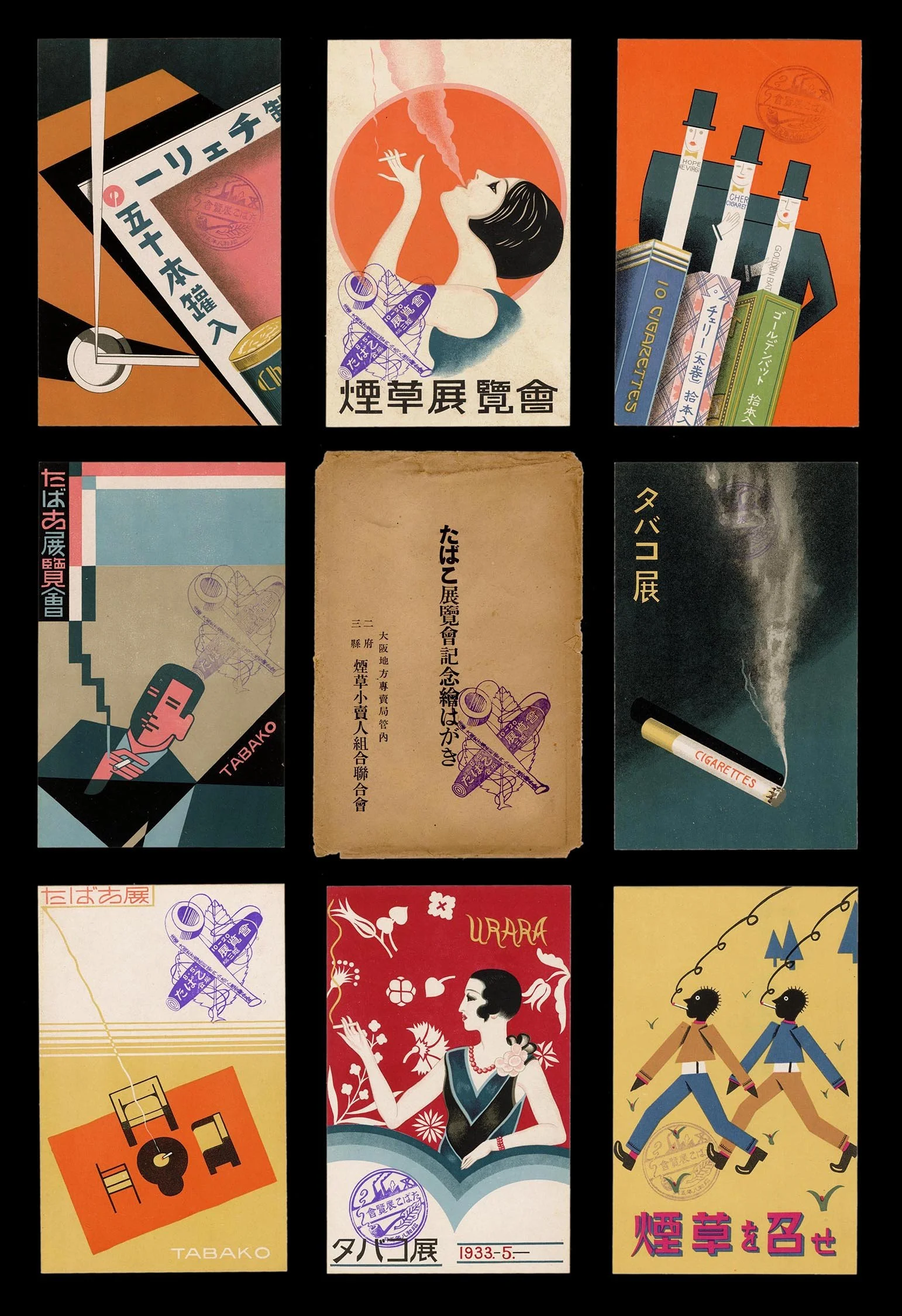
This rare commemorative set consists of eight postcards and the original exhibition envelope issued in conjunction with a tobacco exposition held in Osaka during the late 1920s or early 1930s. Rather than functioning as simple souvenirs, the postcards collectively present a visual essay on the place of tobacco within modern Japanese society. Each design adopts a distinct artistic vocabulary, ranging from bold geometric abstraction and Constructivist-inspired layouts to elegant Art Deco figuration and whimsical modernist illustration.
Several cards feature fashionable smokers rendered in the sophisticated style associated with the era's moga (modern girl) culture. One postcard presents a glamorous woman exhaling smoke against a radiant circular backdrop, transforming the act of smoking into an image of urban sophistication. Another depicts a stylish female figure surrounded by decorative floral motifs, merging tobacco advertising with the language of fashion illustration and department-store promotion. Elsewhere, cigarettes become symbols of modern masculinity through sharply dressed gentlemen carrying branded cigarette cartons, while other designs emphasize the product itself through dramatic close-up imagery of burning cigarettes and curling smoke.
The collection also reveals the extraordinary range of graphic experimentation occurring in Japan during the early Shōwa period. Geometric compositions, dynamic diagonals, simplified forms, and striking color combinations reflect the influence of international Art Deco, Bauhaus design, and contemporary commercial illustration. One postcard reduces furniture and smoking accessories to an arrangement of abstract forms, while another employs playful caricature-like figures marching beneath stylized mountains. Together these images demonstrate how Japanese designers adapted global modernist aesthetics to local advertising needs.
The original envelope serves as an important companion piece. Its typography and formal presentation reinforce the exhibition's educational and promotional objectives, while confirming that the postcards were conceived as a unified set. As a complete ensemble, the group provides an unusually comprehensive view of the visual culture surrounding tobacco consumption during one of Japan's most dynamic periods of modernization.
Connoisseur's Note
Few surviving objects capture the intersection of advertising, design, and everyday life in interwar Japan as effectively as this postcard set. During the late 1920s and early 1930s, tobacco occupied a prominent place within modern consumer culture. Government-regulated tobacco sales generated significant public revenue, while cigarette smoking increasingly became associated with urban sophistication, leisure, and participation in modern life. Exhibitions such as this one served both educational and promotional functions, celebrating tobacco production while simultaneously cultivating consumer desire through compelling visual imagery.
The postcards also reflect the broader transformation of Japanese advertising during the period. Advances in printing technology, expanding literacy rates, and the rapid growth of magazines, newspapers, department stores, and mass-market products created unprecedented opportunities for graphic designers. Rather than relying solely on text, advertisers increasingly employed powerful visual identities capable of communicating instantly to a modern audience. The sophisticated use of typography, abstraction, and fashionable imagery seen throughout this set demonstrates how Japanese commercial artists stood at the forefront of international design trends.
Within the curatorial framework of Two Puffs and a Sip: The Moga and Her City, the collection assumes additional significance. Smoking emerged as one of the most recognizable symbols of modern urban identity. Whether depicted in cafés, dance halls, theaters, or shopping districts, cigarettes became visual shorthand for cosmopolitan lifestyles and changing social roles. The elegant women and fashionable men appearing throughout these designs are not merely consumers; they are embodiments of a newly imagined metropolitan Japan.
Today, the set survives as more than an advertising artifact. It offers a vivid record of how commerce, design, and aspiration converged during the formative decades of modern Japanese visual culture. The postcards preserve a world in which tobacco was marketed not simply as a product, but as an expression of modernity itself—a world of streamlined graphics, urban pleasures, and the optimistic spirit of a rapidly changing society.