

 Image 1 of 1
Details
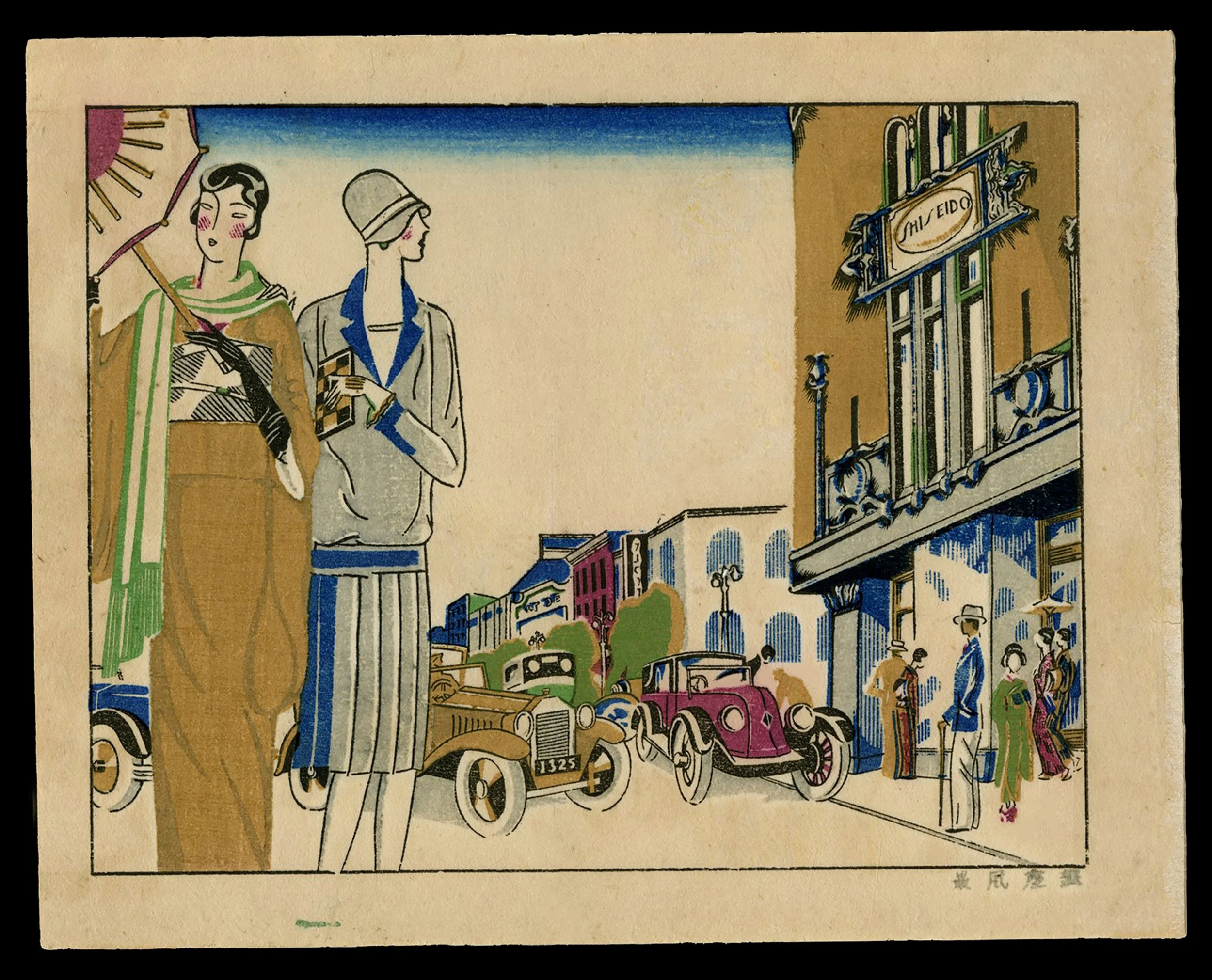
Ginza Scene offers a remarkably vivid portrait of Tokyo’s emerging consumer culture during the late 1920s. Two fashionable women dominate the foreground, their elongated figures positioned before a bustling commercial street lined with automobiles, pedestrians, and department store façades. One woman wears a modern cloche hat and Western-style attire, while the other retains elements of traditional dress softened by contemporary styling and accessories. Their juxtaposition reflects the fluid coexistence of old and new identities that defined urban Japan during this transformative moment.
The setting of Ginza was especially significant within the cultural imagination of the period. Long associated with modern commerce, cafés, imported luxury goods, and cosmopolitan leisure, the district became synonymous with the sophisticated rhythms of metropolitan life. Here, Suwa transforms the street into a stage upon which fashion, mobility, and public identity unfold. Automobiles glide through the composition while elegantly dressed figures gather before storefronts, suggesting a city increasingly shaped by spectacle and consumption.
The composition itself is notable for its extraordinary balance between openness and detail. Large passages of unoccupied space lend the design a refined clarity, allowing the figures and architecture to breathe within the picture plane. The restrained use of color — pale ochres, cool blues, rose accents, and delicate greens — reinforces the print’s atmosphere of urban elegance rather than visual excess. Suwa’s line work remains crisp and decorative, reflecting both contemporary graphic design trends and the influence of Art Deco aesthetics circulating internationally during the decade.
As an image produced for Lady’s Handbook, the print functioned not merely as illustration but as cultural aspiration. The women depicted embody new forms of urban femininity associated with independence, style, and participation in public city life. The design therefore operates simultaneously as advertisement, fashion image, and subtle social document recording the transformation of everyday life in modern Tokyo.
Connoisseur's Note
Works produced as advertisement by Suwa Kanenori remain comparatively obscure within the broader history of Sosaku Hanga, making surviving impressions of Ginza Scene particularly significant. Unlike formally published print editions intended for collectors, this design was created as promotional ephemera for Lady’s Handbook, a context that fundamentally shaped both its production and survival rate. Prints intended for temporary commercial use were rarely preserved with care, and many disappeared entirely through ordinary handling and disposal.
As a result, impressions of Ginza Scene are exceedingly rare today. The survival of this work offers valuable insight into the intersection of commercial graphic design and artistic woodblock practice during the late 1920s, a period when Sosaku Hanga artists increasingly engaged with advertising, publishing, and mass visual culture. Such works occupy an important space between fine art and modern print media, revealing how woodblock aesthetics adapted to the expanding consumer economy of interwar Japan.
Collectors and scholars increasingly recognize ephemeral prints such as this as essential documents of modern visual culture. Beyond their rarity, they preserve fleeting aspects of metropolitan life — fashion trends, commercial environments, gender ideals, and advertising aesthetics — that more formally produced editions often omit. In this respect, Ginza Scene functions not only as a refined artistic composition, but also as a remarkably intact artifact of Tokyo’s modern consumer imagination.
More prints by Kanenori Suwa: