

 Image 1 of 1
Details
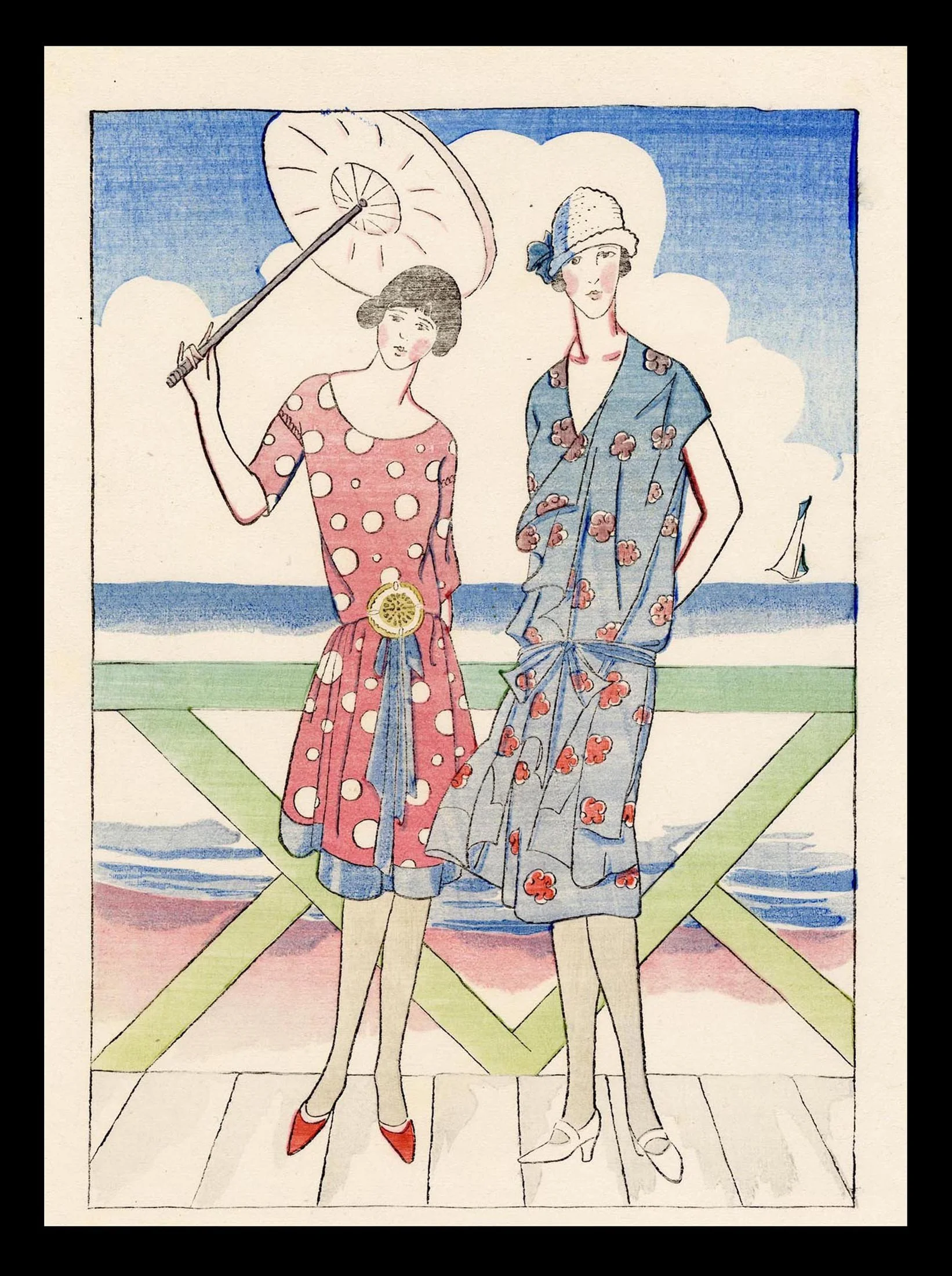
In Two Women on Boardwalk, Takehisa Yumeji presents two fashionable young women standing before a bright seaside horizon, framed by a simplified boardwalk railing and expansive sky. One woman carries a parasol while dressed in a playful pink polka-dot dress accented with vivid red shoes; beside her, a companion wears a flowing blue floral ensemble paired with a stylish cloche hat. Behind them, the sea stretches quietly toward a distant sailboat, transforming the composition into an image of modern leisure and refined escape.
The print captures a distinctly international sensibility that had become increasingly fashionable among urban Japanese women during the late 1920s and early 1930s. Resort culture, beach promenades, Western dress, and seasonal travel had become associated with sophistication and modern identity. Yumeji’s figures embody this atmosphere effortlessly. Their slim silhouettes, lowered gazes, and carefully coordinated attire suggest not merely fashion illustration, but a new model of feminine self-presentation shaped by department stores, magazines, cafés, and imported European aesthetics.
Yumeji simplifies the setting into broad decorative planes of pastel color, allowing the women themselves to dominate the composition. The openness of the background heightens the airy elegance of the design while reinforcing the sense of freedom associated with contemporary leisure culture. The print balances commercial sophistication with emotional restraint, qualities that made Yumeji one of the defining visual stylists of modern Japanese femininity.
Though often associated with romantic imagery and poetic illustration, Yumeji possessed an acute understanding of changing social attitudes. His depictions of women frequently move beyond simple idealization, presenting figures who appear contemplative, independent, and quietly self-aware. Here, the seaside promenade becomes a stage upon which modern identity itself is performed.
Connoisseur's Note
Takehisa Yumeji occupies a singular place within twentieth-century Japanese art. While often linked to the broader Shin Hanga movement through his commercial print production and immensely popular bijinga imagery, his work exists somewhat outside conventional categories. Yumeji worked fluidly across illustration, design, poetry, book arts, and woodblock printmaking, helping shape the visual language of Taishō and early Shōwa modernity.
His influence on representations of the moga, or modern girl, was profound. Long before the term entered popular usage, Yumeji had already developed a feminine ideal defined not by traditional conventions, but by introspection, elegance, and subtle individuality. His women possess an unmistakable psychological presence that distinguished his work from more formal bijinga traditions.
This print is particularly compelling for the way it merges fashion illustration with fine print aesthetics. The restrained palette, delicate contour lines, and spacious composition reveal Yumeji’s remarkable sensitivity to graphic design and modern advertising culture.
More prints by Takehisa Yumeiji: