

 Image 1 of 1
Details
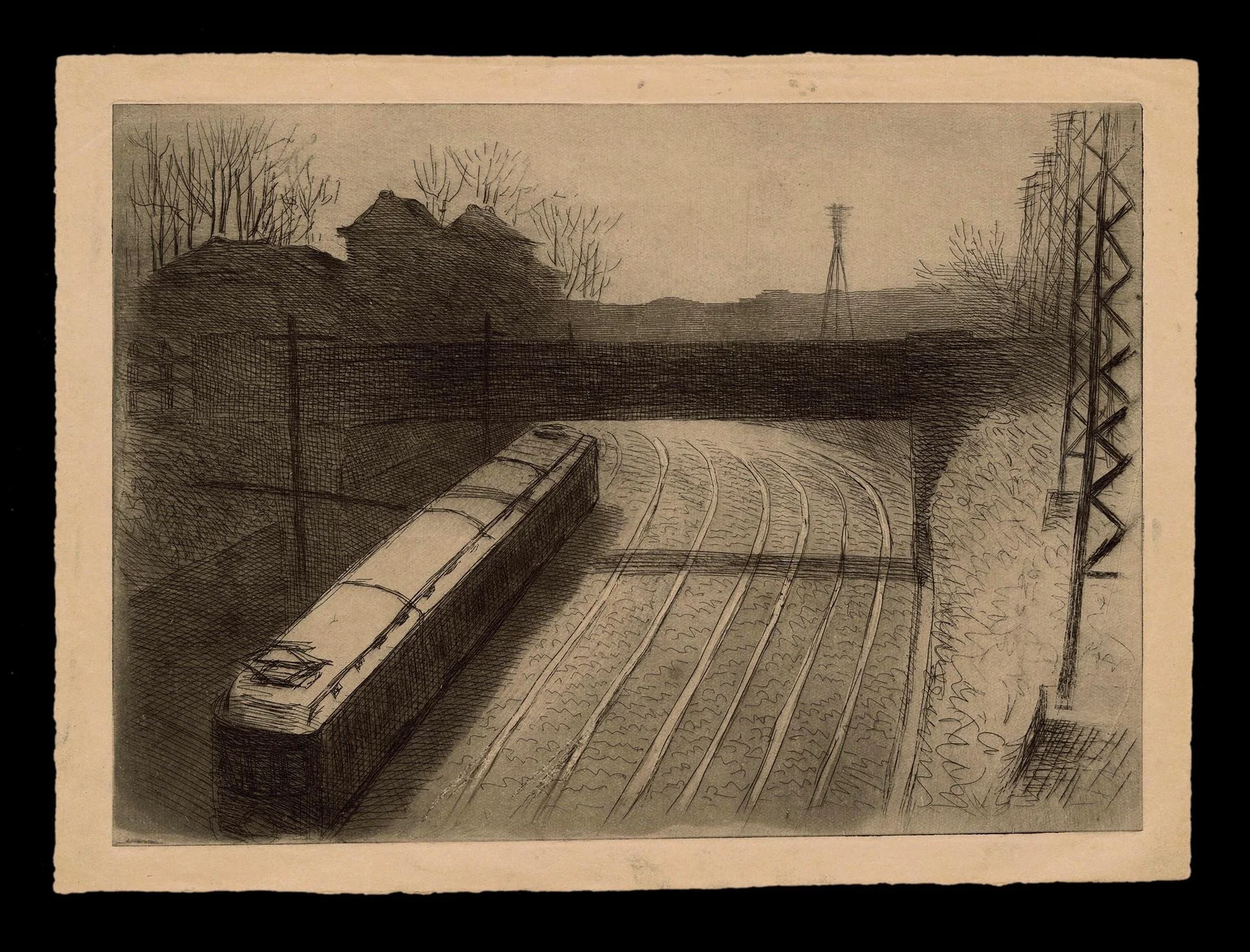
This haunting etching depicts a solitary electric train curving through a recessed railway cutting beneath darkened embankments and silhouetted winter trees. Executed almost entirely through delicate networks of etched line and tonal crosshatching, the composition presents a stark industrial landscape stripped of anecdotal distraction. Utility poles rise rhythmically along the right edge of the image while distant transmission towers and shadowed rooftops emerge faintly through the atmospheric haze beyond the tracks. The train itself glides silently into the composition, its streamlined form emphasizing the growing presence of electrified transportation within the expanding outskirts of modern Japanese cities.
Created around 1925, this print belongs to a formative period in Japanese modernism when artists increasingly turned toward the visual language of infrastructure, mechanized transit, and urban expansion. Rather than celebrating industrialization triumphantly, Nakada approaches the railway environment with restraint and introspection. The deep cutting through which the train passes creates a sense of isolation and compression, as though the machinery of modern life has carved itself directly into the landscape. Human figures are absent entirely, leaving only the quiet movement of the electric train threading through an environment defined by steel, wire, and shadow.
The print also reveals the growing influence of European printmaking techniques upon younger Japanese artists associated with the broader Sosaku Hanga movement and related circles of independent print experimentation. Etching allowed for extraordinary subtlety of tonal gradation and linear density, qualities Nakada exploits masterfully here. The intricate mesh of fine lines produces an atmosphere of winter stillness while simultaneously emphasizing the engineered precision of railway tracks, electrical systems, and retaining walls. The resulting image feels suspended between observation and abstraction, documentary realism and psychological landscape.
Connoisseur's Note
Nakada’s handling of spatial recession is particularly sophisticated for such an early work. The curving railway tracks guide the eye diagonally into the depth of the composition while the dark bridge structure compresses the upper register into an almost oppressive horizontal mass. This careful orchestration of perspective creates a subtle tension between movement and containment: although the train advances forward, the surrounding architecture and embankments seem to close inward around it. The composition reflects the growing fascination among interwar artists with the psychological effects of modern infrastructure and engineered space.
Equally striking is the print’s disciplined monochromatic palette. By limiting himself almost entirely to variations of black, gray, and pale paper tone, Nakada allows texture and line density to carry the emotional weight of the scene. The etched surfaces shimmer with extraordinary delicacy, particularly in the softly worked sky and the lightly incised vegetation along the embankments. This restraint gives the image an atmosphere of quiet suspension, where industrial modernity appears not as spectacle, but as an integral and almost inevitable condition of contemporary life.
Early works by Nakada are especially important within the history of modern Japanese printmaking because they reveal a generation of artists grappling directly with the altered visual realities of electrified urban expansion. Railway cuttings, telegraph poles, and transmission towers had become increasingly common features of the Japanese landscape by the 1920s, yet they remained relatively uncommon subjects within traditional print culture. In this etching, Nakada treats these modern structures with unusual seriousness and formal elegance, demonstrating how industrial infrastructure could serve not merely as documentary subject matter, but as the foundation for a new poetic vision of modern Japan.
More prints by Kikuji Nakada: