

 Image 1 of 1
Details
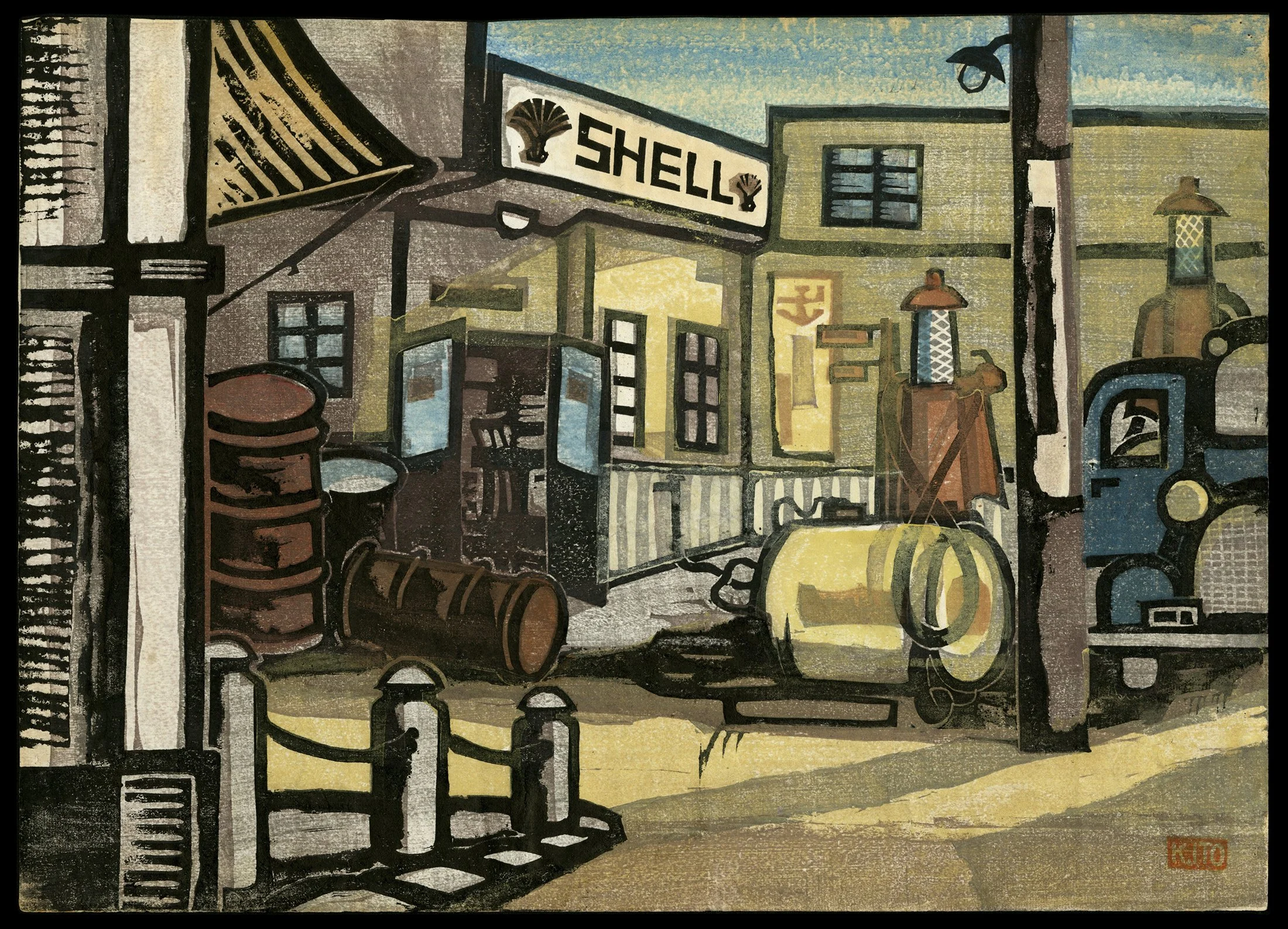
This striking Sosaku Hanga print presents a compact urban gas station rendered through bold architectural simplification and sharply contrasting tonal planes. Beneath the illuminated “Shell” sign, fuel pumps, oil drums, hoses, and industrial fixtures crowd the foreground while a dark blue automobile appears partially at right, emerging from the edge of the composition. Lantern-like street lighting and angular building façades frame the service station, creating an atmosphere that feels simultaneously modern and intimate. The print transforms an ordinary commercial streetscape into a carefully orchestrated study of urban machinery and light.
By the mid-1920s, automobiles remained relatively uncommon in Japan compared to Europe or the United States, making gas stations powerful symbols of technological modernization and cosmopolitan urban life. Such spaces embodied the arrival of new rhythms of movement, commerce, and mechanized convenience within Japanese cities. The inclusion of the internationally recognizable Shell branding further underscores the increasingly global character of urban consumer culture during the interwar years, when imported technologies and foreign commercial imagery became increasingly visible within the streetscapes of Tokyo, Yokohama, Kobe, and Osaka.
Rather than depicting crowds or bustling activity, Itō focuses on the quiet physical presence of industrial objects themselves. Fuel pumps, barrels, and hoses are arranged almost sculpturally across the composition, while the station’s stark geometry is softened by muted lighting and textured carving. The absence of visible attendants or customers gives the scene a contemplative stillness unusual for depictions of commercial infrastructure. This restraint allows the print to function not merely as a document of modern technology, but as a meditation on the changing visual environment of the modern city.
Connoisseur's Note
The print demonstrates a highly sophisticated understanding of compositional compression, a quality that became central to many Sosaku Hanga experiments with urban subject matter during the interwar period. Itō constructs the image through tightly interlocking verticals, diagonals, and rectangular planes, creating a dense spatial arrangement that mirrors the confined architecture of modern commercial streets. The eye moves rhythmically from the illuminated signage to the pumps, barrels, and automobile, each element contributing to a carefully balanced network of industrial forms.
Equally notable is the artist’s treatment of artificial illumination. Rather than relying upon dramatic color contrasts, Itō achieves atmosphere through muted tonal gradation and subtle shifts between illuminated and shadowed surfaces. The softly glowing windows and reflective highlights on the fuel equipment evoke the growing transformation of Japanese cities through electric lighting and twenty-four-hour commercial activity. This sensitivity to nocturnal urban atmosphere aligns the print with broader modernist fascinations surrounding machine-age environments and the aesthetics of commercial infrastructure.
Gas stations rarely appeared as primary subjects within Japanese printmaking of the 1920s, making this work especially significant within the history of modern urban imagery. While earlier generations of print artists focused on landscapes, actors, or seasonal subjects, Sosaku Hanga artists increasingly turned their attention toward the overlooked architecture of modern life: railway stations, industrial harbors, cafés, factories, and automobile culture. In Gas Station, Itō elevates a utilitarian roadside structure into a compelling emblem of technological transition, revealing how profoundly mechanization had begun reshaping the visual and social texture of everyday Japanese life.
More prints by Kennosuke Ito: