

 Image 1 of 1
Details
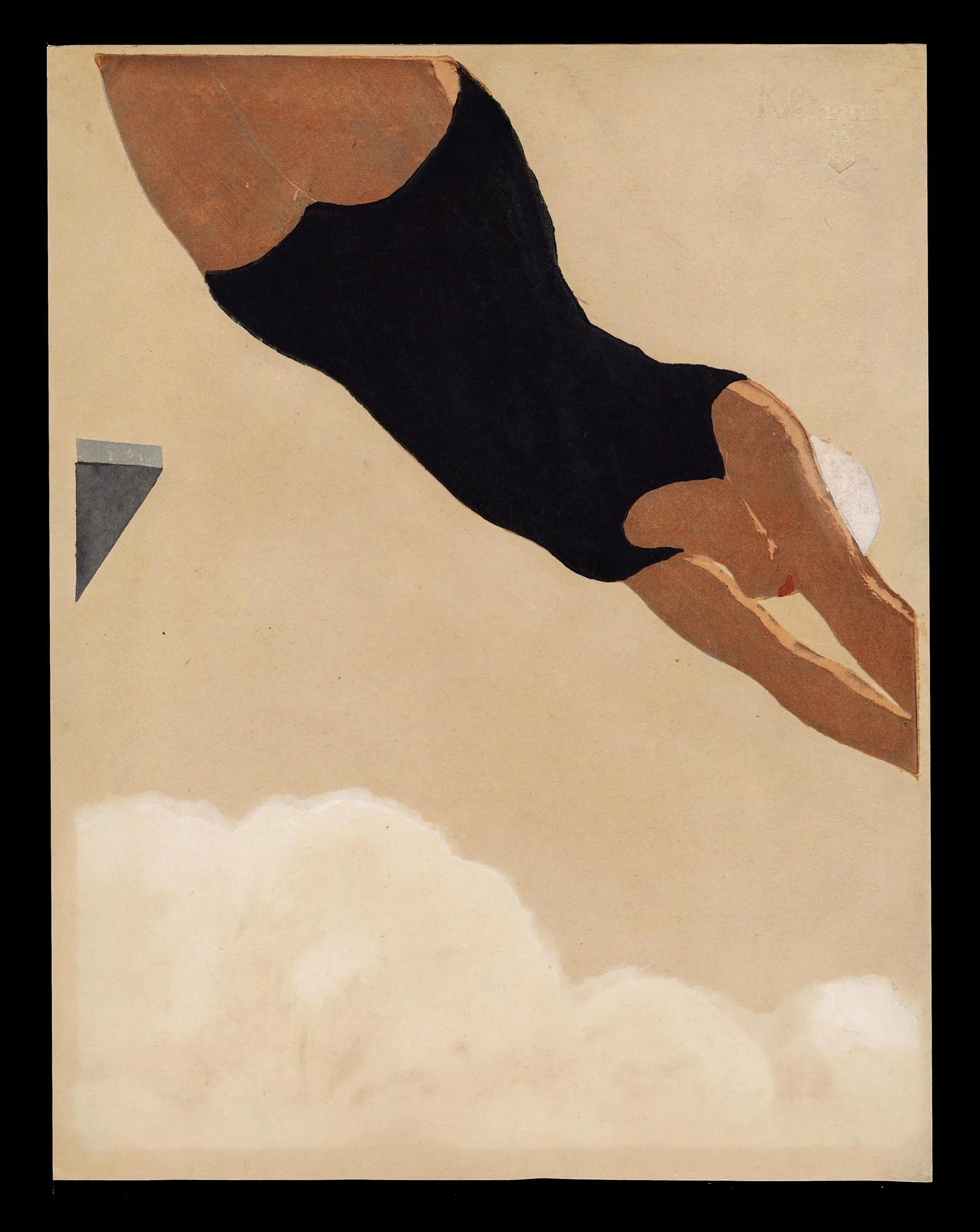
With extraordinary economy of form, Kōshirō Onchi transforms the act of diving into one of the defining images of Japanese modernism. Suspended diagonally across an open field of pale atmosphere, the diver’s streamlined body cuts through space with striking elegance and controlled motion. The simplified black bathing suit, sharply reduced anatomy, and broad empty ground eliminate all unnecessary detail, allowing the composition itself to embody movement, balance, and modern athletic grace.
The design occupies an important place within the exhibition Two Puffs and a Sip: The Moga and the City because it celebrates modern Japan through the international cosmopolitan culture of sport and physical recreation. By the early Shōwa period, athletic competition, swimming clubs, seaside leisure, and Olympic participation had become highly visible symbols of Japan’s emergence as a global modern nation. Diving in particular represented discipline, refinement, and bodily control associated with international modernity. Onchi’s image reflects this cultural moment while simultaneously elevating sport into the realm of poetic abstraction.
Unlike traditional Japanese figural imagery grounded within narrative or seasonal setting, Diving exists almost entirely outside conventional space. The diver appears suspended between sky and abstraction, surrounded only by pale clouds and an immense emptiness that heightens the sensation of weightlessness. This dramatic use of negative space reveals Onchi’s sophisticated engagement with European modernist design and abstraction while remaining deeply connected to Japanese aesthetic sensitivity toward interval, silence, and asymmetrical balance.
The print also reflects Onchi’s broader commitment to expanding the expressive possibilities of woodblock printmaking. The sharply simplified geometry of the figure, combined with the flattened atmospheric field, demonstrates how sōsaku hanga artists adapted international modernist visual language into a uniquely Japanese mode of expression. The result is neither purely decorative nor descriptive; rather, the image becomes an emotional and spatial experience. The diver appears less as an individual athlete than as a symbol of modern vitality itself.
Particularly fascinating is the work’s complex developmental history. The composition was first conceived as a much larger diptych intended for an international art competition held in conjunction with the 1932 Olympic Games in Los Angeles. In that original version, the diver plunged above a broad expanse of water, emphasizing horizontal movement and athletic spectacle. Subsequent revisions gradually reduced and refined the composition into increasingly distilled forms, ultimately arriving at this remarkably balanced vertical design.
Connoisseur's Note
Diving is widely regarded as one of Kōshirō Onchi’s masterpieces and stands among the most sophisticated achievements of modern Japanese printmaking before the Second World War. The design reveals the artist at the height of his ability to fuse abstraction, graphic clarity, emotional atmosphere, and spatial daring into a single unified image.
This particular impression represents the third state of the composition and is especially important for understanding the evolution of Onchi’s artistic vision. The first state—the original Olympic competition design—was executed as an elongated diptych nearly double the size of this version, unfolding horizontally in a scroll-like format with water occupying the lower register. The second iteration retained much of the horizontal emphasis but became somewhat shorter and less expansive. In this third state, however, Onchi achieves an extraordinary compositional resolution. The slightly widened side margins and compressed vertical orientation create a heightened sense of suspension and psychological stillness absent from the earlier versions.
The resulting balance between figure and emptiness is masterful. The diver no longer appears simply to move through physical space, but through an abstract atmosphere of silence and light. The clouds beneath the figure soften the athletic subject into something almost dreamlike, transforming competitive sport into a meditation on gravity, motion, and modern existence itself. Such refinement reflects Onchi’s mature understanding that the emotional force of a print often emerges through reduction rather than elaboration.
Equally significant is the print’s place within the broader international context of modern art during the early 1930s. Few Japanese artists of the period integrated global modernist themes as seamlessly as Onchi. Here, Olympic athletic culture, abstraction, and Japanese print tradition coexist with remarkable harmony. The work embodies the cosmopolitan aspirations of interwar Japan while remaining unmistakably personal in tone and execution.
Diving endures not only as a landmark of the sōsaku hanga movement, but as one of the defining visual statements of Japanese modernism itself. Through its radical simplicity and profound spatial intelligence, the print captures the spirit of an era when Japan sought to redefine itself through modern culture, international engagement, and artistic experimentation.
More prints by Koshiro Onchi:
1938
$3,000
Yuigahama Beach, Kamaura
Koshiro Onchi (1891–1955)
SERIES: New 100 Scenic Views of Japan
MEDIUM: Woodblock print
DATE: 1938
DIMENSIONS: 9 x 12 ¼ inches
CONDITION: Excellent, no problems to note
$3,000.00