

 Image 1 of 1
Details
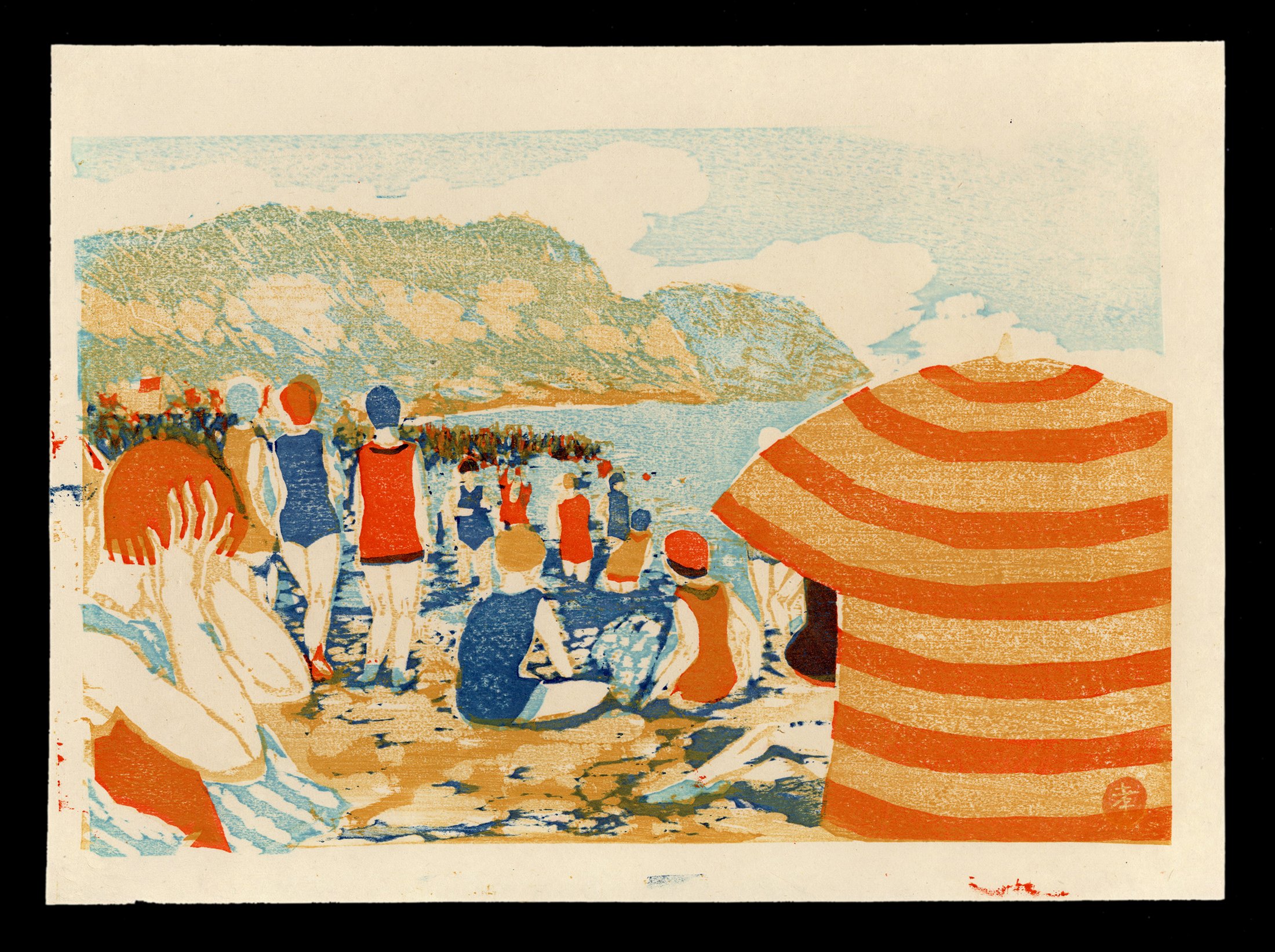
In this luminous and highly modern composition, Kōshirō Onchi transforms the crowded shoreline of Yuigahama Beach in Kamakura into a rhythmic meditation on leisure, modernity, and collective experience. Bathers gather beneath the summer sky while striped parasols, brightly colored swimsuits, and shimmering water dissolve into simplified planes of color and texture. The scene possesses the fleeting atmosphere of a passing summer afternoon, where individual figures merge into the larger pulse of seasonal recreation and urban escape.
Unlike traditional Japanese landscape prints that emphasized famous scenic sites through carefully ordered perspective, Onchi approaches Yuigahama Beach as a distinctly modern social environment. The beach is not depicted as an untouched natural setting, but as a contemporary leisure destination animated by crowds, tourism, and changing cultural habits. By the 1930s, Kamakura had become an increasingly fashionable coastal retreat for urban residents escaping the dense modernity of Tokyo during the summer months. Here, modern bathing culture itself becomes the subject of artistic contemplation.
The composition reveals Onchi’s sophisticated understanding of European modernist design while remaining deeply rooted in Japanese print aesthetics. Figures are flattened into abstracted silhouettes, while the striped parasol dominating the foreground functions almost as a geometric color field, balancing the composition through broad bands of warm orange and cream. The reduced palette of blues, ochres, and coral tones evokes both sunlight and sea air with remarkable economy. Rather than describing details naturalistically, Onchi suggests atmosphere through texture, spacing, and subtle tonal vibration.
Particularly striking is the way the figures themselves embody the emergence of modern Japanese identity during the late 1930s. The swimmers and beachgoers—many of them young women in fashionable bathing attire—reflect the growing influence of Western leisure culture and the evolving freedoms associated with urban middle-class life. Though informal and spontaneous in appearance, the scene quietly documents the social transformations of interwar Japan, where recreation, travel, and public leisure became increasingly central to modern existence.
Connoisseur's Note
Kamakura (Yuigahama Beach) occupies an important place within Onchi’s broader artistic vision and within the history of the sōsaku hanga movement itself. As the leading intellectual and creative force behind modern creative printmaking in Japan, Onchi sought to move beyond the conventions of both ukiyo-e revivalism and commercial shin hanga. His prints instead pursued mood, psychology, abstraction, and personal expression through the handmade language of woodblock printing.
This design exemplifies Onchi’s mature synthesis of abstraction and atmosphere. The composition is built less through line than through carefully orchestrated relationships between color, shape, and open space. The large striped parasol anchoring the foreground functions almost architecturally, flattening space while simultaneously intensifying the visual rhythm of the beach scene. Such compositional daring reveals Onchi’s deep engagement with international modernist aesthetics, including elements of Art Deco and post-Impressionist simplification, yet the work retains the contemplative quietness unique to Japanese visual sensibility.
The print also reflects the broader ambitions of the unrealized series One Hundred Views of New Japan. Rather than celebrating nostalgic or historical landscapes, Onchi envisioned a Japan defined by contemporary life—its rebuilt cities, industrial growth, transportation networks, modern leisure culture, and evolving social customs. In this sense, Yuigahama Beach becomes not merely a seaside scene, but a portrait of a changing nation experiencing modernity through the body, through movement, and through seasonal pleasure.
More prints by Koshiro Onchi:
1938
$3,000
Yuigahama Beach, Kamaura
Koshiro Onchi (1891–1955)
SERIES: New 100 Scenic Views of Japan
MEDIUM: Woodblock print
DATE: 1938
DIMENSIONS: 9 x 12 ¼ inches
CONDITION: Excellent, no problems to note
$3,000.00