

 Image 1 of 1
Details
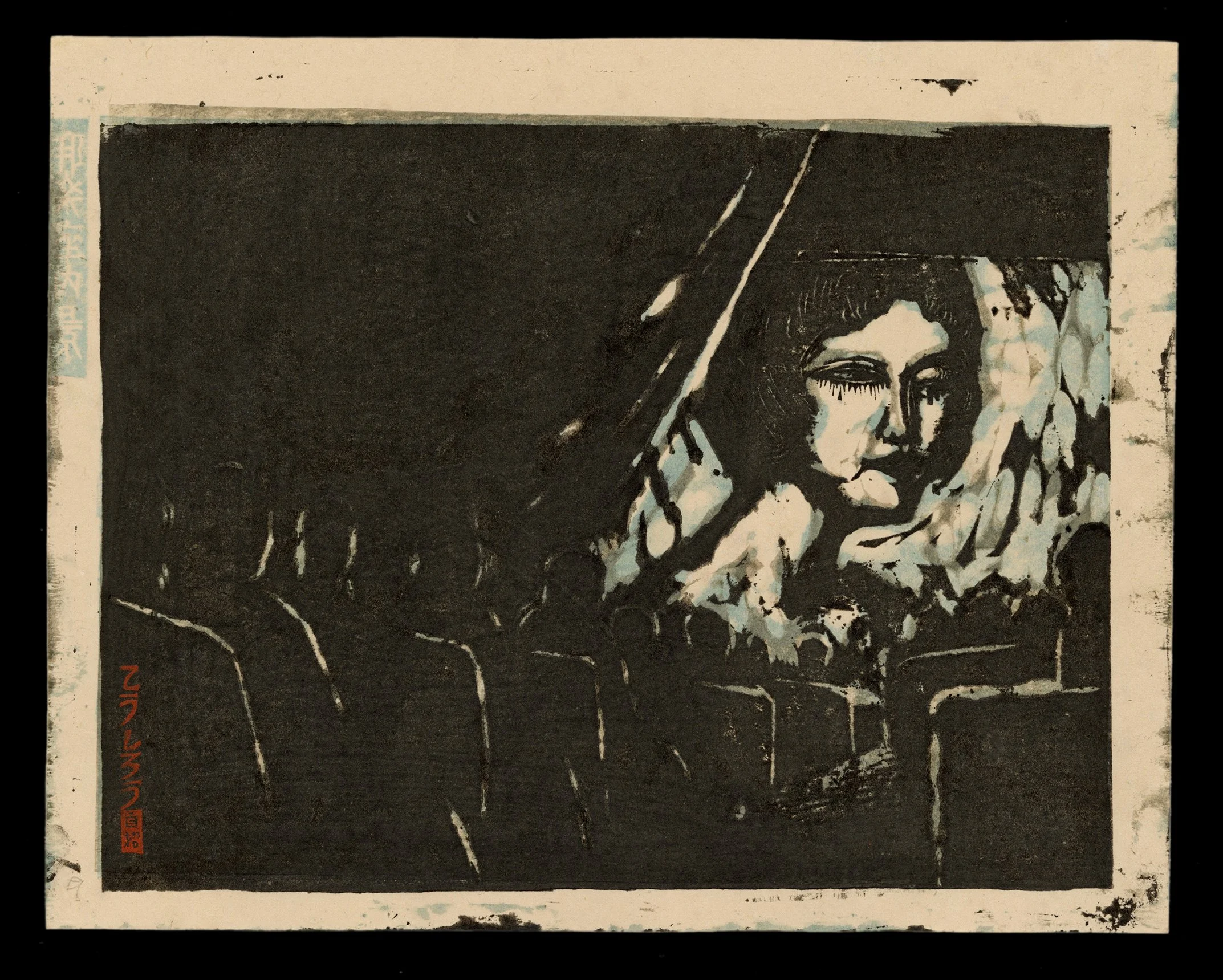
Rendered in deep blacks and muted silver-grey tones, Inside the Hogaku Theater departs dramatically from traditional Japanese pictorial space. Onchi constructs the composition through broad fields of darkness interrupted only by the pale glow of the movie screen and the spectral faces emerging from shadow. Rows of seated viewers dissolve into abstract silhouettes, their individuality absorbed into the collective experience of modern spectatorship. The projected image—a close-up of a stylish moga with cropped hair and cosmopolitan features—dominates the scene with an uncanny intimacy, transforming the cinema into a chamber of desire, fantasy, and urban escape.
The work belongs to the pivotal series One Hundred Views of New Tokyo, an ambitious collaborative project among Sosaku Hanga artists seeking to redefine the visual language of Japanese printmaking after the devastation of the earthquake. Rather than celebrating famous landscapes or seasonal beauty, these artists turned toward the rebuilt city itself: bridges, cafés, factories, theaters, trains, and electric streets became the new subjects of modern life. Here, Onchi captures not architecture but atmosphere—the psychological condition of Tokyo’s expanding urban culture. The cinema, newly central to metropolitan leisure, emerges as a modern sanctuary illuminated not by lanterns or moonlight, but by projected light and illusion.
Connoisseur's Note
Onchi occupies a singular position within Sosaku Hanga history. More than any of his contemporaries, he transformed the movement into a vehicle for psychological and emotional expression rather than straightforward representation. Deeply aware of European modernism, Symbolism, and abstraction, he approached printmaking as a synthesis of poetry, design, music, and inner sensation. In this work, the theater becomes less a physical location than a meditation on alienation and modern consciousness. The darkness surrounding the audience evokes the emotional ambiguity of urban existence, where intimacy and isolation coexist beneath the glow of entertainment culture.
The choice to center the projected image of a moga is especially revealing within the context of Two Puffs and a Sip: The Moga and the City. By the late 1920s, the modern girl had become both a cultural icon and a site of public fascination—appearing in magazines, advertisements, cafés, and cinema screens throughout Tokyo. Onchi does not present her directly within the city streets, but as a mediated image consumed by anonymous viewers. The print therefore reflects a crucial transformation in modern identity: femininity itself becomes cinematic, reproducible, and inseparable from mass culture. Few prints from the One Hundred Views of New Tokyo series capture this psychological dimension of urban modernity with such haunting restraint.
Only fifty impressions of each design in the One Hundred Views of New Tokyo series were produced, making surviving examples increasingly scarce today. The limited production reflects the highly artisanal nature of the project and the independent ethos central to the Sosaku Hanga movement. Prints from the series are now regarded among the most important visual records of Tokyo’s reconstruction during the interwar period.
More prints by Koshiro Onchi:
1938
$3,000
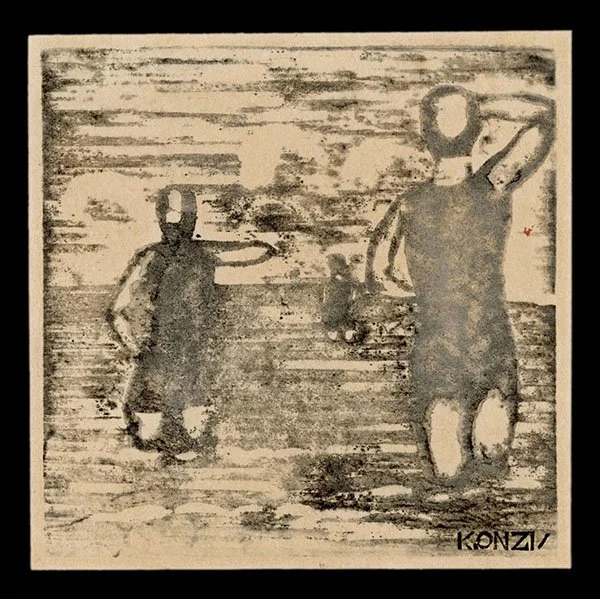
Yuigahama Beach, Kamaura
Koshiro Onchi (1891–1955)
SERIES: New 100 Scenic Views of Japan
MEDIUM: Woodblock print
DATE: 1938
DIMENSIONS: 9 x 12 ¼ inches
CONDITION: Excellent, no problems to note
$3,000.00