

 Image 1 of 1
Details
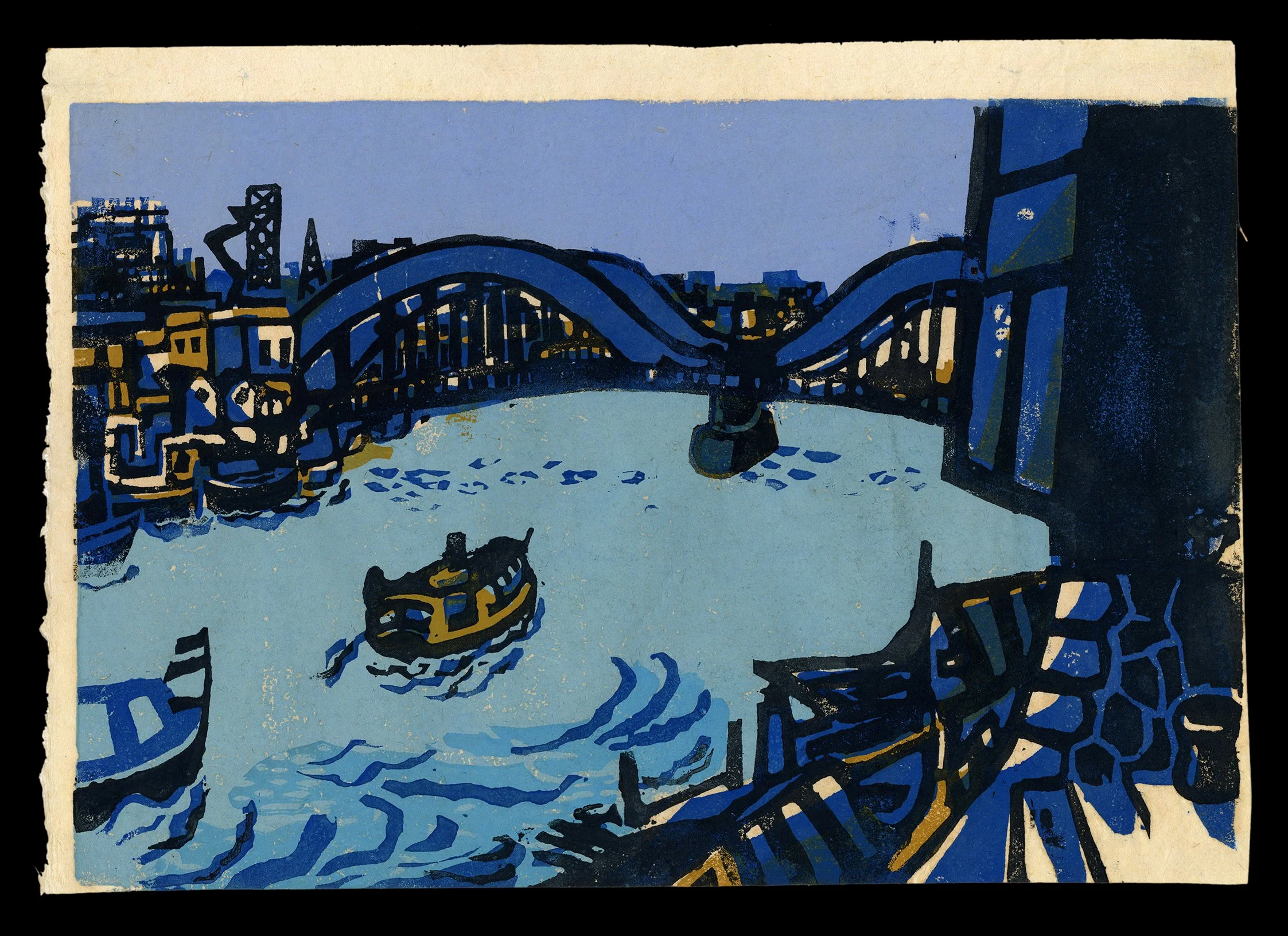
In Ferry Port, Masahiro Shimizu captures the modern city through its waterways and industrial architecture rather than through monumental civic buildings or traditional landmarks. The broad river becomes an active urban artery crowded with boats moving beneath sweeping steel bridges while factories, cranes, and dense structures gather along the distant shoreline. The composition celebrates the working energy of the metropolis, presenting Tokyo not as nostalgic memory but as a living machine of commerce, transportation, and expansion.
The design is especially notable for its dramatic handling of color. Deep cobalt blues dominate the scene, interrupted by flashes of white and muted yellow that create the impression of reflected electric light shimmering across moving water. This limited palette gives the print remarkable visual unity while also heightening its modern sensibility. The city appears illuminated not by natural atmosphere alone, but by the mechanical glow of urban industry.
Shimizu’s composition reflects the influence of modernist graphic design and international Art Deco aesthetics that circulated widely through Japan during the interwar years. The curving steel bridge cuts boldly across the center of the image with a rhythmic elegance that recalls contemporary architecture and industrial illustration. Rather than treating infrastructure as merely functional, the artist transforms it into the primary visual poetry of the print.
The harbor setting also situates the work within the broader culture of metropolitan mobility that defined the period. Ferries, bridges, docks, and waterways formed the connective tissue of Tokyo’s expanding urban life, linking commercial districts, industrial zones, and residential neighborhoods into a rapidly modernizing capital. Such imagery resonated deeply during a period when speed, circulation, and technological development became central symbols of national progress.
Unlike Shin Hanga artists who often softened modern subjects through atmospheric lyricism, Shimizu embraces the angular vitality and graphic immediacy characteristic of younger Sosaku Hanga artists of the 1930s. The strong carving, flattened spatial relationships, and bold abstraction of form reveal an artist deeply engaged with contemporary visual culture while still working within the woodblock tradition.
Connoisseur's Note
Ferry Port stands as an especially compelling example of early Shōwa Sosaku Hanga devoted to industrial modernity and urban infrastructure. While earlier generations of Japanese printmakers frequently emphasized famous sites, seasonal landscapes, or poetic travel imagery, Shimizu turns his attention toward the working mechanics of the contemporary city itself: bridges, shipping lanes, waterfront labor, and steel construction.
The print is remarkable for the confidence of its graphic language, particularly considering the artist’s youth at the time of execution. Born in 1914, Shimizu belonged to a younger generation of printmakers who inherited the artistic freedoms established by pioneers such as Kanae Yamamoto and Koshiro Onchi. These artists increasingly explored bold simplification, experimental color relationships, and modern industrial subjects that aligned Japanese printmaking with broader international modernist movements.
More prints by Masahiro Shimizu:
1984
$1,500
Street Scene
Masahiro Shimizu (b. 1914)
EDITION: 3/5
DATE: 1984
MEDIUM: Woodblock Print
DIMENSIONS: 24 × 18 inches
CONDITION: Excellent impression and color; small spots of pigment splatter in image from the time of production, as is often the case with the work of this artist
$1,500.00
Contact us to purchase